
06, JUNE 2026 - CURRENT AFFAIRS
Guwahati’s ‘Purple City’ Initiative
Photo credit – G-Plus

Why in news ?
The Guwahati Municipal Corporation (GMC) has announced plans to transform Guwahati into a “Purple City” by incorporating the purple hues of the Kopou (Foxtail Orchid), Assam’s state flower, into public spaces, buildings, and neighbourhoods. The initiative aims to combine urban beautification, cultural branding, environmental sustainability, and public participation.
Source -Assam Tribune
Key Features
1. Purple City Branding
- Purple colour chosen to reflect the Kopou (Foxtail Orchid), the State Flower of Assam.
- Aims to create a unique visual identity for Guwahati rooted in Assamese culture and heritage.
2. Citywide Beautification
- Shops, residential buildings, boundary walls, public spaces, and civic infrastructure will be encouraged to adopt shades of purple.
- To be implemented in phases across different parts of the city.
3. Link with Swachh Survekshan
- Initiative complements India’s annual Swachh Survekshan rankings.
Guwahati has moved from the bottom tier in its category last year to the middle rung, ranking 44 out of 95 cities in the 3 to 10 lakh population category in the Swachh Survekshan Awards 2024-25. Last year, Guwahati ranked 402 out of 448 cities (G-Plus)
4. Mass Plantation Drive.
- Target of 1 lakh saplings in each Assembly constituency.
- Indigenous species such as Azar, Kanchan, and Kopou will be planted.
5. Ecological Restoration
- Plantation activities will extend to ecologically sensitive areas such as Deepor Beel and Silsako.
- Integrates urban greening with biodiversity conservation.
Kopou (Foxtail Orchid)
- Scientific name: Rhynchostylis retusa.
- State Flower of Assam.
- Traditionally worn by Assamese women during Bohag Bihu celebrations.
Azar Tree
- Scientific name: Lagerstroemia speciosa.
- Known as the Queen’s Crape Myrtle.
- Valued for soil conservation, medicinal properties, and historical use in Ahom-era boat construction.
Deepor Beel
- Designated as a Ramsar Site in 2002.
- One of the largest freshwater wetlands in the Brahmaputra Valley and an important habitat for migratory birds.
Colour-Coded Cities in India
- Pink City - Jaipur
- White City - Udaipur
- Orange City - Nagpur
- Yellow City - Jaisalmer
- Green City - Chandigarh
- Silver City - Cuttack
- Blue City - Jodhpur
- Golden City - Amritsar.
Prelims Practice Questions
Q1. With reference to the ‘Purple City’ initiative, consider the following statements:
- The initiative derives its name from the colour of Assam’s State Flower, the Kopou.
- Kopou is scientifically known as Rhynchostylis retusa.
- The initiative is linked with Guwahati’s participation in Swachh Survekshan.
Which of the statements given above are correct?
A. 1 and 2 only
B. 2 and 3 only
C. 1 and 3 only
D. 1, 2 and 3
Answer: D
Q2. Consider the following pairs:
|
Species |
Common Name |
|
1. Rhynchostylis retusa |
Kopou Orchid |
|
2. Lagerstroemia speciosa |
Azar Tree |
|
3. Bauhinia acuminata |
Kanchan |
How many pairs given above are correctly matched?
A. Only one
B. Only two
C. All three
D. None
Answer: C
APSC Mains Practice Question
Q. Urban beautification initiatives can serve as instruments of cultural preservation and environmental sustainability. Discuss with reference to Guwahati’s proposed “Purple City” initiative. (150 words)
Majuli Mukha Shilpa (Mask-Making Tradition)
Source: The Assam Tribune (5 June 2026)
In the News ,
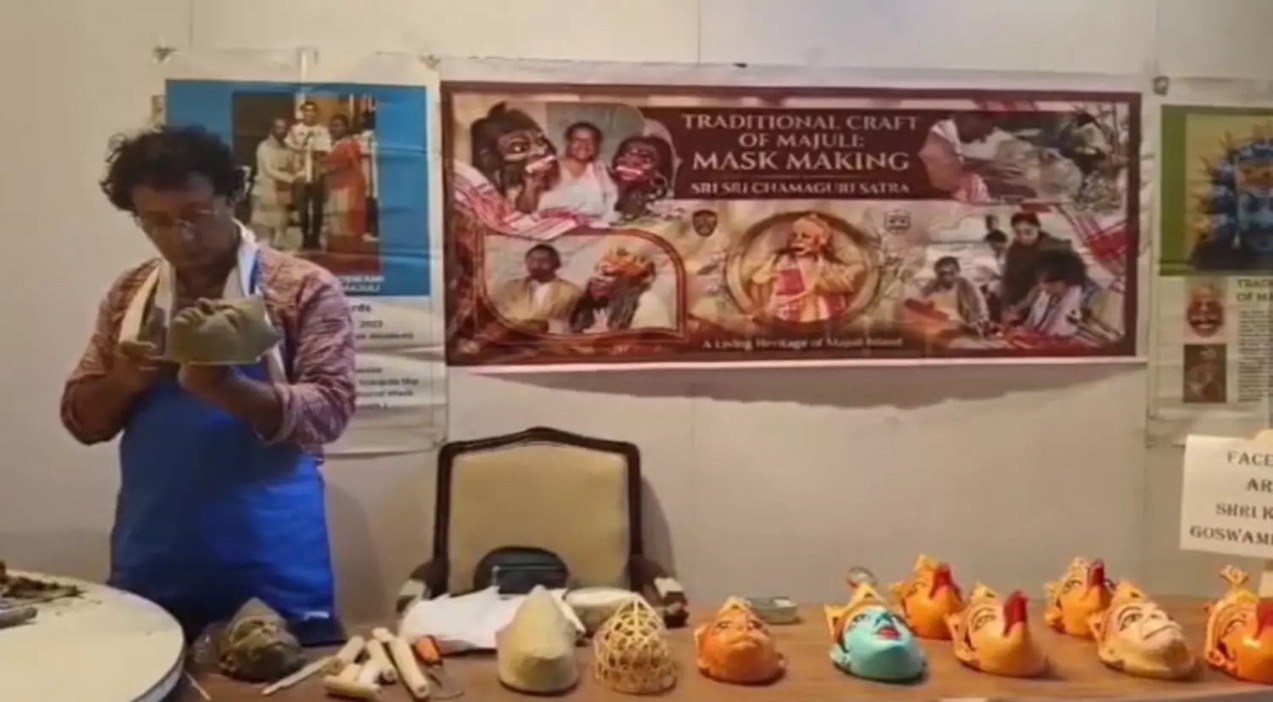
Traditional mask artist Khagen Goswami from Majuli showcased Assam’s renowned Mukha Shilpa (Mask Art) at a National Folk and Contemporary Art Camp in Jaipur, Rajasthan, bringing national attention to one of Assam’s most distinctive cultural traditions.
Artist Khagen Goswami with his mask making tools
Majuli Mukha Shilpa (Mask-Making Tradition)
Origin and Historical Background
- Associated with Assam’s Neo-Vaishnavite movement founded by Srimanta Sankardeva.
- Developed in the 15th–16th centuries as a medium to spread Krishna Bhakti among the masses.
- Tradition is believed to have originated through Sankardeva’s theatrical production Chinha Jatra.
- “Chinha Jatra” literally means “explaining through images or visual representations.”
Recognized with a Geographical Indication (GI) tag on March 4, 2024, the Majuli Mask stands as a symbol of Assam’s cultural heritage and eco-friendly artistry. (Source -The Indian express)
Purpose and Usage
- Used in Bhaona, a traditional devotional theatre form of Assam.
- Bhaona performances depict episodes from Hindu mythology and Vaishnavite literature.
- Masks help portray gods, demons, mythical beings, animals, and birds.
Types of Masks
- Mukh Mukha
- Covers only the face.
- Most commonly used in stage performances.
- Cho Mukha
- Covers the entire head and body.
- Used for larger-than-life characters and dramatic presentations.
Sattras and Mask Tradition
What are Sattras?
- Monastic institutions established by Sankardeva and his disciples.
- Majuli contains 22 Sattras.
- Mask-making tradition is concentrated mainly in:
- Samaguri Sattra
- Natun Samaguri Sattra
- Bihimpur Sattra
- Alengi Narasimha Sattra
Majuli Manuscript Painting
Key Features
- Traditional painting style originating in the 16th century.
- Executed on Sanchi Pat (manuscripts prepared from the bark of the agar/sanchi tree).
- Uses handmade natural ink.
Historical Importance
- Earliest illustrated manuscript is believed to be the Assamese rendering of Adya Dasama of the Bhagavata Purana by Sankardeva.
- Received patronage from the Ahom Kings.
- Continues to be practised in the Sattras of Majuli.
Majuli – Important Facts
Geographical Significance
- Recognized as the world’s largest river island.
- Located in the Brahmaputra River in Assam.
Majuli has reduced in size from 1,250 square kilometre at the beginning of the 20th century to 483 square kilometre by 2014 (https://india.mongabay.com)
Formation
- Bounded by:
- Brahmaputra River to the south.
- Kherkutia Xuti and Subansiri River system to the north.
PYQ )
(1)In which of the following places, "Mask making" is predominantly practiced?
(ADRE SLRC 2022 Paper V)
- Charaidew
- Majuli
- Goalpara
- Sadiya
Ans – 2(Majuli)
- Charaideo – Renowned for its Ahom Maidams, the royal burial mounds of the Ahom dynasty.
- Goalpara – Celebrated for its rich folk traditions, particularly its distinctive folklore and dance heritage.
- Sadiya – Historically significant as the ancient capital of the Chutiya Kingdom, though it is not associated with the mask-making tradition of Assam.
(1)HOW DOES THE GRANTING A GEOGRAPHICAL INDICATOR (GI) TAG TO MAJULI MASKS AND MAJULI MANUSCRIPTS IMPACT THE CULTURAL PRESERVATION AND ARTISAN EMPOWERMENT WITHIN THE REGION? (APSC MAINS)
Hints -Significance of GI Tag to Majuli Masks & Manuscripts
- Preserves Cultural Heritage by safeguarding Majuli’s unique mask-making and manuscript-painting traditions.
- Empowers Local Artisans through enhanced market value, income generation, and livelihood opportunities.
- Provides Intellectual Property Protection against imitation and unauthorized commercial use.
- Promotes Tourism and Global Recognition by increasing awareness of Assam’s cultural legacy.
- Encourages Sustainable Development through government support, market linkages, and preservation of traditional skills.
Prelims Practice Questions
Q1. With reference to Majuli Mukha Shilpa, consider the following statements:
- It is closely associated with the Neo-Vaishnavite movement of Assam.
- Masks are traditionally used in Bhaona performances.
- The masks are primarily made from metal and stone.
- Cho Mukha masks cover the entire head and body of the performer.
Which of the statements given above are correct?
A. 1 and 2 only
B. 1, 2 and 4 only
C. 2, 3 and 4 only
D. 1, 2, 3 and 4
Answer: B
Q2.Which one of the following best explains the significance of the GI Tag granted to Majuli Masks?
A. It recognizes the masks as an exclusively religious product.
B. It grants patent rights over the artistic designs of the masks.
C. It legally recognizes the geographical origin and unique traditional craftsmanship associated with the masks.
D. It prohibits the manufacture of similar masks outside Assam.
Answer: C
Assam Cabinet Expansion 2026: 12 New Ministers took Oath
Why in News?
Source – The Assam Tribune

PC – Dibrugarh Unofficial
The Himanta Biswa Sarma-led Assam Government is undertaking its first Cabinet expansion after the 2026 Assembly elections. Twelve new ministers took oath on 5 June 2026, taking the strength of the Assam Council of Ministers close to its constitutional limit.
Main Highlights
- 12 new ministers were inducted into the Assam Council of Ministers.
- Oath ceremony held at Jyoti-Bishnu Antaratik Kala Mandir, Guwahati.
- Four first-time ministers:
- Ashwini Ray Sarkar
- Biswajit Daimary
- Nilima Devi
- Sushanta Borgohain
- Nilima Devi (Mangaldoi) will become the second woman minister in the Sarma 2.0 Cabinet after Ajanta Neog.
- Biswajit Daimary, former Speaker of the Assam Legislative Assembly, is entering the Cabinet for the first time.
- Krishnendu Paul becomes the second minister from Barak Valley, alongside Kaushik Rai.
- After the expansion, only two ministerial berths will remain vacant.
Ministers Designate
- Ashwini Ray Sarkar
- Ashok Singhal
- Bimal Borah
- Biswajit Daimary
- Jayanta Malla Baruah
- Kaushik Rai
- Keshab Mahanta (AGP)
- Krishnendu Paul
- Nilima Devi
- Pijush Hazarika
- Ranoj Pegu
- Sushanta Borgohain
Constitutional Provisions Related to State Council of Ministers
Article 163
- Provides for a Council of Ministers to aid and advise the Governor.
- Governor generally acts on the advice of the Council of Ministers except in matters requiring discretion.
Article 164
- Governor appoints the Chief Minister.
- Other ministers are appointed by the Governor on the advice of the Chief Minister.
- Ministers hold office during the pleasure of the Governor.
Article 166
- Deals with the conduct of business of the State Government.
- Executive actions of the State are taken in the name of the Governor.
Article 167
- Specifies the duties of the Chief Minister regarding furnishing information to the Governor and communicating decisions of the Council of Ministers.
Article 170
- Deals with the composition of the Legislative Assembly.
- Assembly strength: Minimum 60 and Maximum 500 members (except for special constitutional provisions applicable to certain states).
91st Constitutional Amendment Act, 2003
- Total number of ministers (including the Chief Minister) in a State shall not exceed 15% of the total strength of the Legislative Assembly.
- The Council of Ministers shall not have fewer than 12 members.
Prelims Practice Questions
Q1. With reference to the State Council of Ministers, consider the following statements:
- Article 163 provides for a Council of Ministers to aid and advise the Governor.
- The Governor appoints ministers on the advice of the Chief Minister.
- The total number of ministers in a State cannot exceed 20% of the strength of the Legislative Assembly.
Which of the statements given above is/are correct?
A. 1 and 2 only
B. 2 and 3 only
C. 1 and 3 only
D. 1, 2 and 3
Answer: A
Q2. Which of the following Articles are correctly matched with their provisions?
|
Article |
Provision |
|
1. Article 163 |
Council of Ministers to aid and advise Governor |
|
2. Article 164 |
Appointment of Ministers |
|
3. Article 167 |
Duties of Chief Minister towards Governor |
|
4. Article 170 |
Composition of Rajya Sabha |
Select the correct answer using the code below:
A. 1, 2 and 3 only
B. 1 and 4 only
C. 2 and 4 only
D. 1, 2, 3 and 4
Answer: A
(Article 170 deals with the composition of the State Legislative Assembly, not the Rajya Sabha.)
