
08, JUNE 2026 - CURRENT AFFAIRS
Assam’s Fertility Rate Falls Below Replacement Level: Demographic and Cultural Implications
Source: The Assam Tribune
Why in News ?
Key Points :
- NFHS-6 Findings — Assam’s Total Fertility Rate (TFR) has declined to 1.6, below both the replacement level fertility (2.1) and the national average.
- Twenty-Year Decline — Assam’s TFR fell from 2.6 in NFHS-3 (2005-06) to 1.6 in NFHS-6, representing a decline of approximately 38% over two decades.
- Rural-Urban Gap — Under NFHS-6, rural Assam recorded a TFR of 1.7, while urban Assam reached 1.2, indicating a much sharper fertility decline in urban areas.
- NFHS Trendline
- NFHS-3 (2005-06): 2.6
- NFHS-4 (2015-16): 2.2
- NFHS-5 (2019-21): 1.9
- NFHS-6 (latest): 1.6
The data indicates a sustained downward demographic transition.
- Replacement Fertility Level — A TFR of 2.1 children per woman is generally considered necessary to maintain a stable population size without migration.
- Assamese-speaking Population Concern —The fertility rate among the broader Assamese-speaking cultural population is expected to be around 1.2, significantly below replacement level.
- Community-wise Variation — Assam’s Muslim population, constituting approximately 34% of the state’s population, is estimated to have a TFR near 2.0, though it is also declining.
- Role of Public Health — Declining fertility is attributed to:
- Expansion of ASHA workers’ outreach
- Increased female education
- Improved access to contraception
- Better maternal and child health services
- Changing family-size preferences
- Demographic Transition — Lower fertility typically leads to:
- Ageing population
- Shrinking workforce
- Rising dependency ratio
- Increased healthcare and elderly-care burdens
Global Comparison — Assam’s low fertility trajectory resembles with countries such as:
- Japan
- South Korea
South Korea’s TFR has reportedly fallen to around 0.72(2023), despite extensive government incentives.
PYQ’S
(1)Consider the following countries :
1. Italy
2. Japan
3. Nigeria
4. South Korea
5. South Africa
Which of the above countries are frequently mentioned in the media for their low birth rates, or ageing population or declining population?
(UPSC CSE Prelims 2024: General Studies Official Paper)
- 1, 2 and 4
- 1, 3 and 5
- 2 and 4 only
- 3 and 5 only
Answer – (1)
Prelims Practice Questions
Q1. With reference to the Total Fertility Rate (TFR), consider the following statements:
- Replacement level fertility is generally considered to be 2.1 children per woman.
- According to NFHS-6, Assam’s TFR is below the replacement level.
- A sustained decline in TFR may contribute to population ageing.
Which of the statements given above is/are correct?
A. 1 and 2 only
B. 2 and 3 only
C. 1 and 3 only
D. 1, 2 and 3
Answer: D
Q2. Which of the following factors are commonly associated with declining fertility rates?
- Increased female literacy
- Greater access to contraception
- Improved maternal and child healthcare
- Rising infant mortality
Select the correct answer using the code below:
A. 1, 2 and 3 only
B. 2 and 4 only
C. 1 and 4 only
D. 1, 2, 3 and 4
Answer: A
APSC MAINS Practice question
(1)Improving sex ratio at birth and declining fertility rates indicate important demographic transitions in India. Discuss with reference to Assam. (150 words)
News Spotlight
Source: The Hindu
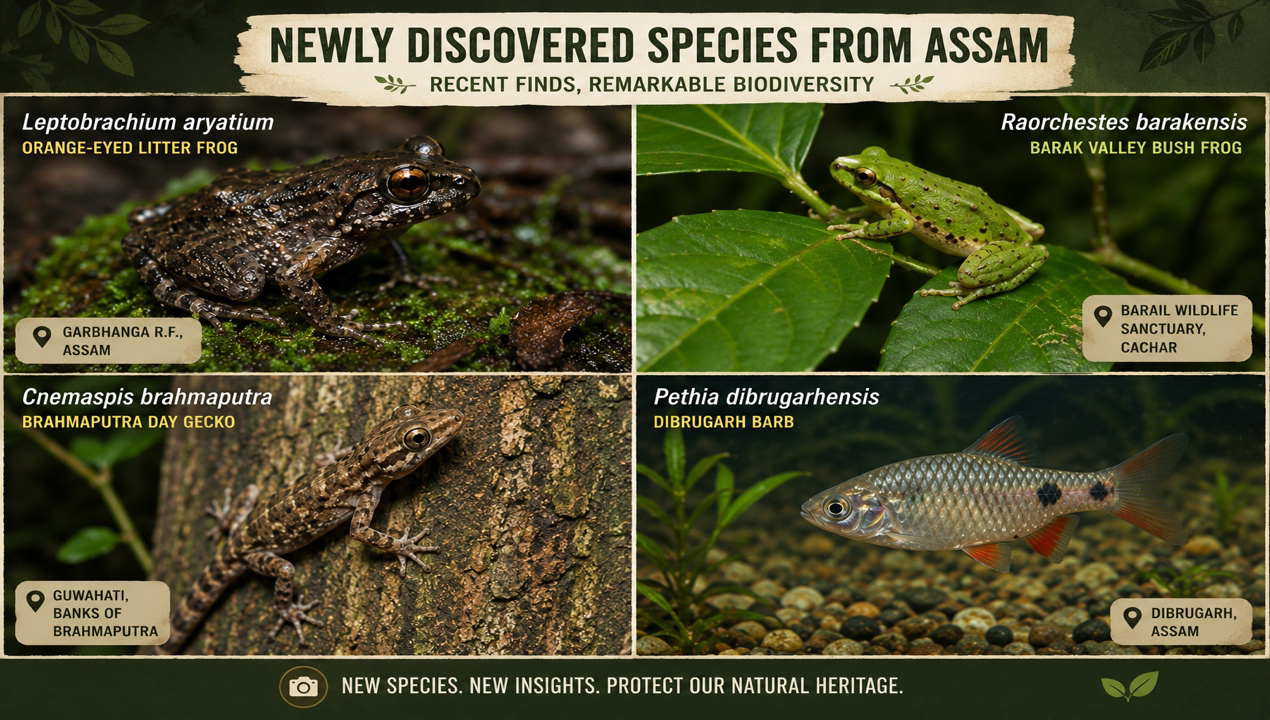
Newly Discovered Species from Assam :-
- New Frog Species Identified — A new frog species, Leptobrachium aryatium, has been formally described after a 21-year-long scientific investigation. The species was first recorded in 2004 but was initially misidentified as Leptobrachium smithi.The researchers behind this discovery are > Dr .Jayaditya Purkayastha,Dr.Dipankar Dutta ,Dr.Jayanta Gogoi and Dr.Saibal Sengupta
- Discovery Location — The species was discovered in Garbhanga Reserve Forest.
- Ecological Significance — Garbhanga Reserve Forest lies adjacent to Deepor Beel, Assam’s only Ramsar Site, and forms part of the Garbhanga–Rani–Deepor Beel Elephant Corridor, a crucial wildlife movement route.
- Naming Significance — The species has been named after Arya Vidyapeeth College in recognition of the institution’s contribution to transforming the locality into a major educational hub.
- Distinctive Features — Leptobrachium aryatium is characterized by:
- Fiery orange-and-black eyes
Other Notable New Species from Assam
Raorchestes barakensis (Barak Valley Bush Frog)
- Discovery Site — Found in Barail Wildlife Sanctuary.
- Research Contribution — Part of a broader discovery of 13 new species from Northeast India documented by the Wildlife Institute of India (WII).
Cnemaspis brahmaputra (Brahmaputra Day Gecko)
- Unique Status — Only the second known day gecko species from Northeast India.
- Discovery Location — Recorded near Dirgheswari Temple along the banks of the Brahmaputra River.
- Biogeographic Importance — Shows evolutionary links with gecko lineages found in Sri Lanka, indicating an ancient biogeographic connection.
Pethia dibrugarhensis (Dibrugarh Barb)
- Taxonomic Group — Freshwater barb fish belonging to the family Cyprinidae.
- Discovery Area — Found in the Brahmaputra River system near Dibrugarh, Assam.
- Institutional Discovery — Identified by scientists of ICAR-CIFRI.
- Significance — Highlights the rich and still underexplored freshwater biodiversity of the Brahmaputra basin.
Prelims Practice Questions
Q1. Consider the following statements regarding Leptobrachium aryatium:
- It was discovered in Garbhanga Reserve Forest of Assam.
- The species was confirmed using DNA and bioacoustic analyses.
- It has been named after a Ramsar Site in Assam.
Which of the statements given above is/are correct?
A. 1 and 2 only
B. 2 and 3 only
C. 1 and 3 only
D. 1, 2 and 3
Answer: A
Q2. Which of the following newly discovered species has been reported from near the Dirgheswari Temple along the Brahmaputra River?
A. Raorchestes barakensis
B. Leptobrachium aryatium
C. Cnemaspis brahmaputra
D. Pethia dibrugarhensis
Answer: C
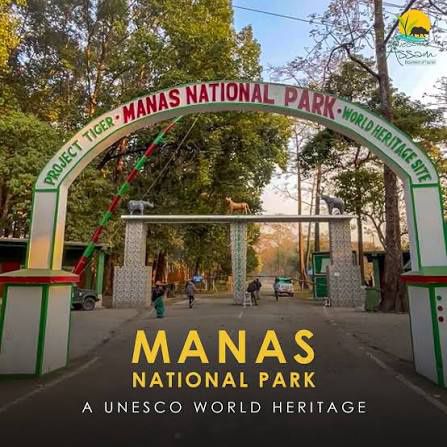
Encroachment Threat Puts Manas National Park Under Global Conservation Scrutiny
Source: The Assam Tribune
WHY IN NEWS?
Current Issue
- Persistent Encroachment — Large parts of Manas National Park and Tiger Reserve remain under illegal settlements and agricultural activities despite repeated warnings from conservation agencies.
- Protected Area Loss — Official data indicates 36.79 sq km of protected forest land within Manas is currently under illegal occupation.
- NTCA Concern — The National Tiger Conservation Authority has repeatedly flagged encroachment in Manas, but substantial remedial action remains pending.
- IUCN Warning — The International Union for Conservation of Nature has cautioned that habitat degradation caused by encroachment could undermine long-term conservation goals.
- Kokilabari Hotspot — The Kokilabari Seed Farm in the Bhuyanpara Range covers 9.3 sq km and represents critical tiger habitat as well as one of the last strongholds of the critically endangered Bengal Florican.
- Lease Anomaly — The Kokilabari Seed Farm was scheduled to revert to Manas Tiger Reserve authorities after expiry of its lease in 2001, but the transfer never occurred.
- Agricultural Leasing — The area continues to be leased for cultivation by the Bodoland Territorial Region (BTR) administration through the Agriculture Department.
- IUCN Outlook 2025 — The IUCN World Heritage Outlook 4 (2025) classified Manas under “Significant Concern” due to habitat encroachment, illegal cultivation, settlements and infrastructure development.
Affected Ranges — The Bhuyanpara and Panbari ranges have been specifically identified by IUCN as major encroachment and illegal cultivation zones.
Manas National Park:
Location & Rivers
- Strategic Location — Manas National Park lies in the Himalayan foothills of Assam and shares an international boundary with Royal Manas National Park in Bhutan.
- River System — The park derives its name from the Manas River, a major tributary of the Brahmaputra River. The Beki River also flows through the park.
Unique Distinction
- Five-fold Recognition — Manas is simultaneously:
- UNESCO Natural World Heritage Site
- Tiger Reserve
- Elephant Reserve
- Biosphere Reserve
- Important Bird Area (IBA)
Historical Timeline
- 1928 Status — Declared a Game Sanctuary/Reserve.
- 1973-74 Inclusion — Brought under Project Tiger and designated a Tiger Reserve.
- 1985 Recognition — Inscribed as a UNESCO Natural World Heritage Site.
- 1989 Upgrade — Declared a Biosphere Reserve.
- 1990 National Park — Notified as a National Park covering approximately 500 sq km.
Geographical Features
- Major Habitats — The park contains:
- Bhabar grasslands
- Terai ecosystems
- Marshlands
- Riverine tracts
- Forest Types —
- Semi-evergreen forests
- Mixed moist deciduous forests
- Dry deciduous forests
- Alluvial grasslands
- Swamp forests
- Climate Type — Tropical monsoon climate with high rainfall and annual flooding that sustains grassland ecosystems.
Biodiversity Richness
- Flagship Mammals —
- Bengal Tiger
- Indian Elephant
- Greater One-horned Rhinoceros
- Clouded Leopard
- Sloth Bear
- Endemic & Rare Species —
- Pygmy Hog
- Hispid Hare
- Golden Langur
- Bengal Florican
- Highest Protection — More than 22 endangered species found in Manas are listed under the highest protection schedules of India’s wildlife protection framework.
Prelims Practice Questions
Q1. Consider the following statements regarding Manas National Park:
- It shares an international boundary with Bhutan.
- It is simultaneously a UNESCO World Heritage Site, Tiger Reserve, Elephant Reserve and Biosphere Reserve.
- The Manas River is a tributary of the Barak River.
Which of the statements given above is/are correct?
A. 1 and 2 only
B. 2 and 3 only
C. 1 and 3 only
D. 1, 2 and 3
Answer: A
Q2. Which of the following species are closely associated with the grassland ecosystem of Manas National Park?
- Pygmy Hog
- Hispid Hare
- Bengal Florican
- Golden Langur
Select the correct answer using the code below:
A. 1 and 2 only
B. 1, 2 and 3 only
C. 2, 3 and 4 only
D. 1, 2, 3 and 4
Answer: B
