
10th March Editorials & Articles
UPSC 360°
The Hindu Unwrapped – Daily Current Affairs Mastery for UPSC CSE (Clear that it’s based on The Hindu editorials / news analyses – very aspirant-friendly)
|
Significance |
|
Algorithmic sovereignty is crucial for India to safeguard its digital independence, national security, and economic competitiveness in the AI-driven world. Control over algorithms ensures that data governance, technological development, and digital platforms align with national interests, cultural diversity, and democratic values, reducing dependence on foreign tech ecosystems and strengthening India’s position in the global digital order. |
Securing India’s Digital Future: The Case for Algorithmic Sovereignty
Introduction
In the digital age, power is increasingly shaped not only by military strength or economic influence but also by control over data, algorithms, and artificial intelligence systems. Algorithms determine how information is processed, how decisions are made, and how narratives are shaped in the global digital ecosystem. For India, a rapidly growing digital power with over a billion internet users, achieving algorithmic sovereignty has become a strategic necessity. Without control over the algorithms that influence governance, security, economy, and public discourse, India risks becoming dependent on foreign technological ecosystems that may not align with its national interests.
Understanding Algorithmic Sovereignty
Algorithmic sovereignty refers to a nation's ability to design, control, regulate, and govern the algorithms and artificial intelligence systems that influence its digital infrastructure, economy, and public life. It ensures that key technological systems operate according to a country’s laws, cultural values, strategic interests, and democratic norms.
This concept is closely linked to data sovereignty, digital infrastructure, and national security. When algorithms that influence financial systems, social media platforms, defence analytics, and governance tools are controlled by foreign corporations or governments, the country using them may lose strategic autonomy.
In simple terms, algorithmic sovereignty means that a country must have the capacity to build and regulate its own AI ecosystems rather than relying completely on external technological frameworks.
Why Algorithmic Sovereignty Matters for India
1. Protecting National Security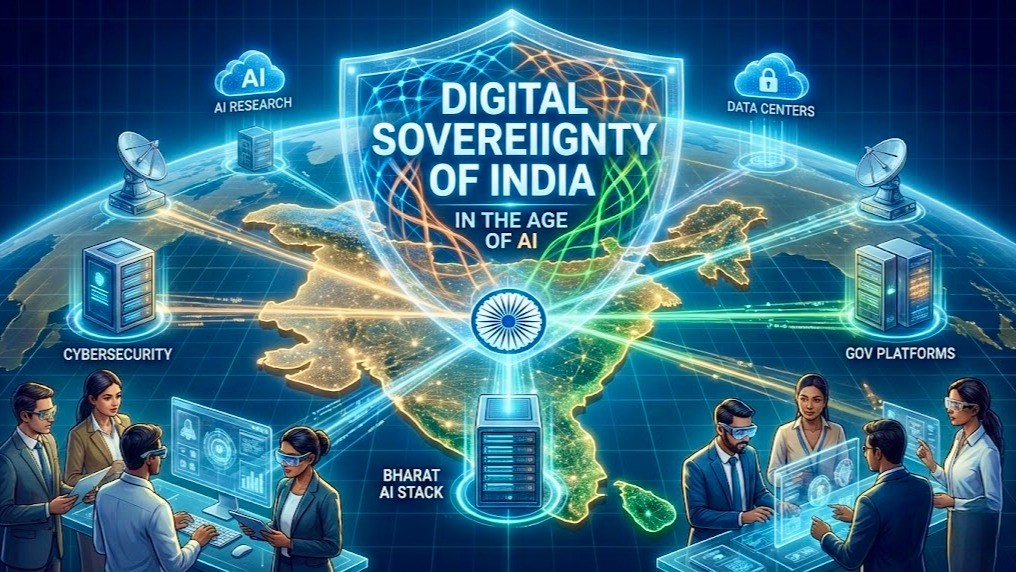
Artificial intelligence and algorithms play an increasing role in defence systems, intelligence analysis, cybersecurity, and surveillance technologies. If these systems rely heavily on foreign-developed algorithms, there is a risk that sensitive data and strategic insights could be exposed or manipulated.
For India, which faces complex geopolitical challenges in South Asia and the Indo-Pacific region, maintaining technological independence in AI-driven defence systems is crucial for safeguarding national security.
2. Reducing Dependence on Foreign Tech Platforms
Most global digital platforms—search engines, social media networks, cloud services, and AI tools—are dominated by Western technology companies or emerging Chinese digital ecosystems. These platforms operate based on algorithms designed outside India and trained primarily on datasets reflecting foreign social, political, and cultural contexts.
Such dependence can create digital asymmetry, where India’s digital economy functions within systems that prioritize external interests. Developing indigenous algorithms ensures that Indian perspectives, languages, and priorities are represented.
3. Ensuring Fair Representation of Indian Knowledge Systems
Many artificial intelligence systems are trained primarily on Western datasets and academic frameworks, which may overlook or misinterpret knowledge from other civilizations. When AI models interpret geopolitical events, social issues, or historical narratives, they may reflect biases embedded in the training data.
For a diverse and historically rich society like India, algorithmic sovereignty allows the integration of Indian languages, cultural contexts, philosophical traditions, and regional knowledge systems into digital platforms and AI models.
4. Strengthening Economic Competitiveness
The future global economy will be driven by data, artificial intelligence, and digital innovation. Countries that control advanced AI technologies and algorithms will shape the next phase of global economic growth.
By investing in domestic AI research, digital infrastructure, and algorithm development, India can:
- Strengthen its technology sector
- Promote innovation and startups
- Generate high-skilled employment opportunities
- Enhance global competitiveness in emerging industries
Algorithmic sovereignty therefore becomes essential for India’s digital economy and long-term economic resilience.
5. Safeguarding Democratic Processes
Algorithms influence how information is distributed across digital platforms, shaping public opinion, political discourse, and media narratives. Social media algorithms can amplify certain viewpoints while suppressing others, potentially affecting democratic processes such as elections and public debates.
When algorithmic systems are controlled by foreign entities, they may not fully align with India’s democratic values, regulatory frameworks, and social realities. Strengthening domestic control over these systems helps ensure transparency, accountability, and protection against misinformation.
Challenges in Achieving Algorithmic Sovereignty
Despite its importance, achieving algorithmic sovereignty presents several challenges for India.
Technological Gap
Developing advanced AI systems requires large datasets, computing power, skilled researchers, and significant investment. Competing with global technology giants in these areas can be difficult.
Infrastructure Limitations
High-performance computing infrastructure, data centers, and semiconductor capabilities are essential for AI development. India must expand these capabilities to support domestic innovation.
Regulatory Complexity
Balancing innovation with regulation is a delicate task. Excessive regulation may hinder technological growth, while weak oversight may expose the country to risks associated with foreign-controlled platforms.
Talent and Research Ecosystem
India must strengthen its AI research institutions, universities, and innovation ecosystems to produce skilled professionals capable of developing advanced algorithms.
Steps India Can Take
To build algorithmic sovereignty, India can adopt several strategic measures.
1. Invest in Indigenous AI Development
Government and private sector collaboration can support domestic AI research, innovation hubs, and technology startups.
2. Build Strong Data Infrastructure
India must develop secure data centers, cloud computing systems, and national data platforms to support large-scale AI training.
3. Promote Open and Responsible AI
Encouraging open-source AI frameworks and ethical AI standards can help create transparent and accountable technological ecosystems.
4. Encourage Multilingual AI Systems
India’s linguistic diversity requires algorithms that support regional languages, enabling inclusive digital participation.
5. Strengthen Regulatory Frameworks
Policies related to data protection, digital competition, cybersecurity, and AI governance must ensure that algorithms operate in accordance with national interests.
Conclusion
As artificial intelligence becomes a defining force in global politics, economics, and security, algorithmic sovereignty has emerged as a critical pillar of national power in the digital age. For India, achieving control over its digital infrastructure, data ecosystems, and AI algorithms is not merely a technological goal but a strategic imperative. By investing in domestic innovation, strengthening regulatory frameworks, and building inclusive AI systems that reflect its cultural and social diversity, India can ensure that its digital future remains secure, autonomous, and aligned with its national interests.
UPSC CSE & State PCS Relevance
Prelims
- India AI Mission 2023
- DPDP Act 2023
- National Security Directive on Telecom
- Digital Personal Data Protection Act
GS-2 (Governance & IR)
- Digital sovereignty & national security
- India’s role in global AI governance
- Federalism in digital regulation
GS-3 (Economy & Technology)
- Emerging technologies & economic growth
- Self-reliance in critical technologies
- Data economy & AI competitiveness
Essay / Interview
- “Algorithmic Sovereignty: India’s Strategic Imperative in the AI Era”
- “Balancing Innovation and Security in India’s Digital Journey”
MCQs
- Algorithmic sovereignty primarily refers to a nation’s ability to:
(a) Control internet bandwidth
(b) Design, regulate, and govern AI algorithms affecting its society
(c) Ban foreign social media platforms
(d) Develop indigenous semiconductors only
Answer: (b)
- Which of the following is NOT a key pillar of algorithmic sovereignty for India?
(a) Indigenous foundational AI models
(b) Data localization for critical sectors
(c) Mandatory use of foreign LLMs
(d) Domestic compute infrastructure
Answer: (c)
- The Digital Personal Data Protection Act, 2023 is most closely related to which aspect of algorithmic sovereignty?
(a) Compute infrastructure
(b) Data sovereignty
(c) Hardware manufacturing
(d) Talent development
Answer: (b)
- Which initiative is India’s flagship programme for building sovereign AI capabilities?
(a) Make in India
(b) India AI Mission 2023
(c) Digital India
(d) Atmanirbhar Bharat
Answer: (b)
Mains Questions
- “In the age of artificial intelligence, algorithmic sovereignty is as critical as territorial sovereignty.” Discuss the strategic importance of algorithmic sovereignty for India and the steps needed to achieve it. (15 marks / 250 words)
- Examine the challenges India faces in reducing dependence on foreign AI models and platforms. (10 marks / 150 words)
- “India must balance openness to global AI innovation with the imperative of protecting national interests.” Critically evaluate this statement in the context of algorithmic sovereignty. (15 marks / 250 words)
- Essay (250 marks) “Algorithmic Sovereignty: The Next Frontier of National Power in the Digital Age – India’s Path Ahead”
Click Here to download the PDF
