26th February Current Affairs
CLICK HERE to download the PDF
Why in News?
- On 25 February 2026, the Office of the Registrar General and Census Commissioner of India (RG&CCI) informed all States and Union Territories that field operations for the first-ever digital Population Census 2027 will be monitored in real time by senior officials through a dedicated web-based portal.
- The Census Management and Monitoring System (CMMS) has been developed to track progress, identify delays/gaps, and ensure timely completion of activities within prescribed timelines.
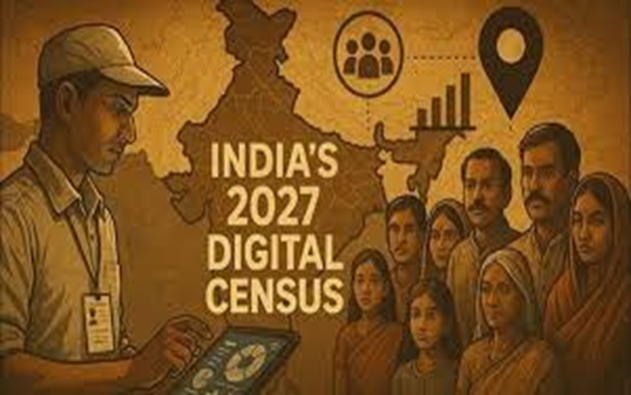
- This is part of the government’s push to conduct the long-delayed decennial Census (originally due in 2021, postponed due to COVID-19) in a fully digital, transparent, and efficient manner.
- Registrar General Mritunjay Kumar Narayan stated that around 32 lakh field functionaries will be deployed across the country.
Key Features of Census 2027
Two-Phase Structure (First digital Census in India’s history):
Phase I – Houslisting Operations (HLO)
-
- Period: 1 April 2026 to 30 September 2026 (6 months).
- 33 questions on housing conditions, amenities, assets, etc.
- Will generate “working maps” using latest satellite imagery for accurate identification of habitations and settlements.
Phase II – Population Enumeration
-
- Scheduled for February 2027.
- Collection of demographic, socio-economic, cultural, and caste details (first full caste census since 1931).
Technological Innovations:
- Real-time monitoring via CMMS portal by senior officials (including RG&CCI).
- Extensive use of digital tools, mobile apps, and satellite imagery.
- “Working maps” for ground-level accuracy.
- Aim: Higher quality, efficiency, timeliness, and transparency in data collection and dissemination.
Background & Significance
- The last Census was conducted in 2011 (15 years ago — longest gap since independence).
- The 2021 Census was postponed indefinitely due to the COVID-19 pandemic.
- This will be India’s first fully digital Census, marking a shift from paper-based to technology-driven enumeration.
- Inclusion of caste data in Phase II will be a historic step (last caste census was in 1931).
- The exercise is of “national importance” and will form the basis for:
- Delimitation of constituencies.
- Resource allocation under schemes.
- Planning for education, health, employment, and infrastructure.
- Updating the National Population Register (NPR).
Major Challenges & Government Strategy
- Scale: Deploying and monitoring 32 lakh field functionaries across urban and rural India.
- Data Quality & Privacy: Ensuring accuracy while protecting personal data under the DPDP Act, 2023.
- Timelines: Strict adherence to schedules (HLO by Sep 2026, enumeration in Feb 2027).
- Political Sensitivity: Caste data collection may trigger debates on reservation policy and social justice.
- Mitigation: Real-time CMMS monitoring, training of enumerators, and use of satellite imagery for verification.
|
UPSC-CSE/State PCS Relevance |
|
Prelims |
|
|
|
|
GS-2 (Polity & Governance) |
|
|
|
GS-1 (Society) |
|
|
|
GS-3 (Economy) |
|
|
Essay / Interview |
|
|
Que 1. With reference to the upcoming Census 2027, consider the following statements:
- It will be India’s first fully digital Census.
- The first phase (Houslisting Operations) will be conducted from April to September 2026.
- Caste data will be collected for the first time since the 1931 Census.
Which of the statements given above is/are correct?
(a) 1 and 2 only
(b) 2 and 3 only
(c) 1 and 3 only
(d) 1, 2 and 3
Answer: (d)
Que 2. The Census Management and Monitoring System (CMMS) portal is primarily meant for:
(a) Real-time monitoring of field operations by senior officials
(b) Collection of caste data only
(c) Publication of final Census results
(d) Training of field functionaries
Answer: (a)
Que 3. The second phase of Census 2027 (Population Enumeration) is scheduled for:
(a) April–September 2026
(b) February 2027
(c) October–December 2026
(d) January 2027
Answer: (b)
Que 4. Which of the following is NOT a stated objective of the real-time monitoring system for Census 2027?
(a) Identifying gaps and delays
(b) Ensuring timely completion of activities
(c) Conducting the Census without field functionaries
(d) Overseeing progress in accordance with prescribed timelines
Answer: (c)
Que 1. “The first-ever digital Census 2027, with real-time monitoring through the CMMS portal, marks a transformative shift in India’s statistical system.” Discuss the significance, technological innovations, and potential challenges of this exercise. (15 marks / 250 words)
Que 2. The inclusion of caste data in the 2027 Census after a gap of nearly a century has far-reaching socio-political implications. Critically examine the opportunities and challenges associated with this decision. (15 marks / 250 words)
Que 3. “Accurate and timely Census data is fundamental to evidence-based governance and federal resource allocation.” In the light of the Census 2027 preparations, analyse the role of technology in strengthening India’s statistical architecture. (10 marks / 150 words)
Essay (250 marks) “From paper to pixels: How digital transformation is reshaping India’s decennial Census and governance ecosystem.”
Why in News?
- On 25 February 2026, the Indian Space Research Organisation (ISRO) publicly released the report of the apex failure analysis committee that investigated the unsuccessful orbit-raising of the NVS-02 navigation satellite.
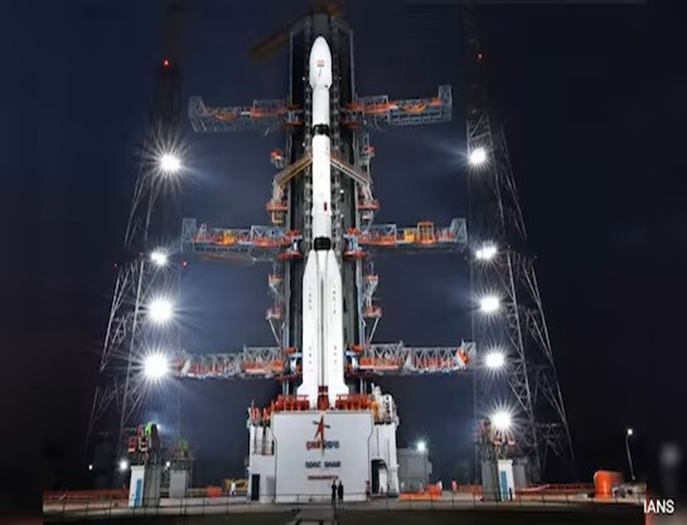
- The satellite was launched on 29 January 2025 aboard the GSLV-F15 rocket from Sriharikota but could not reach its intended geosynchronous orbit due to a critical failure in the upper stage.
- The committee identified a loose electrical connection in the oxidiser line valve as the root cause — a seemingly minor technical glitch with major mission impact.
- This is the second major failure analysis report released by ISRO in February 2026 (after the PSLV probe committee), reflecting increased transparency and accountability in the organisation.
Key Facts of the NVS-02 Mission Failure
- Launch Date: 29 January 2025 (100th launch from Sriharikota).
- Vehicle: GSLV-F15 (Mk II variant with indigenous cryogenic upper stage).
- Payload: NVS-02 — second satellite in the NavIC (NVS series) for India’s regional navigation system.
- Intended Orbit: Geosynchronous orbit at ~36,000 km altitude.
What Happened:
-
- The rocket successfully placed the satellite into a sub-geosynchronous transfer orbit.
- However, the liquid apogee motor (LAM) of the spacecraft failed to fire properly.
- Reason: The electrical signal to activate the key oxidiser valve in the engine never reached it.
- Root cause: Loose/faulty connection in the electrical connector serving both primary and backup lines.
- Outcome: Satellite remained in an elliptical orbit instead of circular geosynchronous orbit → mission objectives (navigation services) could not be fully met.
Findings of the Apex Committee
- Chairman: Prof. K. VijayRaghavan (former Principal Scientific Adviser).
- Members: Dr. S. Somanath (former ISRO Chairman) and other senior experts.
Main Conclusion:
-
- “The signal meant to activate the key valve in the engine’s oxidiser line never reached it.”
- This valve is crucial for firing the engine to raise the spacecraft’s orbit.
- Most Likely Explanation: At least one connection in the electrical connector came loose or failed in both primary and backup lines.
- The committee also reviewed redundancy and reliability of the pyro system operations and gave recommendations to “enhance redundancy and reliability” for future missions.
- Note: The same pyro systems performed successfully in the CMS-03 (GSAT-7R) mission launched on LVM3-M5 in November 2025.
Significance of NVS-02 Mission
- NVS series is the second-generation NavIC satellites with enhanced capabilities (L1, L5, S-band signals).
- NavIC (formerly IRNSS) is India’s independent regional navigation system, critical for:
- Defence (missile guidance, troop positioning).
- Civil aviation, maritime, disaster management.
- Strategic autonomy (alternative to GPS in hostile scenarios).
Broader Implications & ISRO’s Response
- For ISRO: Second major failure probe in a month (after PSLV-C61/C62). Highlights need for stricter quality control in electrical harnesses and connectors.
- Organisational Learning: Committee recommendations will be implemented across GSLV, LVM3, and future missions.
- Transparency: ISRO’s decision to publicly release detailed failure reports (rare earlier) shows growing institutional accountability.
- Strategic Impact: Delay in full NavIC constellation affects strategic and civilian users. Next NVS satellite is now critical.
|
UPSC-CSE/State PCS Relevance |
|
Prelims |
|
|
|
|
GS-3 (Science & Technology) |
|
|
|
|
GS-3 (Internal Security/Disaster Management) |
|
|
Essay / Interview |
|
|
Que 1. With reference to the NVS-02 mission failure, consider the following statements:
- The satellite was launched on GSLV-F15 in January 2025.
- The root cause was a loose electrical connection in the oxidiser valve circuit.
- The mission was the 100th launch from Sriharikota.
Which of the statements given above is/are correct?
(a) 1 and 2 only
(b) 2 and 3 only
(c) 1 and 3 only
(d) 1, 2 and 3
Answer: (d)
Que 2. NVS-02 belongs to which series of satellites?
(a) GSAT communication satellites
(b) NavIC navigation satellites (second generation)
(c) EOS earth observation satellites
(d) RISAT radar imaging satellites
Answer: (b)
Que 3. The apex committee that analysed the NVS-02 failure was chaired by:
(a) V. Narayanan
(b) S. Somanath
(c) K. VijayRaghavan
(d) S. Somanath and K. VijayRaghavan jointly
Answer: (c)
Que 4. Which subsystem failure prevented NVS-02 from reaching its intended geosynchronous orbit?
(a) Cryogenic upper stage of GSLV
(b) Liquid Apogee Motor (LAM) of the spacecraft
(c) Solar panel deployment
(d) Attitude control thrusters
Answer: (b)
Que 1. “A single loose electrical connection led to the partial failure of the NVS-02 mission, highlighting the razor-thin margins in space engineering.” Discuss the technical and organisational lessons from this incident for ISRO’s future missions. (15 marks / 250 words)
Que 2. The public release of the NVS-02 failure analysis report in February 2026 reflects ISRO’s evolving culture of transparency. Examine the significance of such accountability mechanisms in high-stakes technological organisations. (10 marks / 150 words)
Que 3. “NavIC is critical for India’s strategic autonomy in navigation and positioning.” In the light of the NVS-02 setback, analyse the importance of an indigenous navigation system and the challenges in building a reliable constellation. (15 marks / 250 words)
Essay (250 marks) “From failure to flight: How ISRO turns setbacks into stepping stones for space leadership.”
Why in News?
The Union Ministry of Rural Development has formally rejected a Right to Information (RTI) application that sought detailed records of pre-legislative consultations held with States, technical workshops, multi-stakeholder discussions, and incorporation of State inputs into the Viksit Bharat-Gramin Rozgar Abhiyan Mission (VB-GRAM) Act, 2025 (also referred to as the “Viksit Bharat Rural Employment Guarantee Act”).
The rejection was communicated in response to an RTI filed by an applicant (name not disclosed in public reports) who had sought: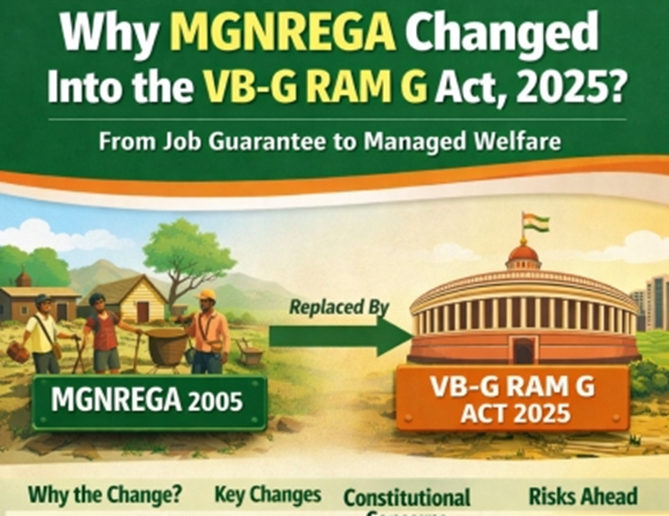
- Copies of correspondence/consultations with States/UTs.
- Minutes/notes of technical workshops.
- Records showing how State feedback was incorporated into the final Bill.
- Status of implementation/notification of the scheme.
The Ministry’s reply (dated ~mid-February 2026) states that:
- The information cannot be disclosed at this stage because the scheme “has not yet been formally notified to the States/UTs and has not become operational in any State/UT”.
- Disclosing pre-legislative consultation records would involve sharing “ongoing deliberations relating to policy implementation” and is therefore exempt.
This decision has reignited debate on transparency in law-making, especially for flagship employment guarantee schemes that directly impact rural India.
Background: The VB-GRAM Act, 2025
- Officially titled Viksit Bharat-Gramin Rozgar Abhiyan Mission (Guarantee of Rural Employment) Act, 2025 (popular short name: VB-GRAM Act).
- Passed by Parliament in December 2025 after extensive pre-legislative consultations (claimed by the government).
- Aims to provide guaranteed wage employment in rural areas under a revamped and expanded framework (building on MGNREGA but with new features).
- Union Rural Development Minister Shivraj Singh Chouhan stated in Parliament (December 2024) that the Bill was preceded by:
- Wide consultations with States.
- Technical workshops.
- Multi-stakeholder deliberations.
- The Act is yet to be notified/operationalised in any State/UT (as of Feb 2026) → implementation process is ongoing.
Core Issue Raised by the RTI Rejection
The Ministry invoked exemption grounds (likely under Section 8(1)(e)/(g)/(j) of RTI Act or internal working process exemption) to deny information, arguing that:
- The matter is still under active policy formulation/implementation.
- Disclosure would reveal “ongoing deliberations” and internal decision-making process.
- The scheme has not become operational → premature to share consultation details.
Critics argue this creates a dangerous precedent:
- Pre-legislative consultations are supposed to enhance democratic legitimacy of laws.
- Once a law is passed, citizens should have the right to know how stakeholder inputs shaped it.
- Blanket denial until “notification/operationalisation” can indefinitely block transparency.
Legal & Policy Debate
- RTI Act vs. Deliberative Process Privilege: Ministries frequently cite “ongoing policy process” to deny pre-legislative records. Courts have sometimes upheld this (if harm to decision-making is demonstrated), but have also directed disclosure when public interest is high.
- Pre-Legislative Consultation Policy, 2014: Mandates wide consultation before major laws → records should ideally be public post-enactment.
- Right to Information as part of Article 19(1)(a): Supreme Court has repeatedly held that RTI is integral to freedom of speech & expression. Denying consultation records can undermine this right.
- Public Interest Override: Even exempt information can be disclosed if larger public interest justifies it (Section 8(2) RTI Act).
Implications
- Transparency Deficit: Citizens, researchers, civil society cannot access how States’ feedback shaped a massive rural employment law.
- Accountability Gap: No independent verification of whether consultations were meaningful or merely perfunctory.
- Precedent Risk: May embolden other ministries to delay disclosure until schemes are “operational” (which can take years).
- Political Angle: Opposition parties may use this to accuse the government of opacity in flagship schemes.
UPSC-CSE/State PCS Relevance
Prelims
- Key Acts: RTI Act 2005 (Section 8 exemptions), DPDP Act 2023 (contextual linkage), VB-GRAM Act 2025.
- Constitutional Articles: 19(1)(a) – RTI as part of freedom of speech.
- Policy: Pre-Legislative Consultation Policy 2014.
GS-2 (Polity & Governance)
- Transparency & accountability in law-making.
- Tension between deliberative privilege and right to information.
- Role of RTI in participatory democracy.
GS-2 (Social Justice)
- Rural employment guarantee schemes (MGNREGA → VB-GRAM).
- Pre-legislative consultation and federalism (Centre-State inputs).
GS-4 (Ethics)
- Ethical governance: transparency vs. administrative convenience.
Essay / Interview
- “Opacity in law-making undermines democratic legitimacy.”
- “Balancing confidentiality of policy deliberations with the citizen’s right to know.”
Que 1. With reference to the recent RTI rejection by the Ministry of Rural Development, consider the following statements:
- The RTI sought details of pre-legislative consultations for the VB-GRAM Act, 2025.
- The Ministry rejected the plea stating the scheme has not been notified to States/UTs.
- The VB-GRAM Act was passed in December 2025.
Which of the statements given above is/are correct?
(a) 1 and 2 only
(b) 2 and 3 only
(c) 1 and 3 only
(d) 1, 2 and 3
Answer: (d)
Que 2. The Right to Information Act, 2005 is constitutionally linked primarily to which of the following?
(a) Article 14
(b) Article 19(1)(a)
(c) Article 21
(d) Article 32
Answer: (b)
Que 3. Which of the following is NOT a stated reason given by the Ministry for rejecting the RTI on VB-GRAM Act consultations?
(a) The scheme has not become operational in any State/UT
(b) Disclosure would reveal ongoing policy deliberations
(c) The consultations were confidential under Cabinet secrecy
(d) The matter is still under active implementation process
Answer: (c) (not explicitly mentioned in the report)
Que 1. “Denying pre-legislative consultation records under RTI after a law has been passed defeats the very purpose of participatory law-making.” Critically examine the Union Rural Development Ministry’s refusal to disclose details of consultations for the VB-GRAM Act, 2025. (15 marks / 250 words)
Que 2. Discuss the tension between the Right to Information and the need to protect internal deliberations of the government. In light of the recent RTI rejection on VB-GRAM Act consultations, suggest measures to strike a constitutional balance. (10 marks / 150 words)
Que 3. “The RTI Act is a cornerstone of democratic accountability, yet repeated exemptions on grounds of ‘ongoing process’ are weakening its effectiveness.” Analyse this statement with reference to the February 2026 rejection by the Rural Development Ministry. (15 marks / 250 words)
Essay (250 marks) “Transparency in law-making: How much secrecy is too much in a democracy?”
Why in News?
- The Viksit Bharat Shiksha Adhiniyam (VBSA) Bill, 2025 — the proposed legislation to replace the University Grants Commission (UGC), All India Council for Technical Education (AICTE) and National Council for Teacher Education (NCTE) with a single 12-member higher education regulator — was formally circulated among 39 Union Ministries and 29 Departments for inter-ministerial consultations.
- The government informed the Joint Parliamentary Committee (JPC) examining the Bill that the draft has already undergone extensive pre-legislative consultations with States and stakeholders.
- Opposition MPs (across parties) strongly criticised the Bill as “executive overreach”, alleging it centralises excessive powers, undermines university autonomy, violates federal principles, and introduces severe penalties, graded compliance requirements, and closure powers.
- The JPC (headed by BJP MP P.P. Chaudhary) held its first meeting on Thursday (likely 26 Feb 2026); senior officials from the Education Ministry and Legislative Department are expected to brief the panel on the Bill’s background and provisions.
- The Bill was introduced in Parliament in December 2025 by Union Education Minister Dharmendra Pradhan.
Salient Features of the VBSA Bill, 2025 (as per government briefing to JPC)
- Replaces three major regulators:
- University Grants Commission (UGC)
- All India Council for Technical Education (AICTE)
- National Council for Teacher Education (NCTE)
- Creates a single 12-member apex body called Viksit Bharat Shiksha Adhiniyam Commission (or similar nomenclature).
Key powers:
-
- Overall regulation of higher education (excluding medical & legal education).
- Setting standards, granting autonomy, accreditation, funding disbursement.
- Graded regulatory framework (light-touch for high-performers; stringent for low-performers).
- Severe penalties, including fines and power to close institutions for non-compliance.
- Important structural change: The Commission will not have direct disbursement powers (unlike UGC). Funding will be routed through the Ministry of Education (or a separate funding agency).
- Aims to reduce conflict of interest (regulator + funder) and enhance transparency in grant allocation.
Major Criticisms & Opposition Concerns
- Excessive Centralisation — Undermines university autonomy and federal character of education (Entry 25 – Concurrent List).
- Executive Overreach — Commission members likely nominated by the Centre → fears of political interference.
- Punitive Powers — Graded penalties and closure powers seen as draconian.
- Lack of Legislative Scrutiny — Opposition alleges inadequate consultation despite government claims.
- Funding Separation — While removing conflict of interest, critics fear it could politicise funding decisions.
Government’s Defence (as briefed to JPC)
- Aims to create a single-window, light-but-strict regulator in line with National Education Policy (NEP) 2020.
- Separation of regulation and funding removes conflict of interest.
- Graded regulation rewards high-performing institutions with autonomy.
- Extensive consultations already done with States and stakeholders.
- Bill still under active consideration — JPC feedback will shape final version.
Current Status
- JPC (31 members, headed by BJP MP P.P. Chaudhary) began deliberations.
- Education Ministry & Legislative Department officials to brief the panel.
- Opposition MPs have demanded wider stakeholder consultations and public disclosure of pre-legislative inputs.
- Final shape of the Bill will depend significantly on JPC recommendations.
UPSC-CSE / State PCS Relevance
Prelims
• Key terms: VBSA Bill 2025, UGC, AICTE, NCTE, NEP 2020.
• Constitutional provision: Entry 25 List III (Concurrent) – Education.
• Regulatory bodies being replaced.
GS-2 (Polity & Governance)
• Federalism in education (Centre-State power balance).
• Executive vs. legislative control over autonomous institutions.
• Role of JPC in scrutinising major legislation.
GS-2 (Social Justice)
• Access, equity, quality in higher education (NEP linkage).
• Autonomy of universities vs. regulatory standardisation.
GS-3 (Economy)
• Impact on private higher education institutions and foreign universities.
Essay / Interview
• “Centralisation vs. Autonomy: The future of higher education regulation in India.”
• “Does a single regulator strengthen or weaken India’s federal education system?”
Que 1. With reference to the Viksit Bharat Shiksha Adhiniyam (VBSA) Bill, 2025, consider the following statements:
- The Bill proposes to replace UGC, AICTE and NCTE with a single 12-member commission.
- The proposed commission will have direct power to disburse grants to universities.
- The Bill was introduced in Parliament in December 2025.
Which of the statements given above is/are correct?
(a) 1 and 2 only
(b) 1 and 3 only
(c) 2 and 3 only
(d) 1, 2 and 3
Answer: (b)
Que 2. The VBSA Bill, 2025 is being examined by which parliamentary committee?
(a) Standing Committee on Education
(b) Joint Parliamentary Committee (JPC)
(c) Public Accounts Committee
(d) Estimates Committee
Answer: (b)
Que 3. Which of the following is NOT a stated objective of the proposed VBSA Bill?
(a) Graded regulatory framework for institutions
(b) Separation of regulatory and funding functions
(c) Direct disbursement of grants by the new commission
(d) Enhanced autonomy for high-performing institutions
Answer: (c)
Que 4. Education figures in which List of the Seventh Schedule of the Constitution?
(a) Union List
(b) State List
(c) Concurrent List
(d) Residuary Powers
Answer: (c)
Que 1. “The Viksit Bharat Shiksha Adhiniyam Bill, 2025 seeks to create a single-window regulator for higher education but risks excessive centralisation and erosion of university autonomy.” Critically examine the key provisions of the Bill and its implications for federalism and institutional independence. (15 marks / 250 words)
Que 2. Discuss the rationale behind separating regulatory and funding functions in higher education as proposed in the VBSA Bill, 2025. Do you think this addresses the conflict of interest in the existing UGC framework? (10 marks / 150 words)
Que 3. “Graded regulation and punitive powers in the VBSA Bill may improve quality but could be misused to curb dissent in universities.” Comment on the potential benefits and risks of the proposed framework. (15 marks / 250 words)
Essay (250 marks) “Centralised regulation vs. institutional autonomy: Reforming higher education in Viksit Bharat.”
Why in News?
- A significant scientific development reported on 25–26 February 2026 reveals that global temperature spikes driven by climate change are compelling meteorologists and climate agencies to redefine the thresholds for classifying El Niño events.
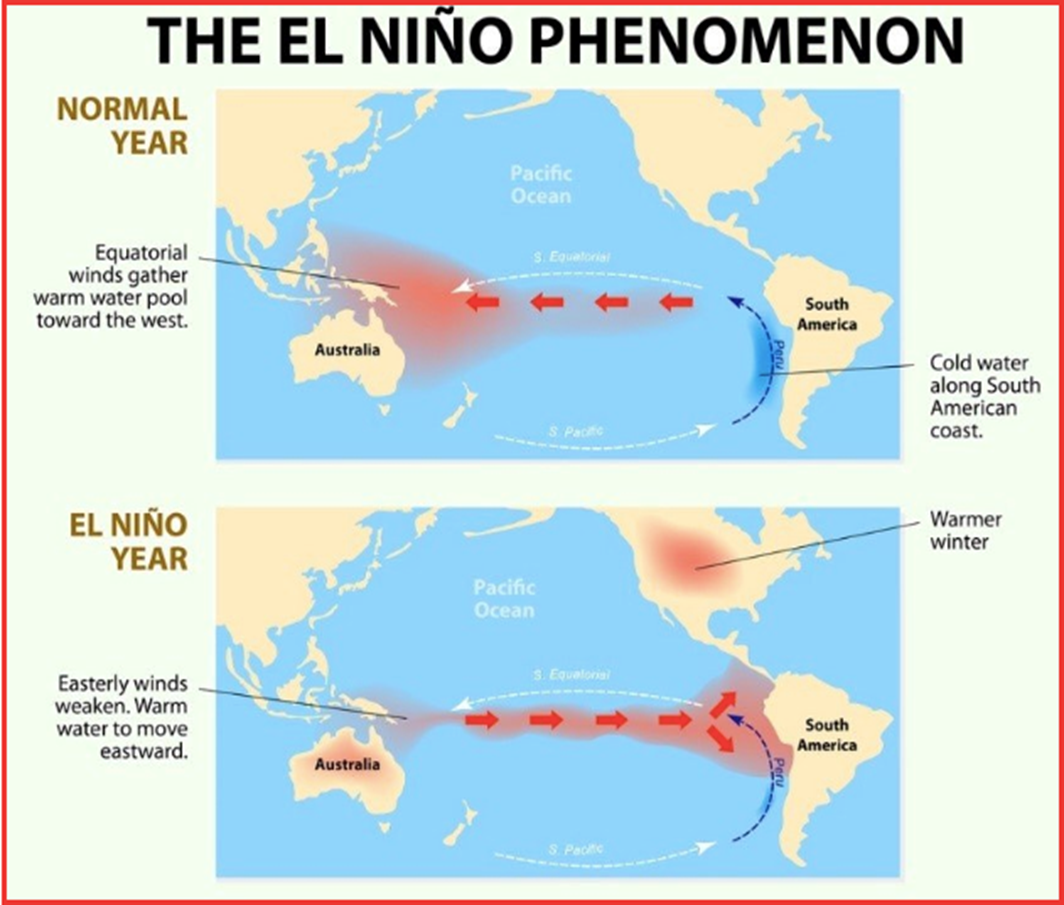
- The traditional Oceanic Niño Index (ONI) and other metrics used by NOAA, WMO, and the India Meteorological Department (IMD) are being adjusted because baseline ocean temperatures have risen so sharply that many recent warming episodes now qualify as “strong” or “very strong” El Niño under old definitions.
- Scientists warn that this re-labelling will lead to more frequent declarations of “very strong” El Niño in the coming decades, with profound implications for global weather patterns, Indian monsoon predictability, agriculture, and disaster management.
What Exactly is Changing?
- Traditional Definition: El Niño is declared when sea surface temperatures (SST) in the Niño 3.4 region (central equatorial Pacific) rise 0.5°C above the 30-year average for 5 consecutive overlapping 3-month periods (ONI ≥ +0.5).
- New Reality: Due to rapid global warming, the baseline (normal) temperature itself has increased by ~0.8–1.0°C since the 1980s–90s. → Many moderate warming events are now crossing the old “strong” (+1.5°C) or “very strong” (+2.0°C) thresholds purely because the entire ocean is warmer.
- Consequence: The same physical intensity of warming now gets labelled as a stronger category of El Niño than before.
- Scientists are debating whether to:
- Shift the baseline to a more recent 30-year period (moving baseline).
- Introduce new absolute thresholds instead of anomaly-based ones.
- Create separate “climate-adjusted” El Niño categories.
Scientific Reason Behind the Change
- Anthropogenic Global Warming: The tropical Pacific Ocean has warmed significantly, raising the “normal” SST baseline.
- A moderate natural El Niño signal superimposed on this higher baseline now appears much stronger in anomaly terms.
- The study (published in a leading journal) shows that without adjustment, future El Niño events will be systematically over-classified, leading to misleading early warnings and policy responses.
Implications for India and the World
For India:
- El Niño is historically linked to weak monsoon and droughts (e.g., 2002, 2009, 2015, 2023).
- More “very strong” labels could trigger unnecessary panic in agriculture planning, water management, and food security policies.
- IMD and Ministry of Earth Sciences will need to recalibrate monsoon forecasting models.
- Increased frequency of declared strong El Niños may affect rural distress, inflation (food prices), and GDP growth.
Global Implications:
- More frequent “very strong” El Niño declarations could influence:
- Global food prices (wheat, rice, soy).
- Extreme weather events (floods in East Africa, droughts in Australia/India).
- Insurance and disaster risk financing models.
- Challenges the reliability of long-term climate projections and early warning systems.
Current Status
- India’s IMD is actively participating in these global scientific deliberations.
- The change is expected to be formalised by mid-2026 or early 2027.
UPSC-CSE / State PCS Relevance
Prelims
- Key concepts: El Niño, La Niña, ENSO, Oceanic Niño Index (ONI), Niño 3.4 region.
- Impact on Indian Summer Monsoon (ISM).
- Institutions: IMD, WMO, NOAA.
GS-1 (Geography)
- Climate phenomena and their impact on Indian agriculture and economy.
GS-3 (Environment & Disaster Management)
- Climate change adaptation and early warning systems.
- Link between global warming and extreme weather classification.
GS-3 (Economy)
- Impact of El Niño on food inflation, rural economy, and GDP.
Essay / Interview
- “Climate change is not just raising temperatures — it is rewriting the rules of global weather systems.”
- India recalibrate its disaster preparedness in an era of shifting climat?”
Que 1. With reference to the recent scientific development on El Niño classification (February 2026), consider the following statements:
- Global temperature spikes have raised the baseline sea surface temperature in the equatorial Pacific.
- This change will lead to more frequent declarations of “very strong” El Niño events.
- The India Meteorological Department (IMD) has already finalised new classification norms independently.
Which of the statements given above is/are correct?
(a) 1 and 2 only
(b) 2 and 3 only
(c) 1 and 3 only
(d) 1, 2 and 3
Answer: (a)
Que 2. The Oceanic Niño Index (ONI) measures sea surface temperature anomalies in which region?
(a) Niño 1+2
(b) Niño 3.4
(c) Niño 4
(d) Indian Ocean Dipole region
Answer: (b)
Que 3. El Niño is typically associated with which of the following impacts on the Indian Summer Monsoon?
(a) Above-normal rainfall
(b) Deficient or below-normal rainfall
(c) No impact
(d) Early onset of monsoon
Answer: (b)
Que 4. The redefinition of El Niño thresholds is primarily driven by:
(a) Changes in ocean current patterns
(b) Anthropogenic global warming raising baseline temperatures
(c) Reduction in solar activity
(d) Volcanic eruptions in the Pacific
Answer: (b)
Que 1. “Global warming is not only intensifying extreme weather events but also fundamentally altering how we classify and predict them.” In the light of the February 2026 development on El Niño redefinition, discuss its implications for India’s monsoon forecasting, agriculture, and disaster management. (15 marks / 250 words)
Que 2. Examine the challenges posed by climate change to traditional meteorological indices like the Oceanic Niño Index (ONI). How should India prepare its climate adaptation strategy in response? (10 marks / 150 words)
Que 3. “The re-labelling of El Niño events due to rising baseline temperatures highlights the urgent need for climate-resilient policy frameworks.” Critically analyse this statement. (15 marks / 250 words)
Essay (250 marks) “From El Niño to Climate Niño: How global warming is rewriting the script of weather extremes and India’s response.”
Why in News?
On 25 February 2026, U.S. President Donald Trump delivered his second State of the Union Address to a joint session of Congress. The speech, widely described by critics as that of a “demagogue salesman”, focused heavily on immigration crackdowns, aggressive tariffs, threats against Iran, and claims of saving the American economy from collapse.
The address came just days after the U.S. Supreme Court struck down his earlier sweeping tariffs imposed under the International Emergency Economic Powers Act (IEEPA), forcing the administration to invoke Section 122 of the Trade Act 1974 as a legal fallback. Analysts say the speech was more campaign-style rhetoric than governance roadmap, deepening political polarisation ahead of the 2026 mid-term elections.
Key Highlights of the Speech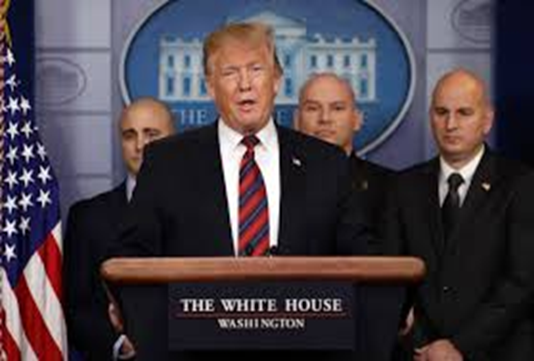
- Immigration: Reiterated plans for mass deportations, border wall expansion, and strict enforcement. Described immigration as an “invasion” threatening American jobs and security.
- Tariffs & Trade: Defended his protectionist policy, claiming it would bring manufacturing back to the U.S. and correct trade imbalances. Announced 15% replacement tariffs under Section 122.
- Iran & Foreign Policy: Issued strong warnings, hinting at possible military action if Iran does not comply with U.S. demands on its nuclear programme.
- Economic Claims: Boasted of saving the U.S. from a “balance of payments crisis” and inflation, despite independent data showing mixed results.
- Tone: Highly confrontational, populist, and divisive — repeatedly attacking “radical left”, media, and previous administrations.
Major Criticisms
- Demagogic Style: Critics (including several U.S. lawmakers and media outlets) called the speech “unfortunate” and accused Trump of prioritising division over unity.
- Economic Reality Check: While Trump claimed success, inflation has only moderated from 9% peak to ~2.9%, and the U.S. still runs a large trade deficit.
- Legal & Constitutional Concerns: The shift from IEEPA to Section 122 tariffs is seen as an attempt to circumvent the Supreme Court ruling.
- International Backlash: Threats against Iran and aggressive tariff policy risk alienating allies and escalating tensions in West Asia.
Implications for the United States
- Domestic: Deepens political divide; may energise Trump’s base but alienate moderates and independents ahead of mid-terms.
- Economic: Continued tariff uncertainty affects global supply chains, inflation, and consumer prices.
- Foreign Policy: Signals return to “America First” unilateralism, straining alliances and multilateral institutions.
Implications for India
- Trade: India is already negotiating under the shadow of U.S. tariffs. The interim trade framework (Feb 2026) may need fresh renegotiation under the new Section 122 regime.
- Energy & West Asia: Any U.S.-Iran escalation could disrupt oil supplies and raise freight/insurance costs for Indian imports.
- Strategic Autonomy: India must carefully balance deepening defence-tech ties with the U.S. while protecting its interests in the Gulf and with Iran (Chabahar Port, INSTC).
- Positive Angle: Strong U.S. focus on countering China may open more opportunities for India in technology, QUAD, and supply-chain diversification.
UPSC-CSE/State PCS Relevance
Prelims
- Key laws: IEEPA 1977, Section 122 of Trade Act 1974.
- Recent events: SC ruling on IEEPA tariffs (23 Feb 2026), Trump’s second State of the Union (25 Feb 2026).
- Terms: Balance of payments deficit, reciprocal tariffs, demagoguery.
GS-2 (International Relations)
- Trump 2.0 foreign policy: Unilateralism, protectionism, and impact on India-U.S. relations.
- India’s multi-alignment in a polarised world.
GS-3 (Economy)
- Impact of U.S. tariffs on global trade, Indian exports, and energy security.
- Link between U.S. domestic politics and global economic stability.
GS-2 (Polity)
- Executive-legislative-judiciary tensions in the U.S. and lessons for Indian constitutionalism.
Essay / Interview
- “The return of aggressive unilateralism: Is the post-1945 liberal order collapsing?”
- “How should India navigate U.S. protectionism under Trump 2.0?”
Que 1. With reference to U.S. President Donald Trump’s 2026 State of the Union Address, consider the following statements:
- The speech was delivered after the Supreme Court struck down tariffs imposed under IEEPA.
- Trump announced 15% replacement tariffs under Section 122 of the Trade Act 1974.
- The address focused primarily on healthcare and climate change reforms.
Which of the statements given above is/are correct?
(a) 1 and 2 only
(b) 2 and 3 only
(c) 1 and 3 only
(d) 1, 2 and 3
Answer: (a)
Que 2. Section 122 of the U.S. Trade Act of 1974 primarily allows the President to impose tariffs in response to:
(a) National security threats
(b) Serious balance of payments deficits
(c) Intellectual property violations
(d) Environmental concerns
Answer: (b)
Que 3. Which of the following issues was NOT a major focus of Trump’s 2026 State of the Union speech?
(a) Immigration enforcement
(b) Tariffs and trade protectionism
(c) Military action against Iran
(d) Comprehensive climate change legislation
Answer: (d)
Que 4. The term “demagogue salesman” used by critics to describe Trump’s speech style refers to:
(a) A leader who promotes unity and consensus
(b) A populist orator who uses emotional appeals and divisive rhetoric to gain support
(c) A technocratic policymaker focused on data-driven governance
(d) A diplomatic statesman prioritising international alliances
Answer: (b)
Que 1. “Donald Trump’s second State of the Union Address (2026) reflects the triumph of populist demagoguery over deliberative governance.” Critically analyse the key themes of the speech and its implications for U.S. domestic politics and global order. (15 marks / 250 words)
Que 2. Examine how U.S. protectionist policies under Trump 2.0, as highlighted in the 2026 State of the Union, pose challenges and opportunities for India’s economic and strategic interests. (15 marks / 250 words)
Que 3. “The weaponisation of trade and immigration policy in Trump’s 2026 address signals the decline of multilateralism.” Discuss with suitable examples and suggest how India should respond. (10 marks / 150 words)
Essay (250 marks) “From Hope to Hard Power: The Transformation of American Global Leadership under Trump 2.0.”
Why in News?
- A pilot noise pollution study conducted in four selected high-traffic zones of Madras (Chennai) during peak hours has revealed average sound intensity levels of 73 decibels (dB) — described as “highly irritating and uncomfortable” by residents — even though these levels fall below the 85 dB threshold considered damaging to hearing.
- The findings, part of a larger multi-city noise mapping initiative by the Department of Science and Technology (DST), Government of India, were published in late February 2026. The study used sophisticated Class-1 sound level meters and involved oto-rhino-laryngologists from Madras Medical College, audiologists, and engineers from IIT Madras.
Key locations surveyed: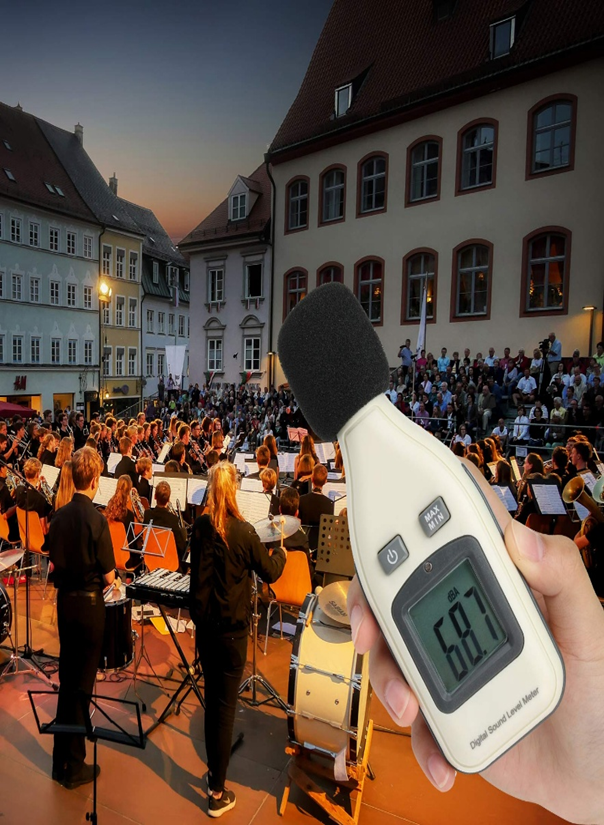
- Anna Nagar Post Office area → 73 dB average
- Central Station vicinity → 71 dB
- General Hospital area → 70 dB
- Parry’s Corner → 70 dB
The study highlighted that two-wheelers and scooters are the dominant sources of peak noise spikes outside the Anna Nagar Post Office, often exceeding 90–100 dB momentarily.
Key Findings of the Pilot Study
- Average daytime levels: 70–73 dB across monitored locations (well below the 85 dB “damaging” threshold but consistently in the “irritating/uncomfortable” zone per WHO and CPCB guidelines).
- Peak noise spikes: Frequently >90 dB due to honking, two-wheeler acceleration, and commercial vehicle movement.
- Comparison with other metros: Madras levels are noticeably lower than peak-hour averages reported in Mumbai (78–82 dB), Kolkata (76–80 dB), and Delhi (75–85 dB) in similar studies.
- Health warning: Even though levels are below immediate hearing-damage thresholds, prolonged exposure (several hours daily) to 70–75 dB can cause:
- Chronic stress
- Sleep disturbance
- Elevated blood pressure
- Cognitive impairment in children
- Tinnitus and early hearing loss over decades
Regulatory Benchmarks in India (for context)
|
Zone |
Daytime Limit (dB) |
Night-time Limit (dB) |
|
Industrial |
75 |
70 |
|
Commercial |
65 |
55 |
|
Residential |
55 |
45 |
|
Silence Zone |
50 |
40 |
Madras commercial/traffic zones surveyed fall under Commercial (65 dB day) or Residential (55 dB day) — meaning 73 dB is a clear violation in most monitored locations.
Broader Context: India’s Urban Noise Pollution Crisis
- CPCB 2024–25 data: Chennai consistently ranks among the top 10 noisiest cities in India (along with Delhi, Mumbai, Kolkata, Bengaluru, Hyderabad).
- WHO guideline: Annual average noise exposure should not exceed 53 dB (day) and 45 dB (night) for residential areas to prevent health effects.
- Sources in Indian cities: Two-wheelers (without silencers), autorickshaws, unnecessary honking, construction, commercial loudspeakers, and traffic congestion.
- Health burden: Noise is now recognised as the second largest environmental cause of health loss after air pollution (Lancet Commission 2022).
Policy & Governance Gaps Highlighted
- Weak enforcement of Noise Pollution (Regulation and Control) Rules, 2000.
- Lack of continuous noise monitoring stations in most cities (only a few in Chennai).
- Poor public awareness — most people consider 70–75 dB “normal traffic sound”.
- Absence of mandatory silencers, honking restrictions, and low-noise road surfaces in high-density corridors.
|
UPSC-CSE/State PCS Relevance |
|
Prelims |
|
|
|
|
|
GS-3 (Environment & Disaster Management) |
|
|
|
GS-3 (Health & Technology) |
|
|
|
GS-2 (Governance) |
|
|
|
Essay / Interview |
|
|
Que 1. With reference to the recent Madras noise pollution pilot study (February 2026), consider the following statements:
- The average noise level recorded in peak hours was 73 dB.
- The study found noise levels significantly higher than those in Mumbai and Kolkata.
- Two-wheelers and scooters were identified as the primary source of peak noise spikes.
Which of the statements given above is/are correct?
(a) 1 and 3 only
(b) 2 and 3 only
(c) 1 and 2 only
(d) 1, 2 and 3
Answer: (a)
Que 2. As per the Noise Pollution (Regulation and Control) Rules, 2000, the daytime permissible noise limit in a commercial area is:
(a) 55 dB
(b) 65 dB
(c) 75 dB
(d) 85 dB
Answer: (b)
Que 3. Which of the following agencies/institutions collaborated on the Madras noise pollution pilot study?
- Madras Medical College (oto-rhino-laryngologists)
- IIT Madras (engineers)
- Central Pollution Control Board (CPCB)
Select the correct answer using the code below:
(a) 1 and 2 only
(b) 2 and 3 only
(c) 1 and 3 only
(d) 1, 2 and 3
Answer: (a)
Que 4. Prolonged exposure to noise levels of 70–75 dB is most likely to cause:
(a) Immediate permanent hearing loss
(b) Chronic stress, sleep disturbance, and elevated blood pressure
(c) No significant health effect
(d) Only temporary threshold shift
Answer: (b)
Que 1. “Noise pollution in Indian cities has crossed the threshold from nuisance to serious public health hazard.” In the light of the recent Madras pilot study, discuss the health, regulatory, and behavioural dimensions of urban noise pollution and suggest a multi-pronged mitigation strategy. (15 marks / 250 words)
Que 2. Critically examine the effectiveness of the Noise Pollution (Regulation and Control) Rules, 2000 in addressing the growing menace of urban noise pollution in India. (10 marks / 150 words)
Que 3. “Technology-led continuous monitoring combined with community awareness and strict enforcement is the only viable path to silence India’s noisy cities.” Evaluate this statement with reference to recent studies and existing governance challenges. (15 marks / 250 words)
Que 4. Essay (250 marks) “Noise: The ignored environmental pollutant silently damaging India’s urban future.”
Why in News?
Exactly 100 years ago, on 25 February 1926, a sub-committee appointed by the Bombay Corporation submitted a hard-hitting report recommending drastic environmental engineering measures to eradicate malaria from the city.
The report — published in newspapers on 26 February 1926 — called for:
- Replacing all open roadside drains with underground stormwater pipes.
- Covering up stormwater pipes and tanks.
- Filling low-lying lands and mills that were breeding mosquitoes.
- Compelling railway companies to fill low-lying lands along railway tracks.
- Holding the Government and all agencies equally accountable under Municipal Law.
This historic document has been highlighted on its centenary (26 February 2026) to draw attention to how little has changed in urban vector control despite a century of scientific progress. India still reports millions of malaria, dengue, and chikungunya cases annually, with urban malaria remaining a persistent challenge in cities like Mumbai, Delhi, Bengaluru, and Chennai.
Key Recommendations of the 1926 Bombay Sub-Committee
- Underground drainage system: Convert all open roadside drains into covered underground pipes to eliminate stagnant water.
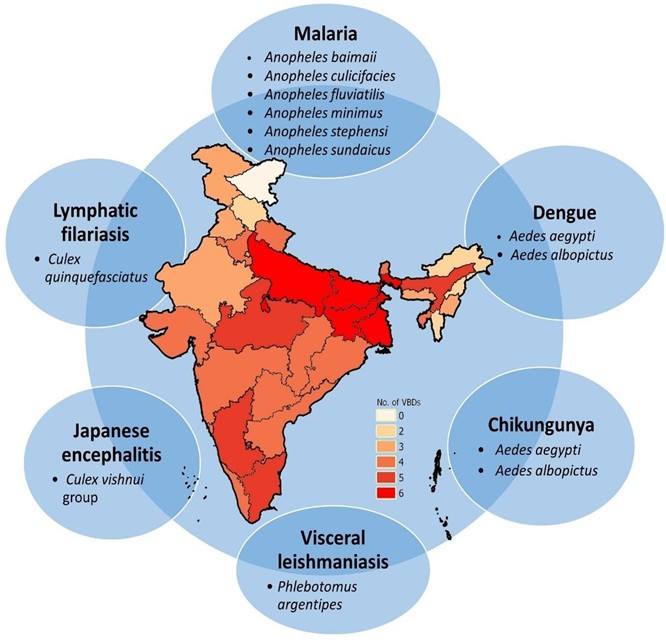
- Filling of low-lying areas: Mandatory reclamation of marshes, swamps, and low-lying lands within city limits.
- Railway accountability: Railways must fill low-lying lands on either side of tracks — no exemption from municipal obligations.
- Strict enforcement: Statutory obligations and liabilities enforceable under Municipal Law against all — including Government departments.
- Holistic approach: Focus on source reduction (environmental management) rather than only curative measures.
Relevance in 2026: Lessons Still Unlearnt
- Urban Malaria Reality Today: Mumbai and other metros continue to report seasonal surges of malaria and dengue due to poor stormwater drainage, clogged nullahs, construction sites, and low-lying unauthorised settlements.
- Climate Change Factor: Rising temperatures and erratic rainfall have expanded mosquito breeding seasons and habitats.
- Policy Continuity Gap: While schemes like Swachh Bharat Mission, AMRUT 2.0, Smart Cities Mission, and National Vector Borne Disease Control Programme (NVBDCP) exist, implementation of source reduction through drainage engineering remains weak in many cities.
- Centenary Reminder: The 1926 report proves that environmental engineering (drainage & land reclamation) has always been the most effective long-term weapon against urban malaria — far more sustainable than repeated fogging or larvicides.
Current Government Initiatives (2026 Context)
- Urban Malaria Action Plan strengthened under NVBDCP.
- AMRUT 2.0 mandates 100% coverage of stormwater drains in cities.
- 15th Finance Commission grants specifically allocated for urban drainage and sanitation.
- National Framework for Malaria Elimination (2016–2030) targets zero indigenous cases by 2030 — drainage improvement is a core strategy.
UPSC-CSE/State PCS Relevance
Prelims
- Historical public health measures (1926 Bombay Malaria Report).
- Vector-borne diseases control strategies.
- Schemes: NVBDCP, AMRUT, Swachh Bharat.
GS-2 (Governance & Health)
- Evolution of urban public health governance from colonial to modern India.
- Centre-State-Municipal coordination in disease control.
GS-3 (Environment & Disaster Management)
- Environmental management as primary tool for vector control.
- Climate change and expansion of mosquito-borne diseases.
GS-1 (Modern History)
- Colonial-era municipal reforms and public health initiatives in Bombay Presidency.
Essay / Interview
- “A century-old drainage solution still holds the key to India’s urban health crisis.”
- “From 1926 Bombay to 2026 Smart Cities: Why environmental engineering remains the forgotten pillar of public health.”
Que 1. With reference to the 1926 Bombay Malaria Report, consider the following statements:
- It recommended replacing open roadside drains with underground stormwater pipes.
- It suggested exempting railway companies from filling low-lying lands.
- It emphasised statutory obligations enforceable under Municipal Law on all agencies including the Government.
Which of the statements given above is/are correct?
(a) 1 and 2 only
(b) 1 and 3 only
(c) 2 and 3 only
(d) 1, 2 and 3
Answer: (b)
Que 2. The 1926 Bombay sub-committee on malaria was appointed by:
(a) Bombay Presidency Government
(b) Bombay Corporation
(c) Viceroy’s Executive Council
(d) Indian Medical Council
Answer: (b)
Que 3. Which of the following is NOT part of the 1926 recommendations for malaria control in Bombay?
(a) Filling low-lying lands
(b) Covering stormwater pipes and tanks
(c) Mandatory fogging with chemical insecticides
(d) Holding railway companies accountable for track-side low-lying areas
Answer: (c)
Que 4. The National Vector Borne Disease Control Programme (NVBDCP) primarily focuses on which of the following?
(a) Only curative treatment of malaria
(b) Integrated vector management including environmental management
(c) Exclusive use of vaccines
(d) International travel restrictions only
Answer: (b)
Que 1. “The 1926 Bombay Malaria Report remains astonishingly relevant in 2026 because India has failed to implement the most fundamental environmental engineering solutions for vector control.” Critically examine the recommendations of the 1926 report and discuss why Indian cities continue to struggle with urban malaria and dengue despite multiple national schemes. (15 marks / 250 words)
Que 2. Discuss the evolution of vector-borne disease control strategies in India from the colonial period to the present. What lessons can be drawn from the 1926 Bombay recommendations for achieving the National Framework for Malaria Elimination target of 2030? (15 marks / 250 words)
Que 3. “Urban drainage is not merely an infrastructure issue but the first line of defence in public health.” In the light of the centenary of the 1926 Bombay Malaria Report, analyse the statement. (10 marks / 150 words)
Essay (250 marks) “From Open Drains to Underground Pipes: How a 100-Year-Old Prescription Can Cure India’s Urban Health Crisis.”
Why in News?
Prime Minister Narendra Modi is scheduled to undertake a standalone bilateral visit to Israel in the last week of February or early March 2026 — his first visit since 2017.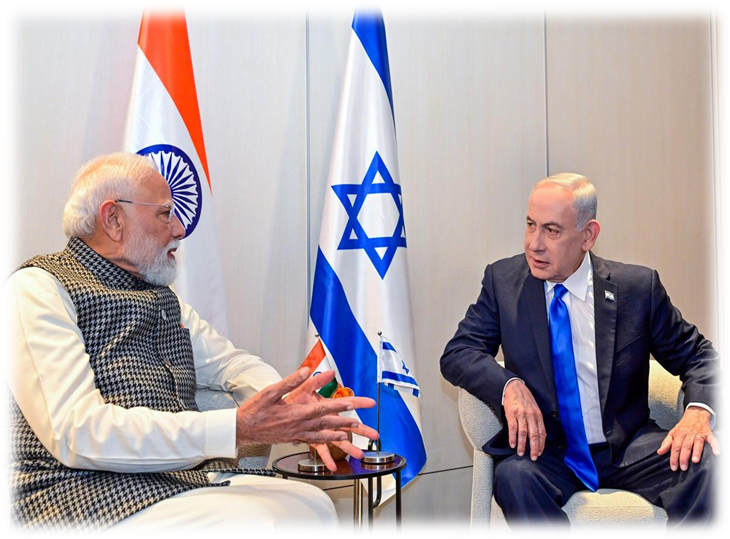
The timing is extremely sensitive:
- It comes days after India joined more than 100 countries at the United Nations in criticising Israel’s actions and settlement expansion in the West Bank.
- Israeli PM Benjamin Netanyahu is expected to use the visit to push for a “hexagonal alliance” involving India, Greece, Cyprus and some Arab/African countries against “radical Sunni and Shia axes” — a proposal that could strain India’s ties with Iran, Saudi Arabia, Qatar and Türkiye.
- The visit will also focus on upgrading defence, security, trade, technology, AI, labour mobility and the India-Middle East-Europe Economic Corridor (IMEC).
Key Agenda of the Visit
- Bilateral meeting with PM Netanyahu.
- Address to the Knesset (Israeli Parliament).
- Interaction with Indian-Jewish diaspora.
- Visit to Yad Vashem Holocaust Memorial.
- Possible joint statement and multiple MoUs on defence, cyber security, agriculture, water technology and IMEC connectivity.
The Balancing Act: Strategic Partnership vs. West Bank Stance
Strong Strategic Partnership:
- Defence & security remains the cornerstone (India is Israel’s largest arms buyer — Heron drones, Barak missiles, Spike anti-tank systems, etc.).
- Trade has grown steadily: India imports diamonds, refined petroleum, electronics; exports refined products, chemicals, textiles.
- Technology collaboration in AI, cybersecurity, agriculture and water management.
- IMEC project (India–Israel–UAE–Saudi–Europe corridor) is a strategic counter to China’s BRI.
Diplomatic Tightrope:
- India voted with the majority at the UN criticising Israeli settlement policies in the West Bank.
- India continues to support the two-state solution and Palestinian cause.
- Strong economic and diaspora ties with Gulf countries (Saudi, UAE, Qatar) and functional engagement with Iran (Chabahar Port).
- Any perception of India joining an “anti-Iran” or “anti-Islamic axis” could damage these vital relationships.
India-Israel Bilateral Snapshot (Key Data)
- Defence: India accounts for ~40–45% of Israel’s arms exports in recent years.
- Trade (2025): ~$10–12 billion; diamonds dominate imports, refined products and chemicals dominate exports.
- Investments: Israeli companies heavily invested in Indian startups, agritech, water management and cybersecurity.
- People-to-People: Growing Indian student and professional community in Israel; strong Indian-Jewish diaspora.
Strategic Significance for India
- Defence & Technology: Access to cutting-edge Israeli systems remains critical for border security and counter-terrorism.
- Energy & Connectivity: IMEC offers an alternative corridor bypassing China-dominated routes.
- Strategic Autonomy: India is successfully balancing deepening ties with Israel while maintaining its traditional support for Palestine and strong Gulf relations — a classic example of multi-alignment.
- Challenges: Any escalation in West Bank/Gaza or US-Iran conflict could disrupt oil supplies and raise shipping costs for India.
|
UPSC-CSE/State PCS Relevance |
|
Prelims |
|
|
|
GS-2 (International Relations) |
|
|
|
|
GS-3 (Economy & Security) |
|
|
|
|
Essay / Interview |
|
|
Que 1. With reference to PM Modi’s proposed visit to Israel in 2026, consider the following statements:
- It is his first visit to Israel as Prime Minister.
- The visit comes after India voted with over 100 countries criticising Israel’s West Bank policies at the UN.
- Netanyahu is expected to push for a “hexagonal alliance” involving India during the visit.
Which of the statements given above is/are correct?
(a) 1 only
(b) 2 and 3 only
(c) 1 and 3 only
(d) 1, 2 and 3
Answer: (b)
Que 2. Which of the following is NOT a major area of cooperation between India and Israel?
(a) Defence and security
(b) Agriculture and water management technology
(c) IMEC connectivity project
(d) Joint military bases in the Gulf
Answer: (d)
Que 3. India’s vote at the UN criticising Israel’s moves in the West Bank reflects India’s continued support for:
(a) One-state solution
(b) Two-state solution
(c) Complete diplomatic isolation of Israel
(d) Abraham Accords
Answer: (b)
Que 4. IMEC stands for:
(a) India-Middle East-Europe Economic Corridor
(b) Israel-Mediterranean-Europe Corridor
(c) Indo-Pacific Maritime Energy Corridor
(d) International Maritime Energy Corridor
Answer: (a)
Que 1. “Prime Minister Modi’s 2026 Israel visit is a masterclass in multi-alignment diplomacy.” Examine how India is balancing its deepening strategic partnership with Israel and its traditional support for the Palestinian cause amid West Bank tensions. (15 marks / 250 words)
Que 2. Discuss the strategic importance of the India-Middle East-Europe Economic Corridor (IMEC) in the context of PM Modi’s upcoming Israel visit and India’s broader West Asia policy. (10 marks / 150 words)
Que 3. “In a highly polarised West Asia, India’s ability to maintain strong ties with Israel while preserving relations with the Gulf and Iran is a test of its strategic autonomy.” Critically analyse this statement. (15 marks / 250 words)
Essay (250 marks) “Walking the Tightrope: India’s West Asia Diplomacy in the Era of Great Power Rivalry.”
Why in News?
A comprehensive analysis published on 26 February 2026 has brought Carbon Capture and Utilisation (CCU) technologies into sharp national focus as India grapples with its status as the world’s third-largest carbon emitter.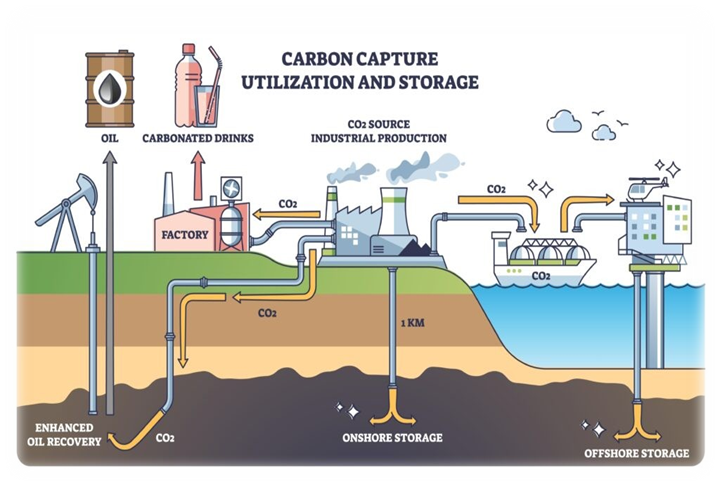
The article highlights how CCU can transform captured CO₂ from industrial sources or even ambient air into valuable products such as fuels, chemicals, building materials, and fertilisers — turning a liability into an economic asset.
With India’s emissions driven largely by power generation, cement, steel, and chemicals, and with the country committed to reaching net-zero by 2070, CCU is emerging as a critical tool in hard-to-abate sectors where complete decarbonisation through renewables alone is technically or economically challenging. The piece also draws attention to the EU’s aggressive Bioeconomy Strategy and Circular Economy Action Plan, urging India to accelerate its own CCU roadmap.
What is Carbon Capture and Utilisation (CCU)?
CCU refers to a set of technologies that:
- Capture CO₂ from point sources (power plants, cement kilns, steel plants) or directly from the air (Direct Air Capture – DAC).
- Convert the captured CO₂ into useful products through chemical, biological, or mineralisation processes.
Key Pathways:
- Chemical conversion: CO₂ + hydrogen → synthetic fuels (e-fuels), methanol, urea.
- Mineralisation: CO₂ + minerals → construction materials (concrete, aggregates).
- Biological utilisation: CO₂ used by algae or bacteria to produce biofuels, proteins, or bioplastics.
Unlike Carbon Capture and Storage (CCS), which focuses only on permanent underground storage, CCU creates economic value by putting carbon back into the economy — aligning with the principles of a circular carbon economy.
Why India Needs CCU Urgently
- India is the third-largest emitter globally (after China and the US).
- Hard-to-abate sectors (cement, steel, chemicals, fertilisers) account for nearly 40% of India’s industrial emissions and cannot be fully decarbonised through electrification or renewables in the near term.
- CCU offers a dual benefit: emission reduction + new revenue streams (green chemicals, sustainable aviation fuels, carbon-based materials).
- It supports Atmanirbhar Bharat by reducing dependence on imported fossil-based chemicals and fuels.
- Aligns with India’s Net-Zero by 2070 and Panchamrit commitments at COP26.
Global & EU Approach
- European Union: Leading through its Bioeconomy Strategy and Circular Economy Action Plan. The EU is using carbon contracts for difference, tax credits, and mandates to scale CCU, particularly for producing sustainable aviation fuel and chemicals.
- United States: Inflation Reduction Act provides tax credits up to $85 per tonne for CCU.
- China: Heavy investment in CCU for coal-to-chemicals and synthetic fuels.
- Common Challenge: High energy intensity and cost remain the biggest barriers worldwide.
India’s Current Efforts & Roadmap
- Department of Science & Technology (DST): Funding research on CO₂ to methanol, CO₂ to polymers, and mineralisation.
- Ministry of Petroleum & Natural Gas: Working on CO₂ utilisation for enhanced oil recovery and synthetic fuels.
- Industry Initiatives: Companies like NTPC, Reliance, and Tata Steel are piloting CCU projects.
- Draft Roadmap: The government is preparing a comprehensive CCU roadmap for hard-to-abate sectors, expected to be finalised in 2026.
- Policy Push Needed: Carbon pricing, mandatory utilisation targets, green hydrogen integration, and international carbon credit mechanisms.
Major Challenges
- High Cost: Current CCU technologies are 2–5 times more expensive than conventional processes.
- Energy Intensity: Requires large amounts of green hydrogen or renewable electricity.
- Scalability: Most projects are still at pilot or demonstration stage.
- Regulatory Vacuum: No clear standards for CO₂-derived products or carbon accounting framework.
- Market Creation: Lack of demand pull for CCU products.
Way Forward for India
- Integrate CCU into National Green Hydrogen Mission and Perform, Achieve & Trade (PAT) scheme.
- Introduce Carbon Take-Back Obligation or utilisation mandates for emitters.
- Develop national standards for CCU products and carbon removal certification.
- Leverage international partnerships (Mission Innovation, bilateral CCU projects with EU, US, Japan).
- Focus on low-hanging fruits: CO₂ to urea, methanol, and construction materials.
UPSC-CSE/State PCS Relevance
Prelims
- Key terms: CCU vs CCS, Direct Air Capture (DAC), Net-Zero 2070, Panchamrit.
- Related missions: National Green Hydrogen Mission, National Mission on Sustainable Habitat.
GS-3 (Environment & Economy)
- Hard-to-abate sectors and decarbonisation pathways.
- Circular economy and green growth strategies.
GS-2 (Governance)
- Policy framework for emerging green technologies.
- International climate cooperation and technology transfer.
GS-3 (Science & Technology)
- Role of CCU in achieving energy transition and industrial decarbonisation.
Essay / Interview
- “Carbon Capture and Utilisation: From climate liability to economic opportunity for India.”
- “Can technology turn India’s emission challenge into a green growth engine?”
Que 1. With reference to Carbon Capture and Utilisation (CCU), consider the following statements:
- CCU involves capturing CO₂ and converting it into useful products such as fuels and chemicals.
- Unlike CCS, CCU creates economic value by putting carbon back into the economy.
- India’s hard-to-abate sectors like cement and steel are ideal candidates for CCU deployment.
Which of the statements given above is/are correct?
(a) 1 only
(b) 1 and 2 only
(c) 2 and 3 only
(d) 1, 2 and 3
Answer: (d)
Que 2. Which of the following is NOT a major application of captured CO₂ under CCU technologies?
(a) Production of synthetic fuels
(b) Manufacturing of construction materials
(c) Permanent underground storage
(d) Production of urea and methanol
Answer: (c) (this is CCS, not CCU)
Que 3. India has committed to achieving net-zero emissions by which year?
(a) 2050
(b) 2060
(c) 2070
(d) 2080
Answer: (c)
Que 4. The EU is promoting CCU technologies primarily through which of the following strategies?
(a) Paris Agreement
(b) Bioeconomy Strategy and Circular Economy Action Plan
(c) REPowerEU Plan only
(d) Carbon Border Adjustment Mechanism
Answer: (b)
Que 1. “Carbon Capture and Utilisation (CCU) represents a strategic opportunity for India to reconcile its developmental needs with climate commitments.” Discuss the potential of CCU in hard-to-abate sectors and the policy measures required to scale it up. (15 marks / 250 words)
Que 2. Differentiate between Carbon Capture and Storage (CCS) and Carbon Capture and Utilisation (CCU). Why is CCU considered more aligned with the principles of circular economy for a developing country like India? (10 marks / 150 words)
Que 3. “India cannot afford to treat CCU as a luxury technology.” In the light of recent global developments, critically examine the challenges and roadmap for mainstreaming CCU in India’s energy and industrial transition. (15 marks / 250 words)
Essay (250 marks) “Turning Carbon from Curse to Currency: The Role of CCU in India’s Journey to Viksit Bharat and Net-Zero 2070.”
Why in News?
On 26 February 2026, Bengaluru-based Sarvam AI made headlines by successfully training two powerful Large Language Models (LLMs) — Sarvam and OpenHathi — entirely on Indian soil using Indian capital, Indian data, and a cost-effective Mixture of Experts (MoE) architecture.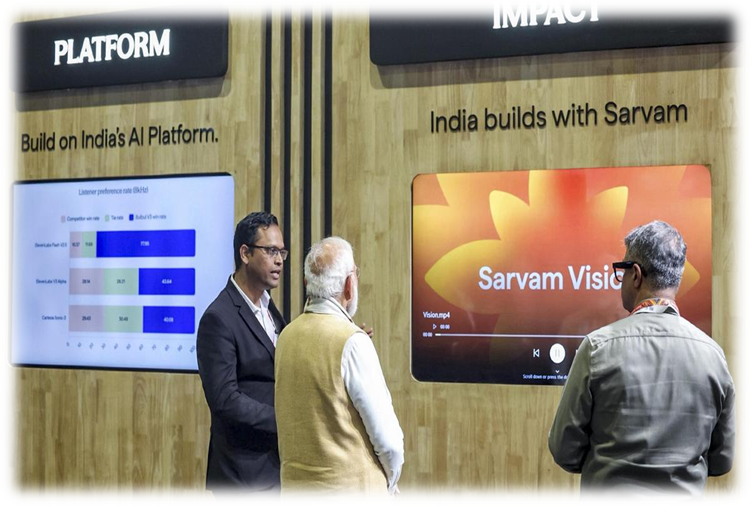
The development has been hailed as a landmark in India’s journey towards AI sovereignty. Sarvam’s models have demonstrated performance comparable to global frontier models while costing significantly less, proving that India can build high-quality LLMs without relying on expensive foreign GPUs or datasets.
This breakthrough comes at a time when the IndiaAI Mission is actively pushing for indigenous LLM development, especially in Indian languages, to reduce dependence on foreign AI models like GPT, Claude, or Llama.
Sarvam AI’s Breakthrough
- Sarvam Model: Trained on 3 trillion parameters.
- OpenHathi Model: Trained on 1.05 trillion parameters.
- Both models were trained in India using 36,000 GPUs hosted in data centres operated by Yotta and other Indian providers.
- Total training cost was substantially lower than comparable global models (estimated at a fraction of the hundreds of millions of dollars spent by OpenAI or Anthropic).
- The models show strong performance in Indian languages (Hindi, Tamil, Telugu, etc.) and English, with better cultural context understanding.
Key Innovation: Use of Mixture of Experts (MoE) architecture, which activates only a small fraction of parameters for each query, making training and inference far more efficient and cost-effective than traditional “dense” models like GPT or Llama.
Why Mixture of Experts (MoE) Architecture Matters
- In MoE, the model has many “expert” sub-networks; only the most relevant experts are activated for a given input.
- This leads to:
- Lower training and inference costs.
- Higher efficiency (faster responses).
- Ability to scale to trillions of parameters without proportional increase in compute.
- Sarvam’s successful implementation of MoE at scale has proven that Indian startups can compete with global giants even with limited resources.
Role of IndiaAI Mission
- The IndiaAI Mission (₹10,172 crore outlay) is providing compute infrastructure, datasets, and funding support for indigenous LLM development.
- It has encouraged companies to train models on Indian soil using Indian data centres.
- Focus areas: Indian language models, sovereign AI capabilities, and reducing dependence on foreign LLMs for critical applications (governance, healthcare, education, defence).
Challenges Highlighted
- High Electricity Costs: Training LLMs requires massive power; India’s electricity tariffs make it more expensive than in the US or Middle East.
- Data Scarcity: High-quality, diverse Indian language datasets are still limited.
- GPU Availability: India still depends on imported high-end GPUs due to US export controls on advanced chips to certain countries.
- Talent Retention: Risk of top AI researchers moving abroad.
Strategic Significance for India
- Digital Sovereignty: Reduces reliance on foreign AI models that may have biases or data privacy issues.
- Economic Opportunity: Positions India as a global hub for cost-effective, multilingual AI development.
- National Security: Sovereign LLMs are critical for defence, governance, and sensitive applications.
- Global Leadership: India can emerge as the voice of the Global South in AI governance and provide affordable AI solutions to developing nations.
UPSC-CSE/State PCS Relevance
Prelims
- Key terms: Large Language Models (LLMs), Mixture of Experts (MoE) architecture, IndiaAI Mission.
- Companies: Sarvam AI, OpenHathi.
- Related schemes: IndiaAI Mission (2024–25).
GS-3 (Science & Technology)
- Artificial Intelligence and emerging technologies.
- Indigenous development of frontier technologies.
GS-2 (Governance)
- Digital sovereignty and data localisation.
- Role of government missions in technology leadership.
GS-3 (Economy)
- Cost-effective innovation models (MoE architecture).
- India as a global AI talent and compute hub.
Essay / Interview
- “India’s AI Moment: From Consumer to Creator of World-Class Large Language Models.”
- “Sovereign AI: The new frontier of national power in the 21st century.”
Que 1. With reference to recent developments in Indian AI, consider the following statements:
- Sarvam AI has trained LLMs named Sarvam and OpenHathi entirely on Indian soil.
- The Mixture of Experts (MoE) architecture is more compute-efficient than dense models like GPT.
- The IndiaAI Mission is providing compute infrastructure and funding for indigenous LLM development.
Which of the statements given above is/are correct?
(a) 1 only
(b) 1 and 2 only
(c) 2 and 3 only
(d) 1, 2 and 3
Answer: (d)
Que 2. The Mixture of Experts (MoE) architecture primarily helps in:
(a) Increasing model size without additional training data
(b) Reducing computational cost by activating only relevant experts for each query
(c) Improving accuracy in image recognition tasks
(d) Enhancing data privacy during training
Answer: (b)
Que 3. Which of the following is NOT a major challenge in training LLMs in India?
(a) High electricity costs
(b) Limited high-quality Indian language datasets
(c) Lack of GPU availability due to export controls
(d) Absence of government support through IndiaAI Mission
Answer: (d)
Que 4. The IndiaAI Mission was launched with an outlay of:
(a) ₹5,000 crore
(b) ₹10,172 crore
(c) ₹15,000 crore
(d) ₹20,000 crore
Answer: (b)
Que 1. “Sarvam AI’s breakthrough in training trillion-parameter LLMs using Mixture of Experts architecture marks India’s arrival as a serious player in sovereign AI development.” Discuss the significance of this development and the role of the IndiaAI Mission in building India’s AI ecosystem. (15 marks / 250 words)
Que 2. Examine the advantages of Mixture of Experts (MoE) architecture over traditional dense models in training Large Language Models. How does this innovation help a resource-constrained country like India? (10 marks / 150 words)
Que 3. “Developing sovereign Large Language Models is not just a technological goal but a strategic necessity for India.” Critically analyse the challenges and opportunities in building indigenous LLMs, with special reference to Sarvam AI’s recent success. (15 marks / 250 words)
4. Essay (250 marks) “From Data Consumer to AI Creator: India’s Quest for Sovereign Large Language Models in the Global AI Race.”
Why in News?
On 24 February 2026, the United States imposed a massive 126% levy (anti-dumping + countervailing duties) on solar cell imports from India, Indonesia, and Laos following a preliminary determination by the US Department of Commerce that Indian firms were exporting subsidized solar products, hurting American manufacturers. 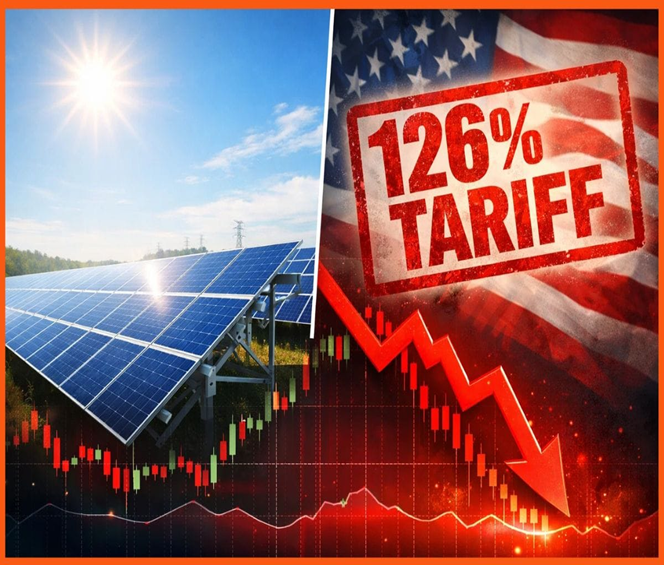
This is the highest tariff imposed on Indian solar products in recent years and comes just weeks after the US Supreme Court struck down earlier Trump tariffs under IEEPA, forcing the administration to use alternative legal routes. The move threatens to wipe out a significant portion of India’s fast-growing solar exports to the US, which had surged from $1 billion in FY23 to much higher volumes in 2024.
Key Details of the US Tariff Action
- Tariff Rate: Up to 125.87% (preliminary) on solar cells from certain Indian firms.
- Affected Companies: Mundra Solar PV Ltd (part of Adani Group), Waaree Energies, Vikram Solar, and others.
- Legal Basis: Anti-dumping and countervailing duty investigation initiated on a complaint by the Alliance for American Solar Manufacturing and Trade.
- Timeline: Preliminary duties effective immediately; final determination expected on 6 July 2026.
- Previous Exports: In 2024, India exported solar cells/modules worth over $1.5–2 billion to the US, with volumes rising sharply from 232 MW (2022) to 2,297 MW (2024).
Background & Trigger
- The US has been aggressively protecting its domestic solar manufacturing under the Inflation Reduction Act (IRA) and “America First” policy.
- Indian solar firms benefited from lower production costs, government incentives (PLI scheme), and cheap Chinese components (despite US restrictions on Chinese solar).
- The US Commerce Department found evidence of subsidies and dumping (selling below fair value), leading to the 126% levy.
- This follows a pattern: similar high tariffs were earlier imposed on Chinese, Vietnamese, and Cambodian solar products.
Impact on India
Negative:
- Major blow to Indian solar manufacturers who had scaled up exports to the US market.
- Companies like Adani, Waaree, and Vikram Solar will see sharp revenue loss and possible idle capacity.
- Threatens jobs in Gujarat (Mundra), Rajasthan, and other solar manufacturing hubs.
- May slow down India’s solar module export ambitions under the PLI Scheme.
Strategic Challenge:
- Forces India to diversify export markets (Europe, Middle East, Africa, Latin America).
- Highlights vulnerability of export-oriented manufacturing to sudden protectionist moves.
- May accelerate push for fully indigenous value chain (from polysilicon to modules) under Atmanirbhar Bharat.
India’s Response & Way Forward
- The government is expected to challenge the duties at the WTO and explore bilateral negotiations with the US.
- Strengthening domestic demand through PM Surya Ghar Muft Bijli Yojana and rooftop solar push.
- Accelerating PLI Scheme 2.0 for deeper localisation.
- Exploring alternative markets and free trade agreements (FTAs) with tariff-free access.
Broader Implications
- Signals rising protectionism under Trump 2.0, affecting green energy supply chains globally.
- Reinforces the need for supply chain diversification and technological self-reliance.
- For India, it is a wake-up call to move beyond assembly to full manufacturing of solar cells and polysilicon.
UPSC-CSE/State PCS Relevance
Prelims
- Key terms: Anti-dumping duty, Countervailing duty, PLI Scheme, Solar module exports.
- Recent event: US 126% tariff on Indian solar cells (24 Feb 2026).
- Schemes: PM Surya Ghar Muft Bijli Yojana.
GS-2 (International Relations)
- Impact of US protectionism on India–US trade relations.
- India’s response to unilateral tariff actions (WTO route vs. bilateral talks).
GS-3 (Economy & Environment)
- Green energy exports and their vulnerability to trade wars.
- Need for self-reliance in critical sectors (solar manufacturing).
GS-3 (Science & Technology)
- Atmanirbhar Bharat in renewable energy technology.
Essay / Interview
- “Protectionism in green tech: Can India shield its solar ambitions from Trump’s tariff storm?”
- “From import dependence to export powerhouse: Challenges before India’s solar industry.”
Que 1. With reference to the US tariffs on Indian solar cells (February 2026), consider the following statements:
- The US imposed a 126% levy on solar cell imports from India, Indonesia and Laos.
- The tariffs were imposed under the anti-dumping and countervailing duty provisions.
- In 2024, India exported over 2,000 MW of solar cells to the US.
Which of the statements given above is/are correct?
(a) 1 and 2 only
(b) 2 and 3 only
(c) 1 and 3 only
(d) 1, 2 and 3
Answer: (d)
Que 2. The US tariff action on Indian solar cells was triggered by a complaint filed by:
(a) US Department of Energy
(b) Alliance for American Solar Manufacturing and Trade
(c) World Trade Organization
(d) Indian Solar Manufacturers Association
Answer: (b)
Que 3. Which of the following Indian states hosts the Mundra Solar PV plant that is likely to be significantly impacted?
(a) Rajasthan
(b) Gujarat
(c) Tamil Nadu
(d) Karnataka
Answer: (b)
Que 4. The final determination of the US anti-dumping and countervailing duty investigation on Indian solar cells is scheduled for:
(a) April 2026
(b) July 6, 2026
(c) December 2026
(d) March 2027
Answer: (b)
Que 1. “The US imposition of 126% tariffs on Indian solar cells in February 2026 exposes the vulnerability of India’s green export strategy to unilateral protectionism.” Critically analyse the causes, immediate impact, and long-term strategic lessons for India. (15 marks / 250 words)
Que 2. Discuss the challenges and opportunities for India’s solar manufacturing sector in the wake of rising US protectionism. How can India achieve true Atmanirbharta in the solar value chain? (15 marks / 250 words)
Que 3. “Tariff wars in green technologies threaten global climate goals.” In the light of the recent US action against Indian solar imports, examine the statement and suggest India’s diplomatic and policy response. (10 marks / 150 words)
Essay (250 marks) “Green Protectionism: How US tariffs on Indian solar cells could reshape India’s renewable energy future.”
Why in News?
On 26 February 2026, the Reserve Bank of India (RBI) released its quarterly analysis of the performance of private non-financial companies for the third quarter of FY26 (October–December 2025).
The data shows that the net profit after tax (PAT) of private non-financial companies rose by 5.2% to ₹81.3 lakh crore in Q3 FY26 compared to ₹77.2 lakh crore in the corresponding quarter of the previous year.
This modest but steady growth comes at a time when private capital expenditure remains subdued, foreign institutional investors are pulling out, and concerns over slowing economic momentum are rising. The RBI data has become crucial for assessing the health of corporate India and the effectiveness of government reforms.
Key Highlights from RBI Data (Q3 FY26)
- Net Profit Growth: +5.2% YoY to ₹81.3 lakh crore.
- Sales Revenue Growth: Strongest pace in eleven quarters, rising 10% YoY to ₹914 lakh crore.
- Manufacturing Sector Performance:
- Cohort of 1,700 manufacturers saw profit growth of 11.4%.
- Sales revenue increased at the fastest pace in eleven quarters.
- Cost Trends:
- Fuel costs reduced for the third consecutive quarter.
- Raw material costs and staffing costs increased modestly.
- Overall Coverage: Analysis based on over 3,100 companies, of which sales revenue of 914 companies came from the top of a 10% rise.
Positive Signals
- Revenue Momentum: Strongest sales growth in nearly three years indicates improving demand, especially from improved sales of manufactured goods.
- Profitability Resilience: Despite rising input costs, companies managed to protect margins through better pricing power and operational efficiency.
- Manufacturing Revival: The 11.4% profit growth in the manufacturing cohort is encouraging and aligns with government’s “Make in India” and PLI schemes.
Areas of Concern
- Subdued Private Capex: Despite profit growth, private sector investment remains weak — a key reason cited for FII exodus from Indian stocks.
- Slow Transmission: Corporate earnings improvement has not yet translated into higher capital expenditure or employment generation.
- External Vulnerabilities: Global uncertainties (US tariffs, geopolitical tensions) and high interest rates continue to weigh on investment decisions.
Implications for Indian Economy
- Positive for Markets: Steady profit growth may provide some support to equity markets in the short term.
- Policy Signal: Reinforces the need for continued focus on capex (both government and private), lower interest rates, and structural reforms to boost investment.
- Inflation & Growth Balance: Moderate profit growth without sharp cost pressures is a good sign for controlled inflation and sustained GDP growth.
- FII Outlook: Data may help stem some FII selling if accompanied by positive triggers on capex and policy continuity.
UPSC-CSE/State PCS Relevance
Prelims
- Key terms: Net Profit After Tax (PAT), Corporate Performance Analysis by RBI, Q3 FY26.
- Related concepts: Private Capex, FII flows, Corporate Earnings.
GS-3 (Economy)
- Corporate sector performance and its linkage to overall economic growth.
- Private investment as a driver of economic recovery.
- RBI’s role in monitoring corporate health.
GS-3 (Indian Economy)
- Challenges of reviving private capex in a high-interest-rate environment.
- Impact of global factors on Indian corporate profitability.
Essay / Interview
- “Profit growth without investment revival: Is India Inc turning cautious or complacent?”
- “Corporate earnings data as a mirror to India’s economic health.”
Que 1. With reference to the RBI’s corporate performance data for Q3 FY26, consider the following statements:
- Net profit of private non-financial companies increased by 5.2% year-on-year.
- Sales revenue registered its strongest growth in eleven quarters.
- The cohort of 1,700 manufacturers recorded 11.4% profit growth.
Which of the statements given above is/are correct?
(a) 1 only
(b) 1 and 2 only
(c) 2 and 3 only
(d) 1, 2 and 3
Answer: (d)
Que 2. According to the RBI data released in February 2026, fuel costs for manufacturers reduced for:
(a) The first time in two years
(b) The third consecutive quarter
(c) Only one quarter
(d) The entire FY26
Answer: (b)
Que 3. The RBI’s analysis of private non-financial companies covers approximately how many companies?
(a) Over 1,000
(b) Over 3,100
(c) Over 5,000
(d) Only listed companies
Answer: (b)
Que 4. Which of the following is cited as a reason for foreign institutional investor (FII) exodus from Indian stocks in recent months?
(a) Rising corporate profits
(b) Subdued private capital expenditure
(c) Strong export growth
(d) Falling inflation
Answer: (b)
Que 1. “A 5.2% rise in private sector net profit in Q3 FY26 signals resilience but masks deeper concerns over private investment.” In the light of the latest RBI corporate data, critically examine the health of India Inc and suggest measures to revive the private capex cycle. (15 marks / 250 words)
Que 2. Discuss the significance of RBI’s quarterly corporate performance data as a leading indicator of economic activity. How does subdued private investment despite profit growth impact India’s growth trajectory? (10 marks / 150 words)
Que 3. “Corporate profit growth without corresponding investment revival reflects caution rather than confidence.” Analyse this statement in the context of Q3 FY26 RBI data and its implications for employment and long-term economic growth. (15 marks / 250 words)
Essay (250 marks) “Profit Without Investment: Is India Inc Ready for the Next Growth Leap?”
Why in News?
On 26 February 2026, the Committee to Protect Journalists (CPJ) released its annual report declaring 2025 as the deadliest year for journalists since it began systematic tracking more than three decades ago.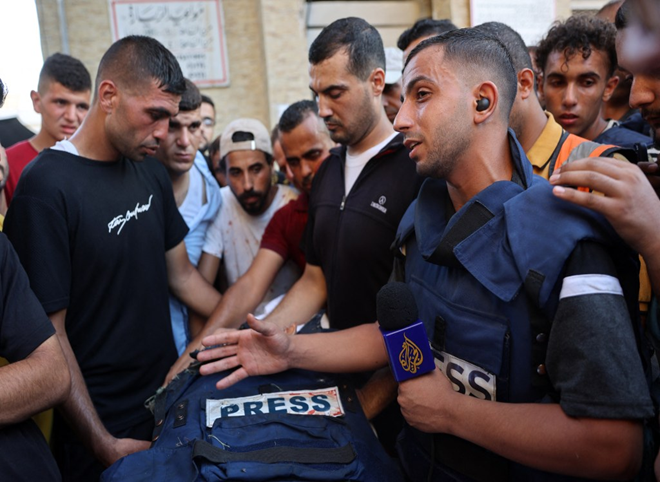
A staggering 129 journalists and media workers were killed worldwide in 2025 — the second consecutive year of record fatalities.
The CPJ held Israel responsible for two-thirds of these deaths, stating that more than 60% of the 86 journalists killed by Israeli fire were Palestinian journalists reporting from Gaza. The report highlights a “persistent culture of impunity” and warns that journalists are increasingly vulnerable due to lack of transparent investigations into such killings.
The findings come amid ongoing conflicts in Gaza, Ukraine, and Sudan, and have triggered global calls for accountability and protection of media professionals in war zones.
Key Findings of the CPJ Report 2025
- Total Killings: 129 journalists and media workers killed globally in 2025.
- Israel’s Share: Responsible for two-thirds of the total deaths.
- Gaza Focus: Over three-quarters of all 2025 fatalities occurred in conflict settings, with the vast majority in Gaza.
- Palestinian Journalists: More than 60% of the 86 killed by Israeli fire were Palestinians reporting from Gaza.
- Drone Attacks: Sharp rise in journalist deaths by drones in Ukraine and Sudan.
- Impunity: Very few cases led to credible investigations or prosecutions — creating a dangerous environment where targeting journalists goes unpunished.
- Trend: 2025 marked the second straight year of record press deaths, surpassing previous highs.
CPJ’s Strong Observations
- “Journalists are being killed in record numbers at a time when access to information is more important than ever.”
- “We are all at risk.”
- The Israeli military maintains it never deliberately targets journalists, but CPJ says this claim is “based on general allegations” without transparent investigations.
- The report flags increased use of drones and deliberate targeting of media workers covering conflicts.
Broader Implications
- Press Freedom Erosion: Highlights growing threats to independent journalism in conflict zones.
- Accountability Deficit: Culture of impunity encourages further attacks on media professionals.
- Global Concern: Raises serious questions about international humanitarian law and protection of civilians (including journalists) under the Geneva Conventions.
- For India: Reinforces the need for strong advocacy on journalist safety at global forums, especially as India aspires to a leadership role in the Global South and champions press freedom narratives.
UPSC-CSE/State PCS Relevance
Prelims
- Key organisation: Committee to Protect Journalists (CPJ).
- Major conflicts: Gaza (2023–2026), Ukraine, Sudan.
- International law: Geneva Conventions on protection of journalists in armed conflict.
GS-2 (International Relations)
- Israel-Palestine conflict and its global ramifications.
- Role of non-state actors and international NGOs like CPJ.
- India’s position on press freedom and conflict reporting.
GS-3 (Internal Security / Ethics)
- Threats to media freedom and its impact on democracy.
- Culture of impunity in conflict zones.
GS-2 (Polity & Governance)
- Freedom of Press as part of Article 19(1)(a).
- Global standards vs. ground realities in conflict reporting.
Essay / Interview
- “In an age of information warfare, who will protect the protectors of truth?”
- “The killing fields of journalism: Impunity as the biggest threat to press freedom.”
Que 1. With reference to the CPJ report released in February 2026, consider the following statements:
- A total of 129 journalists and media workers were killed worldwide in 2025.
- Israel was responsible for two-thirds of these killings.
- More than 60% of the journalists killed by Israeli fire were Palestinians reporting from Gaza.
Which of the statements given above is/are correct?
(a) 1 only
(b) 1 and 2 only
(c) 2 and 3 only
(d) 1, 2 and 3
Answer: (d)
Que 2. The Committee to Protect Journalists (CPJ) is a:
(a) UN body
(b) US-based independent non-profit organisation
(c) European Union agency
(d) International Court of Justice affiliate
Answer: (b)
Que 3. According to the CPJ report, 2025 marked the:
(a) First year of record journalist deaths
(b) Second consecutive annual record for press deaths
(c) Year with the lowest journalist fatalities in a decade
(d) Year when no journalists were killed in Gaza
Answer: (b)
Que 4. Which of the following conflicts saw a notable rise in journalist deaths by drones in 2025, as per CPJ?
(a) Gaza and Syria
(b) Ukraine and Sudan
(c) Yemen and Afghanistan
(d) Myanmar and Ethiopia
Answer: (b)
Que 1. “The killing of 129 journalists in 2025, with Israel responsible for two-thirds of the deaths, exposes a dangerous culture of impunity in conflict zones.” Critically examine the findings of the CPJ report and discuss its implications for press freedom and international humanitarian law. (15 marks / 250 words)
Que 2. Analyse the role of non-governmental organisations like the Committee to Protect Journalists (CPJ) in documenting and highlighting threats to media professionals in armed conflicts. How effective are such reports in ensuring accountability? (10 marks / 150 words)
Que 3. “Journalists are increasingly becoming soft targets in modern warfare.” In the light of the CPJ’s 2025 report, discuss the challenges faced by media professionals in conflict zones and suggest measures for their protection under international law. (15 marks / 250 words)
Essay (250 marks) “Silencing the Messengers: The Global Assault on Press Freedom in an Age of Perpetual Conflict.”
Why in News?
On 25 February 2026, the new government of Bangladesh led by Prime Minister Tarique Rahman (BNP acting chairman) took a significant symbolic and administrative decision by re-equipping the office of President Mohammad Shahabuddin with a full-fledged Press Wing. 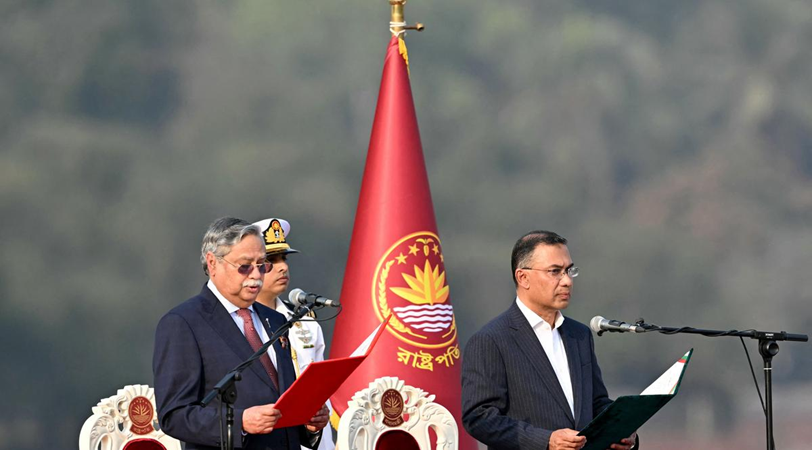
- Mohammad Sarwar Alam, a senior journalist and former press secretary, has been re-appointed as the Press Secretary to the President.
- The President’s Press Wing, which had been abolished during the interim government of Chief Adviser Professor Muhammad Yunus (August 2024–early 2026), has now been restored.
- This move is being widely interpreted as a clear reversal of several institutional changes introduced by the Yunus-led interim administration and a signal of the new government’s intent to restore traditional power structures and presidential dignity.
Key Details of the Decision
- The decision was announced officially on Tuesday (25 February 2026).
- The Press Wing will handle all communication, media interactions, and public outreach functions of the President’s Office (Bangabhaban).
- Mohammad Sarwar Alam had previously served as Press Secretary during earlier political dispensations.
- The restoration comes just weeks after the new government assumed office following political negotiations and the end of the Yunus-led interim setup.
Background & Political Context
- July–August 2024 Uprising: Sheikh Hasina was ousted after a student-led mass movement. Muhammad Yunus was installed as Chief Adviser of the interim government.
- Yunus Era (2024–early 2026): Several institutional reforms were introduced, including downsizing or abolishing certain wings in constitutional offices (including the President’s Press Wing) to reduce perceived politicisation and cut costs.
- Political Transition (February 2026): After months of negotiations, a new political government led by Tarique Rahman (BNP) has taken charge, with President Mohammad Shahabuddin continuing in office.
- The restoration of the Press Wing is seen as part of a broader institutional recalibration — reversing some of the interim government’s decisions and reasserting the dignity and functional autonomy of the President’s Office.
Significance of the Move
- Symbolic Reversal: Directly undoes a key decision of the Yunus interim regime, signalling a return to pre-2024 institutional norms.
- Power Dynamics: Strengthens the office of the President (a largely ceremonial post in Bangladesh’s parliamentary system) and gives it better media outreach capabilities.
- Political Messaging: Indicates that the new government wants to project stability, continuity, and respect for constitutional offices after a period of radical reforms.
- Media & Communication: Will improve coordinated messaging from the President’s Office, especially on national and international issues.
Implications for Bangladesh & India
For Bangladesh:
- Marks the beginning of institutional normalisation after two years of interim rule.
- May lead to further reversals or modifications of Yunus-era reforms in bureaucracy, judiciary, and other institutions.
- Could reduce political uncertainty and help in economic stabilisation.
For India:
- The new government under Tarique Rahman (BNP) has historically maintained a more balanced (sometimes cautious) approach towards India compared to the Awami League.
- Restoration of traditional structures may ease some of the anti-India rhetoric that surfaced during the Yunus period.
- India will closely watch how the new government handles issues like Teesta water sharing, border management, transit, and the Rohingya crisis.
- Opportunity for New Delhi to reset ties on a more stable, mutually beneficial footing.
UPSC-CSE/State PCS Relevance
Prelims
- Key personalities: Tarique Rahman, Muhammad Yunus, Mohammad Shahabuddin, Mohammad Sarwar Alam.
- Recent political transition in Bangladesh (2024–2026).
GS-2 (International Relations)
- India-Bangladesh bilateral relations during regime changes.
- Neighbourhood First Policy and managing political transitions in South Asia.
GS-2 (Polity & Governance)
- Role of President in parliamentary systems.
- Institutional reforms and reversals during interim/transitional governments.
GS-1 (History & Society)
- Political history of Bangladesh post-1971 and recurring cycles of civilian-military-interim rule.
Essay / Interview
- “Political transitions in South Asia: From popular uprisings to institutional restoration.”
- “How regime changes in Bangladesh impact India’s strategic interests in the neighbourhood.”
Que 1. With reference to the recent development in Bangladesh (February 2026), consider the following statements:
- The new government led by Tarique Rahman has restored the Press Wing at the President’s Office.
- Mohammad Sarwar Alam has been re-appointed as Press Secretary to the President.
- The Press Wing was abolished during the interim government of Muhammad Yunus.
Which of the statements given above is/are correct?
(a) 1 only (b) 1 and 2 only
(c) 2 and 3 only
(d) 1, 2 and 3
Answer: (d)
Que 2. Who among the following is the current President of Bangladesh as of February 2026?
(a) Sheikh Hasina
(b) Muhammad Yunus
(c) Mohammad Shahabuddin
(d) Tarique Rahman
Answer: (c)
Que 3. The abolition of the President’s Press Wing was carried out during the tenure of:
(a) Sheikh Hasina
(b) Muhammad Yunus (interim government)
(c) Khaleda Zia
(d) General Ershad
Answer: (b)
Que 4. Which of the following best describes the political significance of restoring the Presidential Press Wing?
(a) A routine administrative decision
(b) A symbolic reversal of interim government reforms and assertion of traditional institutions
(c) A move to reduce presidential powers
(d) An attempt to increase military control over the presidency
Answer: (b)
Que 1. “The restoration of the Presidential Press Wing by Bangladesh’s new government under Tarique Rahman represents a clear institutional reset after the 2024 political transition.” Analyse the significance of this decision and its likely impact on Bangladesh’s governance and India-Bangladesh relations. (15 marks / 250 words)
Que 2. Discuss how political transitions and interim governments in South Asia often lead to institutional experimentation followed by restoration of traditional structures. Use the recent Bangladesh example to illustrate your answer. (10 marks / 150 words)
Que 3. “Regime changes in India’s neighbourhood create both challenges and opportunities for Indian foreign policy.” In the light of the February 2026 developments in Bangladesh, critically examine this statement. (15 marks / 250 words)
Essay (250 marks) “From Revolution to Restoration: The Cyclical Nature of Political Transitions in South Asia and India’s Strategic Response.”
Why in News?
The United Kingdom has paused the ratification process of the landmark Chagos Islands sovereignty treaty signed with Mauritius in May 2025.
UK Foreign Office Minister Hamish Falconer confirmed on 25 February 2026 that the bill operationalising the treaty — which recognises Mauritian sovereignty over the Chagos Archipelago while granting the UK a 99-year lease on the strategically vital Diego Garcia military base — is currently on hold in the British Parliament. 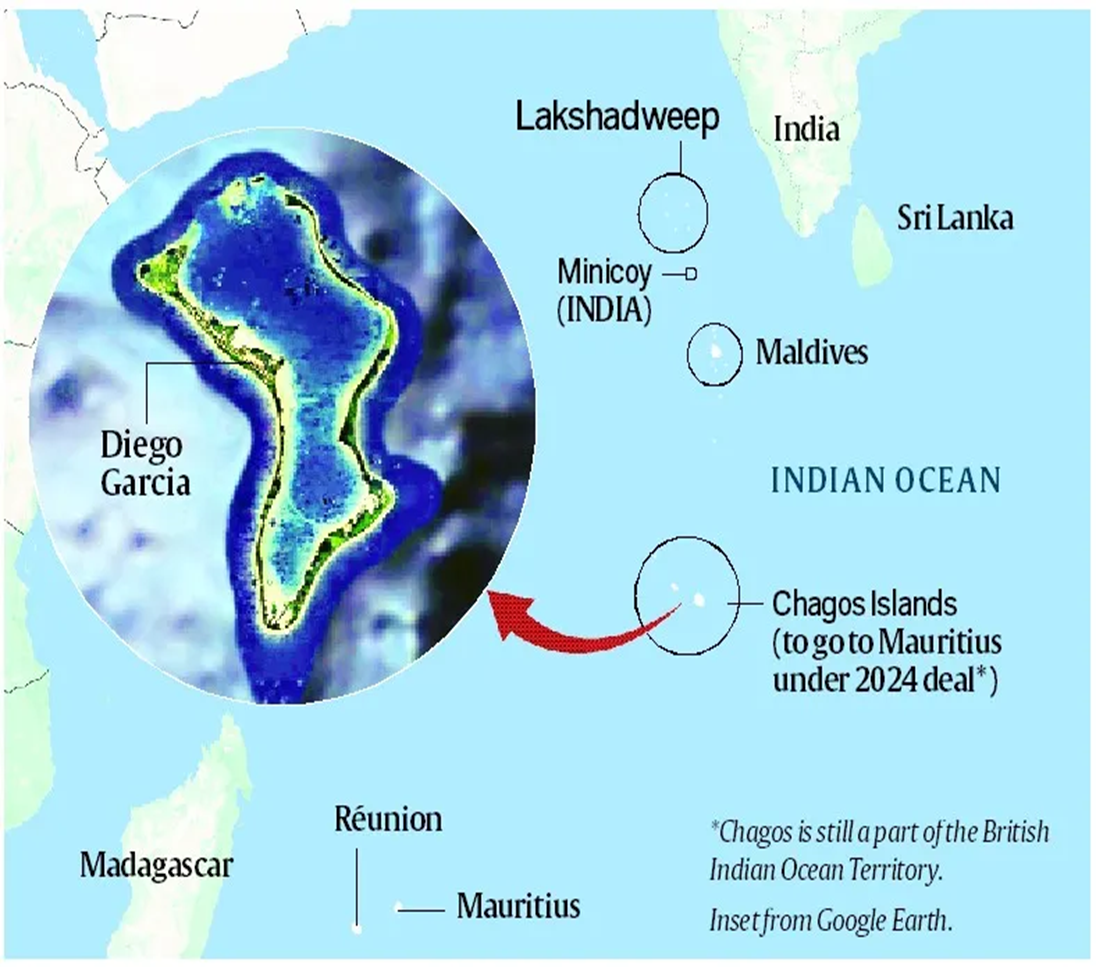
The pause is to allow further discussions with the United States government, following concerns raised by the incoming Trump administration about the long-term security of the Diego Garcia base, a critical US-UK joint military facility in the Indian Ocean.
This development marks a significant geopolitical reversal and has triggered intense debate in the UK, with opposition leader Nigel Farage calling it a potential “sell-out” to China’s growing influence in the region.
Background of the Chagos Treaty
- May 2025: UK and Mauritius signed the historic treaty ending decades of dispute.
- Key Terms:
- Sovereignty of the entire Chagos Archipelago (including Diego Garcia) transferred to Mauritius.
- UK retains a 99-year lease on Diego Garcia for joint US-UK military operations.
- UK to pay Mauritius an average £101 million annually for the lease period.
- The deal was hailed as a major diplomatic victory for Mauritius and a pragmatic solution for the UK to secure the base while addressing decolonisation demands.
- Diego Garcia hosts one of the most important US military bases outside American territory, playing a crucial role in operations across the Indian Ocean, Middle East, and Indo-Pacific.
Reasons for the Current Pause
- US Concerns: The Trump administration has expressed strong reservations about the long-term security of the Diego Garcia base under the new arrangement.
- Strategic Fears: Concerns that Mauritius (with growing Chinese economic influence) could eventually come under pressure from Beijing, threatening the base’s operational freedom.
- Domestic UK Pressure: Nigel Farage and sections of the Conservative Party have strongly criticised the deal, warning it weakens Western strategic posture in the Indian Ocean.
- Legal & Political Hurdles: The treaty requires parliamentary approval in the UK; the government is now seeking broader consensus before proceeding.
Strategic Importance of Diego Garcia
- Located in the central Indian Ocean, approximately 1,000 km south of India.
- Key US-UK military facility used for:
- Long-range bomber operations.
- Naval and intelligence surveillance.
- Logistics support for operations in the Persian Gulf, Red Sea, and Indo-Pacific.
- Critical for monitoring Chinese naval activities in the Indian Ocean.
- Any uncertainty over the base directly impacts the Quad, AUKUS, and overall Western strategy to counter China.
Implications for India
- Strategic Concern: India has always viewed Diego Garcia as a key Western military outpost but has been wary of any arrangement that could increase Chinese influence in the Chagos archipelago.
- Positive Angle: The pause gives India time to engage diplomatically with both the UK and US to ensure the base remains secure and that Mauritius does not tilt excessively towards China.
- Indian Ocean Balance: Strengthens India’s position to push for greater transparency and consultation on Indian Ocean security matters.
- Chabahar & INSTC: Reinforces the importance of India’s own strategic assets (Chabahar Port, Agaléga, etc.) in the region.
UPSC-CSE/State PCS Relevance
Prelims
- Key locations: Chagos Archipelago, Diego Garcia.
- Recent event: UK-Mauritius Chagos Treaty (May 2025), current pause (Feb 2026).
- Strategic concepts: Indian Ocean Region (IOR), military basing, decolonisation.
GS-2 (International Relations)
- UK foreign policy shift under new government and US influence.
- India’s strategic interests in the Indian Ocean and response to Western basing arrangements.
- Decolonisation and sovereignty disputes in the post-colonial era.
GS-3 (Security)
- Military bases and power projection in the Indo-Pacific.
- Emerging challenges to freedom of navigation and strategic stability.
Essay / Interview
- “Diego Garcia and the New Great Game in the Indian Ocean.”
- “Strategic autonomy in the Indian Ocean: How India navigates great-power military footprints.”
Que 1. With reference to the recent development regarding the Chagos Islands (February 2026), consider the following statements:
- The United Kingdom has paused the ratification of the treaty signed with Mauritius in May 2025.
- The treaty grants Mauritius sovereignty over the Chagos Archipelago while giving the UK a 99-year lease on Diego Garcia.
- The pause is primarily due to concerns raised by the United States over the security of the Diego Garcia base.
Which of the statements given above is/are correct?
(a) 1 and 2 only
(b) 2 and 3 only
(c) 1 and 3 only
(d) 1, 2 and 3
Answer: (d)
Que 2. Diego Garcia is strategically important primarily because it hosts:
(a) A major Chinese naval base
(b) A joint US-UK military and intelligence facility
(c) The headquarters of the Indian Ocean Rim Association
(d) A commercial shipping hub controlled by Mauritius
Answer: (b)
Que 3. The Chagos Archipelago sovereignty dispute involves which two countries as primary parties?
(a) India and Maldives
(b) United Kingdom and Mauritius
(c) France and Seychelles
(d) United States and China
Answer: (b)
Que 4. The Chagos Treaty signed in May 2025 provides the United Kingdom with a lease period of how many years on Diego Garcia?
(a) 50 years
(b) 99 years
(c) 150 years
(d) Perpetual lease
Answer: (b)
Que 1. “The United Kingdom’s decision to pause the Chagos Islands treaty highlights the primacy of strategic interests over decolonisation commitments in the Indian Ocean.” Critically examine this statement in the context of the February 2026 developments and discuss its implications for India’s maritime security. (15 marks / 250 words)
Que 2. Analyse the strategic importance of Diego Garcia in the evolving Indo-Pacific security architecture. How should India respond to the current uncertainty surrounding the Chagos sovereignty deal? (15 marks / 250 words)
Que 3. “Great power competition in the Indian Ocean is reshaping traditional notions of sovereignty and decolonisation.” Discuss with reference to the UK-Mauritius Chagos treaty and the recent pause announced by the UK government. (10 marks / 150 words)
Essay (250 marks) “From Decolonisation to Geostrategy: The Chagos Islands Dispute and the New Power Game in the Indian Ocean.”
Why in News?
A alarming new study published on 26 February 2026 by the British Antarctic Survey has revealed that climate-driven sea ice melt is pushing Emperor penguins — the world’s largest penguin species — into dangerously small, overcrowded patches along the remote Antarctic coastline. 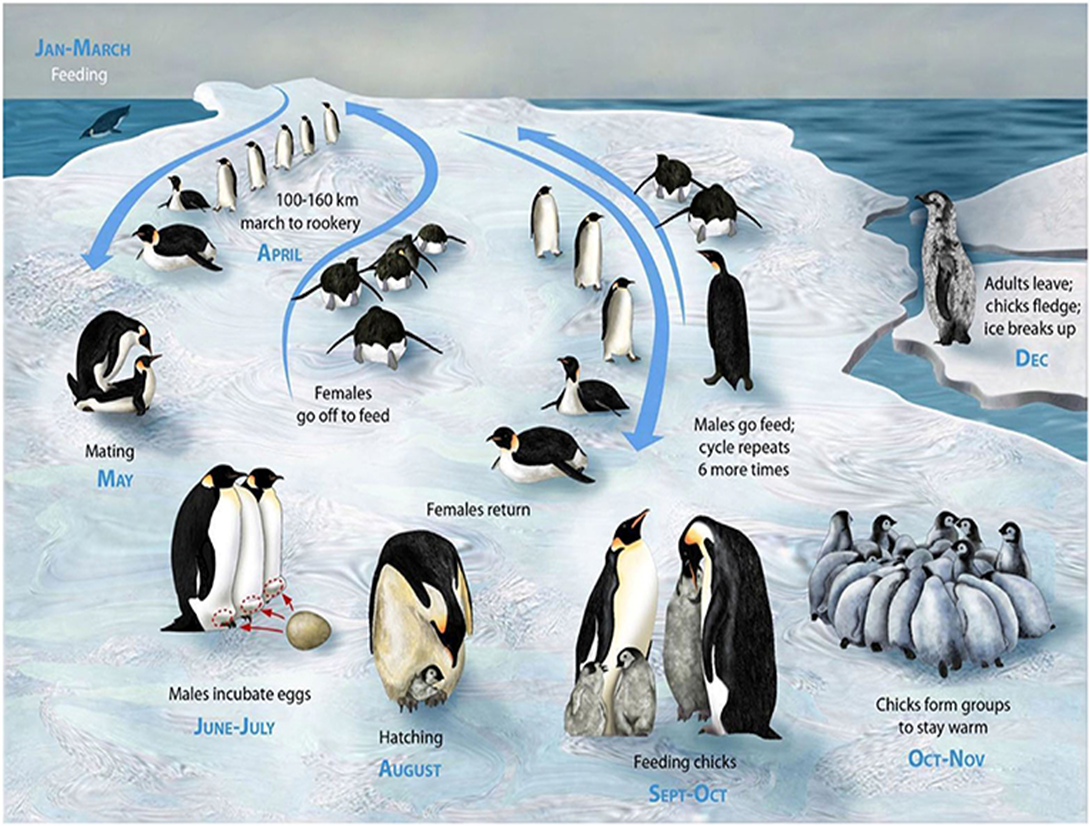
Analysing seven years of high-resolution satellite imagery, researchers found that in 2025, only 25 small groups of molting Emperor penguins were visible in the Marie Byrd Land region, compared to more than 100 groups spotted in previous years.
The study warns that this forced crowding during their annual molting period — when penguins are flightless, fasting, and highly vulnerable — could lead to exhaustion, increased predation, and long-term population decline. This comes as Emperor penguin numbers have already shrunk by almost a quarter globally due to global warming.
Key Findings of the British Antarctic Survey Study
- Molting Crisis: Emperor penguins shed all their feathers once a year in a precarious ritual. They normally fast on stable sea ice for several weeks until new waterproof feathers grow.
- Sea Ice Collapse: Rapid melting has forced them onto land or very small ice patches, resulting in tightly packed colonies.
- Satellite Evidence: In the Marie Byrd Land sector (one of the most remote areas), the number of visible molting groups dropped dramatically from over 100 to just 25 in 2025.
- New Behaviour: Penguins appear to be establishing new moulting sites on ice-free land, but these come with higher risks of exhaustion and predator attacks.
- Population Trend: Global Emperor penguin population has declined by nearly 25% in recent decades, with climate change identified as the primary driver.
Scientific Explanation
- Emperor penguins rely on stable, fast ice (sea ice attached to the continent) for breeding and molting.
- As global temperatures rise, Antarctic sea ice extent has been shrinking at an alarming rate, especially in West Antarctica.
- During molting, penguins cannot swim or hunt. They depend entirely on stored fat reserves. Crowding on small patches increases energy expenditure, stress, and risk of trampling or predation by leopard seals and killer whales.
- Researchers Peter Fretwell and colleagues noted that while some penguins may adapt by moving to new sites, prolonged exposure after entering the Southern Ocean before completing molting can cause energy exhaustion and higher mortality.
Broader Environmental & Global Context
- Antarctic Sea Ice Loss: 2025 recorded one of the lowest sea ice extents on record, consistent with accelerating climate change.
- Biodiversity Impact: Emperor penguins are a keystone species; their decline signals deeper ecosystem collapse in Antarctica.
- Global Warning: The study reinforces that even the most remote parts of the planet are not immune to human-induced climate change.
- Comparison: Similar impacts have been documented in other Antarctic species (Adélie penguins, seals) and Arctic species (polar bears).
Implications for India & the World
- Climate Diplomacy: Strengthens India’s position at forums like COP and the Antarctic Treaty Consultative Meeting to push for stronger emission cuts.
- Scientific Collaboration: India’s Bharati and Maitri stations in Antarctica can contribute to long-term monitoring of penguin colonies.
- Global Food Web: Decline in Antarctic krill (primary food for penguins) due to sea ice loss affects the entire Southern Ocean ecosystem, with cascading effects on global fisheries.
- Policy Lesson: Highlights the urgent need for nature-based solutions, stronger Marine Protected Areas in Antarctica, and accelerated global decarbonisation.
Prelims
- Key species: Emperor Penguin (Aptenodytes forsteri).
- Key concepts: Sea ice extent, molting process in penguins, British Antarctic Survey.
- Related: Antarctic Treaty System, India’s Antarctic research stations.
GS-3 (Environment & Ecology)
- Climate change impact on polar ecosystems and biodiversity.
- Indicator species and early warning signals of environmental collapse.
GS-1 (Geography)
- Physical geography of Antarctica and cryosphere dynamics.
GS-3 (Disaster Management)
- Link between polar ice melt and global climate risks.
Essay / Interview
- “The canary in the coal mine has wings: Emperor penguins as sentinels of climate catastrophe.”
- “From poles to tropics: How climate change is redrawing the map of life on Earth.”
Que 1. With reference to the recent study on Emperor penguins (February 2026), consider the following statements:
- Emperor penguins molt once a year and cannot swim or hunt during this period.
- In 2025, only 25 small groups of molting penguins were visible in the Marie Byrd Land region.
- The British Antarctic Survey study found that sea ice loss has forced penguins into larger, more stable colonies.
Which of the statements given above is/are correct?
(a) 1 and 2 only
(b) 2 and 3 only
(c) 1 and 3 only
(d) 1, 2 and 3
Answer: (a)
Que 2. The Emperor penguin is scientifically known as:
(a) Pygoscelis adeliae
(b) Aptenodytes forsteri
(c) Aptenodytes patagonicus
(d) Eudyptes chrysolophus
Answer: (b)
Que 3. Which of the following is the primary threat to Emperor penguins according to the British Antarctic Survey study?
(a) Overfishing of krill
(b) Shrinking sea ice due to climate change
(c) Increased tourism in Antarctica
(d) Predation by polar bears
Answer: (b)
Que 4. The British Antarctic Survey is headquartered in:
(a) London
(b) Cambridge
(c) Edinburgh
(d) Antarctic Peninsula
Answer: (b)
Que 1. “The forced crowding of Emperor penguins due to Antarctic sea ice melt is not just a wildlife crisis but a loud alarm for humanity.” In the light of the February 2026 British Antarctic Survey study, discuss the cascading ecological and climate implications of polar ice loss. (15 marks / 250 words)
Que 2. Examine the role of indicator species like Emperor penguins in understanding the pace and impact of climate change. How can India leverage its Antarctic research programme to contribute to global polar science? (10 marks / 150 words)
Que 3. “Protecting Antarctica is no longer just about preserving a pristine wilderness — it is about securing the future of the planet’s climate system.” Critically analyse this statement with reference to the recent findings on Emperor penguins. (15 marks / 250 words)
Essay (250 marks) “Melting Thrones: How the Decline of Emperor Penguins Mirrors Humanity’s Reckless Assault on the Cryosphere.”
Why in News?
The European Union’s long-stated goal of completely ending its dependence on Russian fossil fuels by 2027 has suffered yet another serious setback.
Despite the bloc having already slashed Russian pipeline gas imports by over 80% since 2021, Hungary and Slovakia continue to receive large volumes of discounted Russian crude and gas via the Druzhba pipeline and other legacy routes — and both countries are openly blocking any new EU sanctions or phase-out measures that would affect these flows. 
In February 2026:
- Hungary’s Foreign Minister Péter Szijjártó publicly stated that Budapest “will not support any new sanctions” that harm its energy security.
- Slovakia’s government echoed the position, arguing that sudden cuts would cause unacceptable economic damage and energy price spikes.
- EU diplomats privately admit that the bloc’s unanimity rule on foreign policy and sanctions gives both countries effective veto power over further restrictions on Russian energy.
The stand-off has become one of the most visible symbols of the EU’s internal divisions on Russia policy nearly four years after the full-scale invasion of Ukraine.
Key Data & Pipeline Facts
- Druzhba Pipeline (Friendship Pipeline): Still supplies ~8–10 million tonnes/year of Russian crude to Hungary, Slovakia, and the Czech Republic.
- Hungary’s Share: Receives ~60–65% of its crude oil from Russia (2025 average).
- Slovakia’s Share: ~50–55% of crude imports from Russia.
- Gas Flows: Both countries continue to receive Russian pipeline gas via Ukraine and TurkStream routes (Hungary via TurkStream since 2021).
- Discounted Oil: Russian Urals crude delivered to Central Europe remains $10–20 per barrel cheaper than Brent, giving a major cost advantage to refineries in both countries.
- EU Overall Progress: Russian pipeline gas share fell from ~40% (2021) to <10% (2025); seaborne LNG imports from Russia also sharply reduced.
Core Arguments of Hungary & Slovakia
- Energy Security First: Sudden loss of Russian supplies would cause refinery shutdowns, fuel shortages, and sharp price increases.
- No Viable Alternative Yet: LNG terminals in Croatia and Poland are not fully connected to Central Europe; new pipelines or capacity expansions take years.
- Economic Competitiveness: Cheap Russian crude keeps fuel prices lower than in Western Europe, helping control inflation and support industrial competitiveness.
- Political Stance: Both governments (Fidesz in Hungary, Smer-SD in Slovakia) have maintained a pragmatic, non-confrontational line towards Moscow.
EU’s Official Position & Frustrations
- The European Commission and most member states insist that full energy independence from Russia remains a strategic and moral necessity.
- The REPowerEU Plan (2022) set the target of ending Russian fossil fuel dependence “well before 2030”.
- Several countries (Poland, Baltics, Nordic states) accuse Hungary and Slovakia of undermining EU unity and indirectly financing Russia’s war effort.
- The latest proposed 14th sanctions package (late 2025) again stalled partly because of resistance from Budapest and Bratislava.
Implications for India
- Oil Market Dynamics: Continued Russian crude flows to Central Europe keep global Urals discounts alive → indirectly benefits India (still one of the largest buyers of discounted Russian crude).
- Geopolitical Lesson: Demonstrates how energy dependence can be weaponised as veto power within alliances — relevant for India’s own balancing act between Russia, the West, and the Global South.
- Energy Transition: Reinforces that even wealthy blocs like the EU struggle with rapid fossil-fuel phase-outs when legacy infrastructure and political divisions exist — a cautionary tale for India’s own net-zero journey.
Prelims
- Key pipeline: Druzhba (Friendship) pipeline.
- Countries: Hungary, Slovakia, Czech Republic (still receiving Russian crude).
- EU policy: REPowerEU Plan (2022).
GS-2 (International Relations)
- EU internal divisions on Russia policy post-2022.
- Energy as a tool of geopolitical leverage and veto power.
- India’s own energy diplomacy lessons (Russia, Gulf, US).
GS-3 (Economy & Environment)
- Energy security vs. sanctions and decarbonisation goals.
- Impact of discounted Russian crude on global oil markets.
GS-2 (Governance)
- Unanimity rule in EU foreign policy and its consequences.
Essay / Interview
- “Energy dependence as the last veto in European unity.”
- “Can the EU ever truly escape Russian energy without fracturing itself?”
Que 1. With reference to the current EU-Russia energy standoff (February 2026), consider the following statements:
- Hungary and Slovakia continue to receive large volumes of Russian crude via the Druzhba pipeline.
- Both countries have openly stated they will not support new EU sanctions affecting their Russian energy supplies.
- The EU has already completely eliminated Russian pipeline gas imports.
Which of the statements given above is/are correct?
(a) 1 and 2 only
(b) 2 and 3 only
(c) 1 and 3 only
(d) 1, 2 and 3
Answer: (a)
Que 2. The Druzhba pipeline primarily supplies Russian crude oil to which of the following countries?
(a) Germany, France, Italy
(b) Hungary, Slovakia, Czech Republic
(c) Poland, Lithuania, Latvia
(d) Spain, Portugal, Greece
Answer: (b)
Que 3. The REPowerEU Plan was launched by the European Union in which year?
(a) 2020
(b) 2021
(c) 2022
(d) 2023
Answer: (c)
Que 4. Which of the following best explains why Hungary and Slovakia oppose further cuts to Russian energy supplies?
(a) They have no alternative suppliers
(b) Russian crude remains significantly cheaper, supporting economic competitiveness
(c) They are aligned with Russia politically
(d) They lack LNG import terminals
Answer: (b)
Que 1. “Hungary and Slovakia’s continued dependence on Russian energy has effectively given them veto power over the EU’s sanctions policy.” Critically examine this statement and discuss its implications for European unity and the broader Russia-Ukraine conflict. (15 marks / 250 words)
Que 2. Analyse the challenges faced by the European Union in achieving complete energy independence from Russia after the 2022 invasion of Ukraine. What lessons can India draw from the EU experience? (15 marks / 250 words)
Que 3. “Energy security often trumps ideological solidarity in international relations.” In the light of Hungary and Slovakia’s stance on Russian oil and gas imports, discuss the statement. (10 marks / 150 words)
Essay (250 marks) “Energy as the Last Veto: How National Interests Are Testing the Limits of European Unity in the Russia-Ukraine War.”
Why in News?
U.S. President Donald Trump reignited controversy over Greenland by posting on Truth Social that “many people in Greenland are sick” and claiming the U.S. Navy hospital ship USNS Mercy was being dispatched to the Arctic island to provide medical assistance. 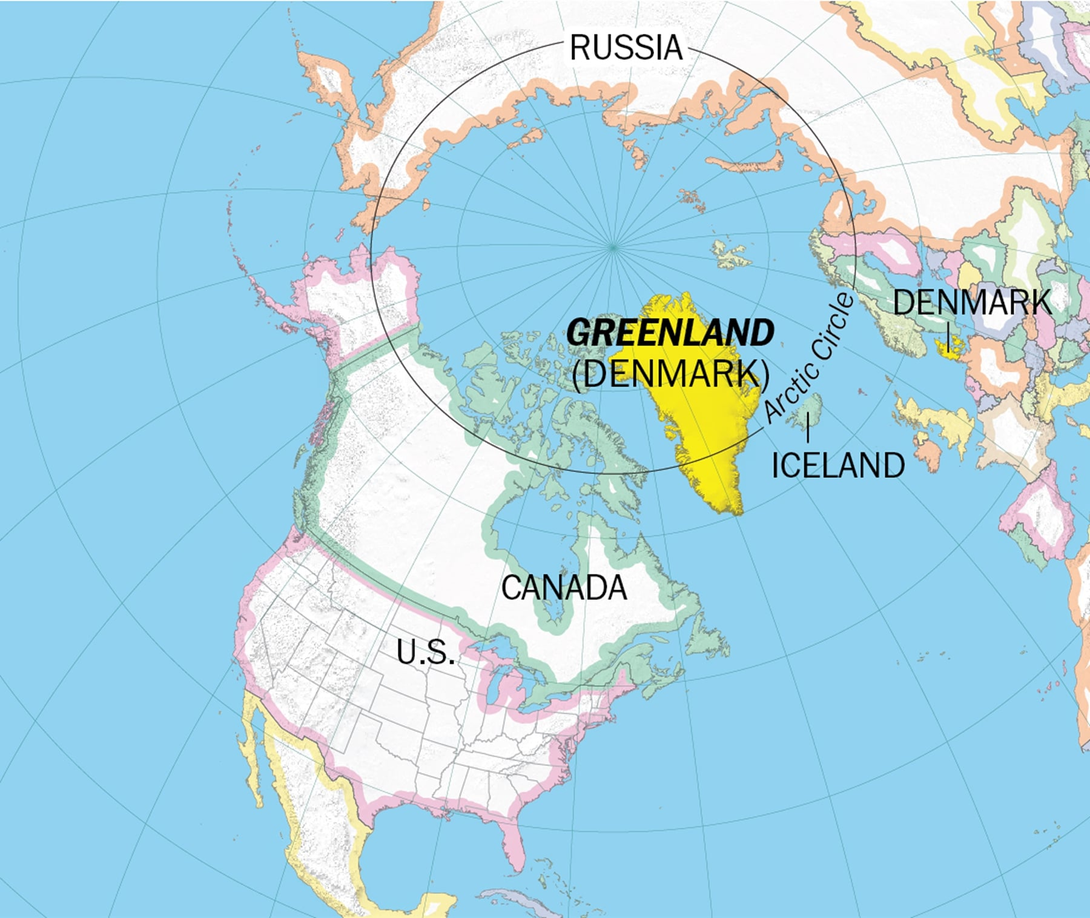
The statement — made without any supporting evidence from U.S. or Greenlandic health authorities — drew immediate pushback from Greenland’s Prime Minister Múte B. Egede and Denmark, who called it baseless and politically motivated. Greenlandic health officials and independent data confirmed there is no ongoing public health emergency on the island.
The episode comes amid renewed U.S. interest in acquiring or deepening strategic control over Greenland — a self-governing Danish territory — due to its critical location for Arctic military operations, rare-earth minerals, and climate research.
Timeline of Key Developments
- Saturday (post date not specified, but recent): Trump posts on Truth Social claiming Greenlanders are “sick” and not receiving care → announces hospital ship deployment.
- Tuesday: USNS Mercy departs Alabama shipyard → tracking data shows it is not headed toward Greenland (destination unclear).
- Greenland response: Prime Minister Múte B. Egede publicly states there is no health crisis and no request for U.S. medical assistance.
- Denmark response: Foreign Ministry calls the claim “factually incorrect” and reiterates Greenland’s autonomy in health matters.
- U.S. clarification: Pentagon and White House decline to comment on the ship’s destination or the basis of Trump’s health claim.
Greenland’s Actual Health System Reality
- Population: ~57,000 (mostly Inuit).
- Healthcare: Free and universal — funded by Denmark and managed by Greenland’s government.
- Life expectancy (2020 data): ~71 years (men), ~77 years (women) — comparable to many developed countries.
- Main challenges: Geographic isolation (remote settlements), high rates of lifestyle diseases (diabetes, obesity), mental health issues, and seasonal affective disorder.
- No major epidemic or public health emergency reported in 2025–26.
- Greenlandic health officials: “We have a functioning system… people can see a doctor.”
Strategic & Geopolitical Context
- Trump has repeatedly expressed interest in “buying” Greenland (first in 2019, repeated in 2025 campaign).
- Diego Garcia-style military basing logic: Greenland hosts the Thule Air Base (U.S. Space Force) — critical for missile defense, space surveillance, and Arctic operations.
- Melting Arctic ice is opening new shipping routes and exposing mineral resources → increasing great-power competition (U.S., China, Russia).
- Denmark & Greenland firmly reject any sovereignty transfer: Greenland is not for sale.
Implications
For U.S.–Denmark/Greenland Relations:
- Renewed friction after the 2019 “purchase” controversy.
- Risk of damaging NATO cohesion (Denmark is a NATO ally).
For India:
- Highlights how climate change is reshaping Arctic geopolitics → indirect impact on global energy routes and critical minerals supply chains.
- Reinforces India’s own Arctic interests (observer status in Arctic Council, research stations).
- Lesson on sovereignty and strategic denial in contested territories.
|
UPSC-CSE/State PCS Relevance |
|
Prelims |
|
|
|
GS-2 (International Relations) |
|
|
|
|
GS-3 (Environment & Disaster Management) |
|
|
|
GS-2 (Polity) |
|
|
Essay / Interview |
|
|
Que 1. With reference to the recent Greenland controversy (February 2026), consider the following statements:
- U.S. President Donald Trump claimed many people in Greenland are sick and announced deployment of a hospital ship.
- Greenland’s Prime Minister confirmed a major public health emergency on the island.
- Greenland is an autonomous territory of Denmark.
Which of the statements given above is/are correct?
(a) 1 and 2 only
(b) 1 and 3 only
(c) 2 and 3 only
(d) 1, 2 and 3
Answer: (b)
Que 2. The strategically important U.S. military facility located in Greenland is:
(a) Pituffik Space Base (formerly Thule Air Base)
(b) Diego Garcia Naval Support Facility
(c) Eielson Air Force Base
(d) Keflavik Air Base
Answer: (a)
Que 3. Greenland’s healthcare system is primarily funded and overseen by:
(a) United States
(b) Denmark
(c) European Union
(d) United Nations
Answer: (b)
Que 4. The USNS Mercy is a:
(a) Nuclear-powered aircraft carrier
(b) Hospital ship operated by the U.S. Navy
(c) Icebreaker vessel
(d) Submarine tender
Answer: (b)
Que 1. “President Trump’s unsubstantiated claim about a health crisis in Greenland and the simultaneous pause on the Chagos Islands treaty reveal how climate-exposed territories are becoming central to great-power rivalry.” Critically examine this statement and discuss its implications for Arctic and Indian Ocean geopolitics. (15 marks / 250 words)
Que 2. Analyse the strategic importance of Greenland in the context of melting Arctic ice, new shipping routes, and rare-earth minerals. How should India position itself in the emerging Arctic power game? (15 marks / 250 words)
Que 3. “Sovereignty over remote territories is increasingly determined by military-strategic value rather than historical or legal claims.” Discuss with reference to recent developments concerning Greenland and the Chagos Islands. (10 marks / 150 words)
Essay (250 marks) “From Frozen Frontier to Geostrategic Prize: How Climate Change is Reshaping Sovereignty and Power in the Polar Regions.”
