
3rd April Current Affairs
Multi-Hazard Early Warning System: A Lifeline for Disaster Management
Why in News? 
- The Multi-Hazard Early Warning Decision Support System, developed by the Indian Meteorological Department (IMD) under Mission Mausam, represents a major digital transformation in weather forecasting and disaster preparedness.
- Launched in January 2024, the system uses open-source technology and real-time GIS mapping to deliver faster, more accurate, and actionable weather alerts, significantly enhancing India’s ability to manage multi-hazard risks.
About the Multi-Hazard Early Warning Decision Support System
- Nodal Ministry
- Ministry of Earth Sciences (MoES)
- Core Objective
- To provide timely, accurate, and user-friendly multi-hazard early warnings by integrating advanced data processing, forecasting models, and dissemination tools.
Key Technological Features
-
- Automated Weather Data Processing: Over 90% of data collection, quality checks, and integration are automated.
- Improved Model Utilisation: More than 95% of numerical weather prediction model inputs are now used.
- Re-engineered Forecasting Process: Real-time alerts and faster decision-making.
- Extended Lead Time: Forecast horizon increased from 5 days to 7 days.
- Faster Preparation: Time to prepare forecasts reduced by ~3 hours (from 6 hours).
- Uses Geographic Information System (GIS) maps for clear visualisation and dissemination.
Significance
- Disaster Risk Reduction
- Enables proactive preparedness for cyclones, floods, heatwaves, heavy rainfall, and other hazards.
- Reduces loss of life and property through timely warnings.
- Technological Self-Reliance
- Built using open-source tools and in-house IMD expertise — a step towards Atmanirbhar Bharat in meteorology.
- Broader Impact
- Supports farmers, disaster management agencies, policymakers, and the public with actionable information.
- Strengthens India’s climate resilience and early warning capabilities.
UPSC CSE Relevance
Prelims
- Key terms: Multi-Hazard Early Warning Decision Support System, Mission Mausam, IMD, GIS-based Forecasting, Lead Time
- Facts: Launched January 2024; Lead time increased to 7 days; Automated processing >90%
GS-3 (Disaster Management & Science & Technology)
- Early warning systems, disaster risk reduction, and use of technology in meteorology.
GS-3 (Environment)
- Climate change adaptation and resilience through improved forecasting.
Essay / Interview
- “Technology-Driven Disaster Management: The Role of Early Warning Systems in Building Climate-Resilient India”
- “From Reactive Response to Proactive Preparedness: Transforming India’s Approach to Natural Disasters.”
MCQs
- The Multi-Hazard Early Warning Decision Support System was developed by:
(a) ISRO
(b) Indian Meteorological Department (IMD)
(c) NITI Aayog
(d) Ministry of Home Affairs
Answer: (b)
- Under the new system, the forecast lead time has been increased to:
(a) 5 days
(b) 7 days
(c) 10 days
(d) 15 days
Answer: (b)
- Which of the following is a key feature of the Multi-Hazard Early Warning Decision Support System?
(a) Manual data entry only
(b) Automated weather data processing (>90%)
(c) Exclusive focus on cyclones
(d) Use of proprietary foreign software
Answer: (b)
- The system operates under which mission?
(a) National Mission on Sustainable Agriculture
(b) Mission Mausam
(c) National Hydrology Project
(d) National Disaster Management Authority
Answer: (b)
Mains Questions
- “The Multi-Hazard Early Warning Decision Support System marks a paradigm shift in India’s disaster management strategy.” Discuss its key features and potential impact on reducing disaster risks. (15 marks / 250 words)
- Examine the role of advanced meteorological tools and early warning systems in building climate-resilient infrastructure and communities in India. (10 marks / 150 words)
- “Technology-led forecasting is crucial for minimising loss of life and property in a disaster-prone country like India.” Analyse this statement with reference to recent initiatives by IMD. (15 marks / 250 words)
- Essay (250 marks) “From Prediction to Protection: Harnessing Technology for Disaster Risk Reduction in the Era of Climate Change.”
Artemis II: Back to the Moon Orbit
Why in News? 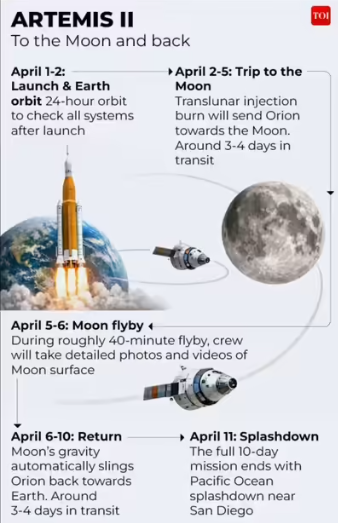
- NASA is preparing for Artemis II, the first crewed mission to the Moon’s vicinity since Apollo 17 in 1972. The mission will send four astronauts on a ~10-day lunar flyby (no landing), testing the Orion spacecraft and Space Launch System (SLS) in deep space.
- It marks a crucial step toward establishing a sustainable human presence on the Moon and eventual missions to Mars.
Artemis Programme: Background & Vision
- Objective
- Return humans to the Moon for long-term exploration and resource utilisation.
- Use the Moon as a stepping stone for human missions to Mars.
- Key Goals
- Sustainable lunar presence.
- Utilise lunar resources (water ice, Helium-3).
- International and private sector collaboration.
- Comparison with Apollo
- Apollo missions (1969–1972) focused on short visits and flags-and-footprints landings.
- Artemis emphasises long-term habitation and scientific/commercial use.
Key Features of Artemis II
- Mission Profile
- Crew: 4 astronauts.
- Duration: ~10 days.
- Trajectory: Lunar flyby, reaching up to 6,500 km beyond the Moon’s far side (farthest humans have ever travelled).
- Launch Vehicle & Spacecraft
- Space Launch System (SLS): NASA’s most powerful rocket.
- Orion spacecraft: Designed for deep space, with advanced life support, radiation shielding, and crew safety systems.
- Flight Path
- Two orbits around Earth before heading to the Moon.
- Tests deep space navigation, communication, and re-entry capabilities.
Significance of the Mission
- Technological Milestone
- First crewed test of SLS and Orion after the uncrewed Artemis I (2022).
- Validates systems for future crewed lunar landing (Artemis III, planned 2028).
- Global & Strategic Importance
- Signals the beginning of a new era of sustained human presence beyond low Earth orbit.
- Involves international partners and private companies.
- For India
- India is a signatory to the Artemis Accords.
- Opens avenues for deeper ISRO–NASA cooperation (already seen in NISAR mission).
- Supports India’s own lunar ambitions, including a planned human landing by 2040.
Challenges
- High financial costs and technical complexities (radiation, system reliability).
- Human safety concerns during long-duration deep space travel.
- Need for robust international governance to manage space traffic and debris.
UPSC CSE & State PCS Relevance
Prelims
- Key terms: Artemis II, SLS Rocket, Orion Spacecraft, Artemis Accords, Lunar Flyby
- Facts: First crewed lunar mission since 1972; Planned landing 2028; Farthest distance ~6,500 km beyond Moon
GS-3 (Science & Technology)
- Space exploration programmes, deep space missions, and international cooperation in space.
GS-2 (International Relations)
- India’s participation in Artemis Accords and growing space diplomacy.
Essay / Interview
- “From Apollo to Artemis: The Evolution of Human Space Exploration in the 21st Century”
- “Space as the Next Frontier: Competition, Collaboration and India’s Strategic Role.”
MCQs
- Artemis II mission is:
(a) A crewed landing on the Moon
(b) A crewed lunar flyby
(c) An uncrewed Mars mission
(d) A space station resupply mission
Answer: (b)
- The Artemis II mission will be launched using:
(a) Saturn V
(b) Space Launch System (SLS)
(c) GSLV Mk III
(d) Falcon Heavy
Answer: (b)
- India has signed which international agreement related to lunar exploration?
(a) Outer Space Treaty
(b) Artemis Accords
(c) Moon Agreement
(d) ISS Agreement
Answer: (b)
- Artemis II is scheduled to be the first crewed mission to lunar vicinity since:
(a) 1969
(b) 1972
(c) 2004
(d) 2012
Answer: (b)
Mains Questions
- “Artemis II marks humanity’s return to deep space after more than five decades.” Discuss the significance of the mission and its implications for future lunar and Mars exploration. (15 marks / 250 words)
- Examine India’s growing role in lunar exploration through the Artemis Accords and its own planned human mission by 2040. (10 marks / 150 words)
- “The new space race is shifting from competition to cooperative exploration.” Analyse this statement with reference to the Artemis programme and India’s space ambitions. (15 marks / 250 words)
- Essay (250 marks) “From Moon Landing to Moon Base: The Evolution of Human Space Exploration in the 21st Century.”
Newcastle Disease Outbreak in Europe: UK Poultry Sector on High Alert
Why in News? 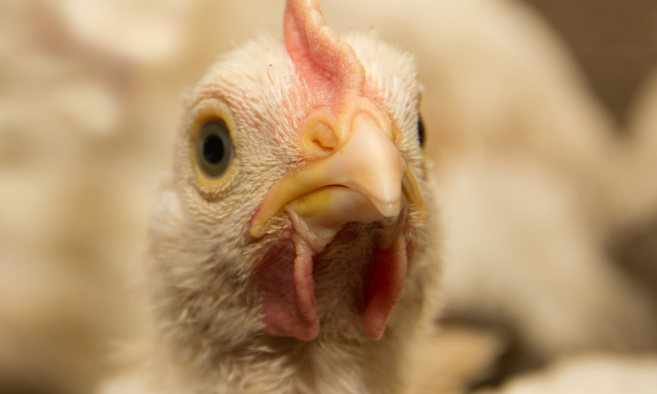
- Reports of Newcastle Disease circulating across Europe have prompted UK poultry producers to step up vigilance as the highly contagious virus spreads westward. The disease poses a serious threat to domestic poultry and wild birds, with potential economic losses for the poultry industry.
About Newcastle Disease
- Causative Agent
- Caused by avian paramyxovirus serotype 1 (APMV-1).
- Affected Species
- Highly contagious disease affecting chickens and a wide range of other birds, including domestic poultry and wild birds.
- Forms of the Disease
- Lentogenic: Mild form, widespread but causes few outbreaks.
- Mesogenic: Moderate form.
- Velogenic: Very virulent (severe) form.
- Transmission
- Spread through exhaled air, respiratory discharge, and faeces of infected birds.
- Virus can survive in manure for up to 2 months and in dead carcasses for up to 12 months.
- Easily killed by disinfectants, fumigants, and direct sunlight.
- Symptoms
- Respiratory signs: gasping, coughing, sneezing, rales.
- Nervous signs: tremors, paralysis of wings/legs, twisted necks, circling, spasms.
- Drop in egg production; abnormal eggs (shape, colour, watery albumen).
- Depression, diarrhoea, or nervous manifestations may predominate.
- Treatment
- No specific treatment available.
- Antibiotics may help control secondary infections.
Significance
- Economic Impact
- Can cause heavy losses in commercial poultry farms due to high mortality and reduced egg production.
- Global Concern
- Present worldwide; recent spread in Europe highlights the risk of transboundary animal diseases.
- For India
- India maintains strict biosecurity measures and vaccination programmes for Newcastle Disease (Ranikhet disease).
- Vigilance is essential to prevent introduction through trade or migratory birds.
UPSC CSE & State PCS Relevance
Prelims
- Key terms: Newcastle Disease, Avian Paramyxovirus Serotype 1, Lentogenic/Mesogenic/Velogenic forms, Ranikhet Disease
- Facts: Highly contagious; Affects poultry; Survives in manure up to 2 months
GS-3 (Agriculture & Animal Husbandry)
- Livestock diseases, biosecurity, and their impact on poultry industry.
GS-3 (Environment)
- Transboundary animal diseases and role of migratory birds in disease spread.
Essay / Interview
- “Emerging and Re-emerging Animal Diseases: Challenges for Global Food Security and Public Health”
- “Biosecurity in Poultry Farming: Lessons from Newcastle Disease Outbreaks.”
MCQs (Prelims Standard)
- Newcastle Disease is caused by:
(a) Bacteria
(b) Avian paramyxovirus serotype 1
(c) Fungus
(d) Protozoa
Answer: (b)
- Which of the following is NOT a common symptom of Newcastle Disease?
(a) Respiratory distress
(b) Nervous manifestations
(c) High fever with skin rashes
(d) Drop in egg production
Answer: (c)
- The disease is also commonly known as in India:
(a) Fowl Cholera
(b) Ranikhet Disease
(c) Marek’s Disease
(d) Avian Influenza
Answer: (b)
- The virus can survive in manure for up to:
(a) 2 weeks
(b) 2 months
(c) 6 months
(d) 1 year
Answer: (b)
Mains Questions
- “Newcastle Disease poses a significant threat to the poultry industry worldwide.” Discuss its causes, symptoms, and the importance of biosecurity measures in its prevention. (15 marks / 250 words)
- Examine the economic and food security implications of transboundary animal diseases like Newcastle Disease for a country like India. (10 marks / 150 words)
- “Early detection and vaccination are key to controlling viral diseases in livestock.” Analyse this statement with reference to Newcastle Disease. (15 marks / 250 words)
- Essay (250 marks) “Emerging Animal Diseases in a Globalised World: Challenges for Biosecurity and Sustainable Agriculture.”
Electoral Integrity in Question: Form 6 Enrolment Row in West Bengal
Why in News? 
- Ahead of the freezing of electoral rolls for the West Bengal Assembly polls (phases on April 23 and 29), allegations have surfaced of a last-minute surge in Form 6 applications (new voter enrolment) from individuals allegedly from Bihar and Uttar Pradesh.
- Opposition parties claim this could alter the state’s electoral demography. The Election Commission has not issued an official response, while the West Bengal Chief Electoral Officer has clarified that final decisions rest with the Electoral Registration Officer (ERO).
What is Form 6?
- Purpose
- Official application form used for new voter enrolment under the Registration of Electors Rules, 1960.
- Submission
- Submitted to the Electoral Registration Officer (ERO) of the concerned Assembly constituency.
- Can be filed online (via ECINET portal) or offline.
- Key Requirements
- Self-declaration of Indian citizenship, age (18+), and ordinary residence.
- No documentary proof of citizenship required at the time of application.
- False declaration can attract penalty or imprisonment up to one year.
- Processing
- Booth-Level Officer (BLO) verifies details.
- ERO assesses eligibility and decides on inclusion in the electoral roll.
Types of Electoral Roll Updates
- Special Summary Revision (SSR): Annual/pre-election large-scale revision.
- Continuous Updation: Runs throughout the year (except between nomination and result declaration).
Key Allegations in West Bengal
- Large numbers of Form 6 applications submitted in a short span (claims of ~30,000 forms in 6–7 hours).
- Violation of rules limiting Booth Level Agents to 50 forms per day.
- Some applicants allegedly already registered as voters in Bihar and Uttar Pradesh (violating the Representation of the People Act, 1950).
- Objection window has closed, limiting scope for challenges.
Election Commission’s Response
- No official statement from the EC so far.
- West Bengal CEO clarified that the office only receives documents and forwards complaints to the ERO.
- Final decision on inclusion/deletion lies with the ERO.
Significance
- Raises concerns over electoral integrity, possible demographic changes, and last-minute roll manipulation.
- Highlights the delicate balance between inclusive voter enrolment and preventing bogus voting.
- Similar allegations have surfaced in past elections (Karnataka 2023, Maharashtra 2024, Delhi 2025).
UPSC CSE & State PCS Relevance
Prelims
- Key terms: Form 6, Electoral Registration Officer (ERO), Booth Level Officer (BLO), Representation of the People Act 1950, Continuous Updation
- Facts: Form 6 for new enrolment; No documentary citizenship proof required; Objection window of at least 7 days
GS-2 (Polity & Governance)
- Electoral process, voter enrolment rules, and challenges to free and fair elections.
GS-2 (Governance)
- Role of Election Commission, ERO, and mechanisms to maintain electoral rolls.
Essay / Interview
- “Electoral Integrity vs Inclusivity: Managing Voter Roll Revisions in a Diverse Democracy”
- “Last-Minute Changes in Electoral Rolls: Implications for Democratic Credibility.”
MCQs
- Form 6 is primarily used for:
(a) Deletion of names from electoral rolls
(b) New voter enrolment
(c) Transfer of vote
(d) Correction of voter details
Answer: (b)
- With reference to Form 6, consider the following statements:
1. It requires documentary proof of Indian citizenship.
2. It is submitted to the Electoral Registration Officer (ERO).
3. False declaration can attract imprisonment up to one year.
Which of the statements given above is/are correct?
(a) 1 only
(b) 2 and 3 only
(c) 1 and 3 only
(d) 1, 2 and 3
Answer: (b)
- The objection window for proposed additions to electoral rolls is at least:
(a) 3 days
(b) 7 days
(c) 15 days
(d) 30 days
Answer: (b)
- Booth Level Agents are allowed to submit a maximum of how many Form 6 applications per day?
(a) 10
(b) 25
(c) 50
(d) 100
Answer: (c)
Mains Questions
- “Last-minute changes in electoral rolls raise serious concerns about the integrity of the electoral process.” Discuss the mechanism of voter enrolment through Form 6 and the challenges involved in maintaining accurate rolls. (15 marks / 250 words)
- Examine the role of the Electoral Registration Officer (ERO) and Booth Level Officers (BLOs) in the voter enrolment and verification process. (10 marks / 150 words)
- “Free and fair elections require robust safeguards against bogus voting and roll manipulation.” Analyse this statement in the context of recent controversies over Form 6 submissions in West Bengal. (15 marks / 250 words)
- Essay (250 marks) “Electoral Integrity in a Diverse Democracy: Balancing Inclusivity with Safeguards Against Manipulation.”
Policy Response to Global Crisis: Petrochemical Duty Exemption
Why in News? 
- The Union Government has announced a full customs duty exemption on around 40 critical petrochemical products until 30 June 2026. The move aims to address supply disruptions and rising input costs caused by the West Asia conflict (Iran crisis and Strait of Hormuz disruptions).
- It is expected to provide relief to industries like textiles, automobiles, pharmaceuticals, and packaging while moderating prices of final goods. The exemption is estimated to cause a revenue loss of about ₹1,800 crore over three months.
About the Exemption
- Products Covered
- Includes key chemicals and intermediates such as methanol, acetic acid, toluene, styrene, polypropylene, polyvinyl chloride, and polycarbonates.
- Rationale
- West Asia tensions have disrupted imports and increased global prices of petrochemical feedstock.
- Domestic production has been strained due to diversion of propane and butane for LPG production.
- Complementary Measures
- Increased allocation of commercial LPG to industries to ease feedstock shortages.
Petrochemical Industry in India
- Importance
- Backbone of manufacturing; used in plastics, textiles, pharmaceuticals, fertilisers, automobiles, packaging, and consumer goods.
- Closely linked with refining and natural gas processing.
- India’s Position
- Both producer and importer; domestic output often insufficient to meet rising demand.
- Heavy dependence on West Asian imports for certain products and feedstock.
Significance of the Move
- Short-term Relief
- Reduces input costs for downstream industries.
- Helps stabilise supply chains and prevents production disruptions.
- Moderates prices of end products for consumers.
- Broader Economic Impact
- Supports industrial output and employment in labour-intensive sectors like textiles.
- Mitigates inflationary pressure from higher raw material costs.
- Strategic Context
- Highlights India’s vulnerability to geopolitical shocks in energy and petrochemical supply chains.
Challenges & Concerns
- Revenue loss of ₹1,800 crore may affect fiscal balances.
- Temporary measure; long-term supply vulnerabilities remain.
- Continued dependence on imports exposes India to external risks.
- Need to address domestic production constraints and diversify sources.
Way Forward
- Expand domestic petrochemical production capacity.
- Diversify import sources beyond West Asia.
- Develop strategic reserves of critical inputs.
- Promote research and innovation in alternative materials and recycling.
- Strengthen supply chain resilience through policy support.
UPSC CSE & State PCS Relevance
Prelims
- Key terms: Petrochemicals, Customs Duty Exemption, West Asia Crisis, Feedstock, PTA, MEG
- Facts: Exemption till 30 June 2026; Estimated revenue loss ~₹1,800 crore; Products include methanol, styrene, polypropylene
GS-3 (Economy)
- Industrial supply chains, input cost management, and impact of global shocks on domestic manufacturing.
GS-2 (IR)
- Geopolitical tensions in West Asia and their transmission to India’s economy.
Essay / Interview
- “Geopolitical Disruptions and Economic Resilience: Managing Supply Chain Vulnerabilities in Critical Sectors”
- “From Import Dependence to Self-Reliance: Strengthening India’s Petrochemical Industry.”
MCQs
- The recent customs duty exemption covers products till:
(a) 31 March 2026
(b) 30 June 2026
(c) 31 December 2026
(d) 31 March 2027
Answer: (b)
- With reference to petrochemicals, consider the following statements:
1. They are derived primarily from crude oil and natural gas.
2. They serve as key inputs for textiles, pharmaceuticals, and plastics industries.
Which of the statements given above is/are correct?
(a) 1 only
(b) 2 only
(c) Both 1 and 2
(d) Neither
Answer: (c)
- Which of the following is NOT a major downstream sector dependent on petrochemicals?
(a) Textiles
(b) Pharmaceuticals
(c) Heavy machinery
(d) Packaging
Answer: (c)
- The estimated revenue loss due to the customs duty exemption on petrochemicals is approximately:
(a) ₹500 crore
(b) ₹1,800 crore
(c) ₹3,500 crore
(d) ₹5,000 crore
Answer: (b)
Mains Questions
- “The customs duty exemption on petrochemicals is a short-term relief measure amid global supply disruptions.” Discuss its rationale, impact on industries, and the need for long-term strategies to reduce import dependence. (15 marks / 250 words)
- Examine the role of petrochemicals in India’s manufacturing sector and the challenges posed by geopolitical tensions in West Asia. (10 marks / 150 words)
- “Building resilience in critical supply chains is essential for economic stability.” Analyse this statement with reference to India’s petrochemical sector and recent policy responses. (15 marks / 250 words)
- Essay (250 marks) “Geopolitics, Supply Chains and Economic Security: Navigating Global Disruptions in India’s Petrochemical Industry.”
Gangotri National Park is Back
Why in News? 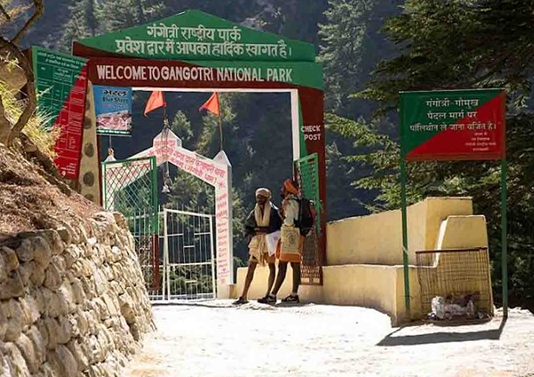
- Gangotri National Park in Uttarakhand has reopened for visitors after a six-month winter closure.
- The park, a high-altitude biodiversity hotspot in the Garhwal Himalayas, is known for its pristine glaciers, diverse flora and fauna, and cultural significance as the origin point of the sacred Ganges River.
About Gangotri National Park
- Location
- Situated in Uttarakhand along the upper catchment of the Bhagirathi River.
- Forms part of the international boundary between India and Tibet (China) in its northeastern section.
- Geographical Features
- Part of the Gangotri Group of the Garhwal Himalayas (eastern Himalayas sub-range).
- Borders Kedarnath Wildlife Sanctuary and Govind National Park.
- Major peaks: Chaukhamba I, Satopanth, Chaukhamba II, Chaukhamba III, and Kedarnath Main.
- Home to the famous Gangotri Glacier — one of the primary sources of the Ganges River.
- Flora
- Lower elevations: Western Himalayan subalpine conifer forests with fir, deodar, oak, spruce, and rhododendron.
- Higher elevations: Western Himalayan alpine shrubs.
- Fauna
- Key species: Snow Leopard, Brown Bear, Blue Sheep, Musk Deer, Asian Black Bear, Himalayan Tahr, etc.
Significance
- Biodiversity & Ecology
- A critical high-altitude ecosystem supporting endangered Himalayan species.
- Plays a vital role in maintaining the hydrological balance of the Ganges basin.
- Cultural & Religious Importance
- Gangotri Glacier and the Bhagirathi River hold immense religious significance in Hinduism as the origin of the Ganges.
- Conservation & Tourism
- Protected area that balances conservation with regulated eco-tourism.
- Winter closure protects the fragile ecosystem during harsh weather.
UPSC CSE & State PCS Relevance
Prelims
- Key terms: Gangotri National Park, Gangotri Glacier, Bhagirathi River, Western Himalayan Subalpine Conifer Forests, Snow Leopard
- Facts: Located in Uttarakhand; Borders Kedarnath WLS and Govind NP; Part of Gangotri Group of Garhwal Himalayas
GS-3 (Environment & Biodiversity)
- High-altitude Himalayan ecosystems, protected areas, and conservation of endangered species.
GS-1 (Geography)
- Physical geography of the Himalayas and major river systems of India.
Essay / Interview
- “Protecting Fragile Himalayan Ecosystems: The Role of National Parks like Gangotri”
- “Cultural, Ecological and Hydrological Significance of the Gangotri Glacier.”
MCQs
- Gangotri National Park is located in which state?
(a) Himachal Pradesh
(b) Uttarakhand
(c) Sikkim
(d) Jammu & Kashmir
Answer: (b)
- With reference to Gangotri National Park, consider the following statements:
- It is situated along the upper catchment of the Bhagirathi River.
2. The Gangotri Glacier, a primary source of the Ganges, lies within the park.
- It borders Kedarnath Wildlife Sanctuary and Govind National Park.
Which of the statements given above is/are correct?
(a) 1 only
(b) 1 and 2 only
(c) 2 and 3 only
(d) 1, 2 and 3
Answer: (d)
- Which of the following is NOT a major fauna species found in Gangotri National Park?
(a) Snow Leopard
(b) Musk Deer
(c) Asiatic Lion
(d) Himalayan Tahr
Answer: (c)
- The Gangotri Glacier is associated with which river system?
(a) Indus
(b) Ganges
(c) Brahmaputra
(d) Narmada
Answer: (b)
Mains Questions
- “High-altitude national parks like Gangotri play a vital role in conserving Himalayan biodiversity and maintaining river systems.” Discuss the ecological and cultural significance of Gangotri National Park. (15 marks / 250 words)
- Examine the challenges in managing protected areas in the fragile Himalayan ecosystem and suggest measures for sustainable conservation. (10 marks / 150 words)
- “The Gangotri Glacier is not just an ecological asset but also a cultural and hydrological lifeline for India.” Analyse this statement. (15 marks / 250 words)
- Essay (250 marks) “Fragile Himalayan Ecosystems: Balancing Conservation, Pilgrimage and Climate Resilience.”
Humanitarian Diplomacy in Action: India’s Food Aid to Burkina Faso
Why in News? 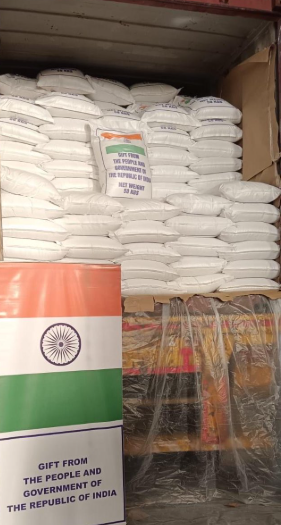
- India has dispatched a consignment of 1,000 metric tonnes of rice to Burkina Faso as humanitarian assistance.
- This gesture reflects India’s continued commitment to South-South cooperation and support for food security in African nations facing challenges.
About Burkina Faso
- Location
- Landlocked country in Western Africa.
- Borders
- Shares borders with six countries:
- Mali (north and west)
- Niger (east)
- Benin (southeast)
- Togo, Ghana, and Ivory Coast (south)
- Shares borders with six countries:
- Capital
- Ouagadougou
- Geographical Features
- Terrain: Predominantly savannahs, plateaus, and low mountains in the southwest.
- Northern region (Sahel): Arid and desert-like.
- Highest point: Mount Tenakourou.
- Major rivers: Black Volta, Red Volta, and White Volta (converge in Ghana to form the Volta River).
- Largest lake: Lake Bam (near the centre).
- Natural Resources
- Rich in minerals: Gold, silver, zinc, manganese, phosphate, and limestone.
Significance of India’s Assistance
- Humanitarian Angle
- Supports food security in Burkina Faso amid regional challenges like conflict, climate variability, and food shortages.
- India-Africa Relations
- Strengthens India’s ties with West African nations through development cooperation and humanitarian aid.
- Aligns with India’s broader engagement in Africa via forums like the India-Africa Forum Summit.
- Global South Solidarity
- Reinforces India’s role as a responsible global player providing assistance to fellow developing countries.
UPSC CSE & State PCS Relevance
Prelims
- Key terms: Burkina Faso, Sahel Region, Volta River System, Mount Tenakourou
- Facts: Landlocked in Western Africa; Borders six countries; Capital – Ouagadougou; Rich in gold and other minerals
GS-2 (International Relations)
- India’s humanitarian diplomacy and development partnership with African countries.
GS-1 (Geography)
- Physical and economic geography of West Africa and the Sahel region.
Essay / Interview
- “India’s Role in South-South Cooperation: Humanitarian Assistance and Food Security Support to Africa”
- “Climate Change, Conflict and Food Insecurity in the Sahel: Challenges for Regional Stability.”
MCQs
- Burkina Faso is a landlocked country located in which region of Africa?
(a) Southern Africa
(b) Western Africa
(c) Eastern Africa
(d) Central Africa
Answer: (b)
- With reference to Burkina Faso, consider the following statements:
1. It shares borders with six countries.
2. Its capital is Ouagadougou.
- It is rich in gold and other mineral resources.
Which of the statements given above is/are correct?
(a) 1 only
(b) 1 and 2 only
(c) 2 and 3 only
(d) 1, 2 and 3
Answer: (d)
- The major rivers of Burkina Faso include:
(a) Nile and Congo
(b) Black Volta, Red Volta, and White Volta
(c) Niger and Senegal
(d) Zambezi and Limpopo
Answer: (b)
- India recently sent humanitarian assistance in the form of:
(a) Wheat
(b) Rice
(c) Pulses
(d) Maize
Answer: (b)
Mains Questions
- “Humanitarian assistance is an important tool of India’s foreign policy in Africa.” Discuss with special reference to recent aid to Burkina Faso and India’s broader engagement with the continent. (15 marks / 250 words)
- Examine the geographical and economic profile of Burkina Faso and the challenges it faces in the Sahel region. (10 marks / 150 words)
- “Climate change, conflict and food insecurity are interlinked challenges in the Sahel region.” Analyse this statement and suggest measures for regional resilience. (15 marks / 250 words)
- Essay (250 marks) “India-Africa Partnership: From Development Cooperation to Strategic Engagement in the 21st Century.”
Click Here to Download the PDF
