4th April Current Affairs
↵
Rongali Bihu: Festive Fervour Grips Assam Ahead of Assembly Elections
1. Why in News?
- As of early April 2026, the festive fervour of Rongali Bihu (also known as Bohag Bihu or Bohag Bihu) has gripped different parts of Assam. Celebrations are set to begin from 14 April 2026, marking the Assamese New Year and the onset of spring.
- This year’s Rongali Bihu holds special significance as it coincides with the build-up to the Assam Legislative Assembly Elections (expected later in 2026). Political parties and cultural groups are actively preparing for grand Bihu events, with some committees opting for more traditional and somber celebrations in memory of legendary Assamese singer Zubeen Garg. The festival is being described as Assam’s largest cultural event, blending joy, community bonding, and political mobilisation.
2. About Rongali Bihu
- Full Name & Significance Rongali Bihu, commonly known as Bohag Bihu (or Saat Bihu / Bibhag Bihu), is the most popular and vibrant of the three Bihus celebrated in Assam. It marks the Assamese New Year and the arrival of spring (Bohag month). The word ‘Rongali’ comes from ‘Rong’, which means joy, happiness, and celebrations in Assamese.
- Cultural Importance It is primarily an agricultural festival signifying the beginning of the sowing season and gratitude to nature for a prosperous harvest. The festival reflects the rich, syncretic culture of Assamese society and is celebrated with great enthusiasm irrespective of caste, creed, or religious background. It symbolises renewal, fertility, love, and community harmony.
Key Traditions & Attire 
-
- Ladies wear traditional Mekhela Chador made of Pat silk, Muga silk, or cotton.
- Men wear Dhoti and Kurta along with the iconic Gamocha (also called Bihuwaan or Bihu Gamusa).
- Gamocha exchange is a prominent custom — offered as a sign of affection, respect, and goodwill.
- Celebrations include Bihu dance (energetic folk dance performed by men and women), folk songs, and playing of traditional musical instruments such as dhol, pepa (buffalo horn), gogona, toka, taal, and hutuli.
Structure of Celebrations (7-Day Cycle)
-
- Goru Bihu (first day): Cattle are worshipped and bathed; they are fed special items like gourds and brinjals.
- Manuh Bihu (main day): People greet each other, exchange gifts, and celebrate the New Year.
- Gosai Bihu (third day): Prayers and offerings at temples. Festivities often extend from mid-April to mid-May with community events, Bihu Husori (door-to-door singing), and stage performances.
3. Three Types of Bihu Festivals
- Rongali Bihu (Bohag Bihu): April (most vibrant; Assamese New Year & sowing season).
- Kati Bihu (Kongali Bihu): October (marks completion of sowing/transplanting; relatively subdued with lighting of earthen lamps).
- Magh Bihu (Bhogali Bihu): January (harvest festival; feasting with traditional delicacies like pitha and laru).
- Bihu as a whole is deeply rooted in Assam’s agrarian society and is often called the “national festival” of the state. It transcends religious boundaries and unites the people of Assam.
4. Significance of Rongali Bihu 2026
- Cultural Preservation: Reinforces Assamese identity, folk traditions, and community bonding in a diverse society.
- Social & Economic Aspect: Boosts local artisans (silk weavers, instrument makers), tourism, and rural economy.
- Political Context: With Assembly elections approaching, Bihu events serve as platforms for cultural outreach and voter mobilisation. The “Bihu Effect” often influences voter sentiment when polls are held close to the festival.
- Unique Note for 2026: Some organising committees have announced toned-down celebrations (cancelling large concerts) as a tribute to the late singer Zubeen Garg, focusing more on traditional rituals.
UPSC CSE & State PCS Relevance
Prelims
- Key terms: Rongali Bihu / Bohag Bihu, Assamese New Year, Mekhela Chador, Gamocha, Bihu dance, Goru Bihu, Manuh Bihu.
- Facts: Celebrated in April; Marks onset of spring & sowing season; Three Bihus (Rongali, Kati, Magh); Instruments: dhol, pepa, etc.; Transcends caste & religion.
GS-1 (Indian Society & Culture)
- Diversity of India; Folk traditions and festivals of Northeast; Syncretic culture; Role of festivals in social cohesion.
GS-2 (Governance & Polity)
- Cultural politics; Festivals as platforms for electoral mobilisation in regional elections.
Essay / Interview
- “Festivals as Threads of Unity in India’s Cultural Tapestry: The Case of Rongali Bihu.”
- “The Intersection of Culture and Politics in Northeast India.”
- “Preserving Indigenous Traditions in the Age of Modernisation and Electoral Politics.”
MCQs (Prelims Standard)
- Consider the following statements about Rongali Bihu:
- It is also known as Bohag Bihu and marks the Assamese New Year.
- It is celebrated in the month of October.
- The exchange of Gamocha is an important custom during the festival. Which of the statements given above is/are correct?
(a) 1 and 2 only
(b) 1 and 3 only
(c) 2 and 3 only
(d) 1, 2 and 3
Answer: (b)
- Which of the following is the first day of Rongali Bihu celebrations?
(a) Manuh Bihu
(b) Goru Bihu
(c) Gosai Bihu
(d) Kati Bihu
Answer: (b)
- Rongali Bihu is primarily associated with which agricultural phase in Assam?
(a) Harvesting season
(b) Beginning of sowing season
(c) Completion of transplanting
(d) End of winter
Answer: (b)
- Which traditional attire is worn by women during Rongali Bihu?
(a) Saree and Blouse
(b) Mekhela Chador
(c) Salwar Kameez
(d) Phulkari
Answer: (b)
- Which of the following is NOT one of the three Bihus celebrated in Assam?
(a) Rongali Bihu
(b) Kati Bihu
(c) Magh Bihu
(d) Rongker Bihu
Answer: (d)
Mains Questions
- “Rongali Bihu is not merely a festival but a reflection of Assam’s syncretic culture and agrarian roots.” Discuss the significance of Bihu festivals in preserving Northeast India’s cultural identity. (15 marks / 250 words)
- Examine the role of traditional festivals like Rongali Bihu in fostering social cohesion and influencing political discourse in a diverse state like Assam. (10 marks / 150 words)
- “Festivals serve as living repositories of a region’s history, economy, and social values.” Analyse this statement in the context of Rongali Bihu celebrations in 2026. (15 marks / 250 words)
- Essay (250 marks) “Unity in Diversity: How Regional Festivals Strengthen the Idea of India – A Case Study of Assam’s Rongali Bihu.”
Myanmar Crisis: From Military Coup to Presidency
Introduction
- The Myanmar military coup 2021 marked the collapse of democratic governance in Myanmar, when the military Tatmadaw seized power and detained elected leader Aung San Suu Kyi.
- In 2026, the crisis deepened as military chief Min Aung Hlaing was declared President.
This move is widely seen as an attempt to institutionalize military rule under constitutional legitimacy.
1. Political Crisis
Military Consolidation of Power 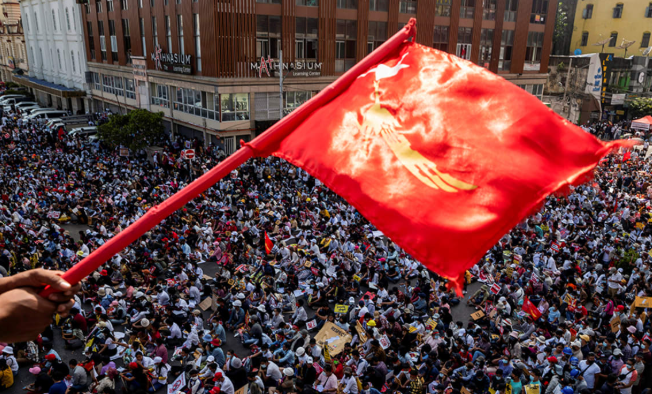
- Systematic weakening of democratic institutions
- Exclusion of opposition parties from elections
- Marginalization or banning of National League for Democracy (NLD)
- Use of constitutional mechanisms to justify authoritarian control
Parallel Governance
- Formation of National Unity Government (NUG) by ousted leaders
- Emergence of dual power centers (military vs democratic opposition)
Analysis
- Example of Electoral Authoritarianism
- Institutional collapse of democracy
- Severe legitimacy crisis of the state
- Transition from democracy to hybrid to military-dominated regime
2. Civil War
Key Actors
- Military (Tatmadaw)
- People’s Defence Force (PDF) under NUG
- Ethnic Armed Organizations (Kachin, Karen, Chin, etc.)
Ground Situation
- Large territories outside military control
- Intensified fighting in border and ethnic regions
- Guerrilla warfare and asymmetric conflict
Analysis
- Transformation into a multi-front civil war
- Erosion of state sovereignty and territorial control
- Risk of Myanmar becoming a fragile or failed state
- Rise of warlordism and localized authority
3. Humanitarian and Economic Crisis
Humanitarian Crisis
- Millions of Internally Displaced Persons (IDPs)
- Thousands of civilian casualties
- Intensification of the Rohingya crisis
- Collapse of healthcare, education, and basic services
Economic Crisis
- Sharp GDP contraction
- Collapse of foreign investment and trade
- Rising unemployment and inflation
- Disruption of supply chains and banking systems
Analysis
- Emergence of a conflict economy (illegal trade, arms economy)
- Decline in Human Development Indicators (HDI)
- Reports of widespread human rights violations by the United Nations
- Long-term developmental setback
4. Geopolitics
Major Powers’ Role
- China: Strategic and economic support to the military regime
- Russia: Military cooperation and arms supply
- Western countries: Sanctions and diplomatic isolation
Role of ASEAN
- Attempted mediation through the Five-Point Consensus
- Limited success due to lack of enforcement
Analysis
- Myanmar as a geopolitical hotspot in the Indo-Pacific
- Arena for great power rivalry
- Strategic importance due to connectivity, natural resources, and location
5. India’s Interests and Impact
Internal Security
- Instability along Northeast borders (Manipur, Mizoram)
- Safe havens for insurgent groups
- Cross-border arms trafficking risks
Refugee Crisis
- Influx of refugees into India
- Humanitarian concerns versus security challenges
- Pressure on local administration and resources
Connectivity Projects
- Delays in Kaladan Multimodal Project
- Slow progress of India–Myanmar–Thailand Highway
- Impact on Act East Policy
China Factor
- Expanding Chinese strategic presence
- Challenge to India’s regional influence
6. Way Forward
Inclusive Political Dialogue
- Engagement between military, NUG, and ethnic groups
- Move toward a federal democratic framework
International Pressure
- Role of the United Nations
- Targeted sanctions on military leadership
- Diplomatic isolation combined with negotiation
Strengthening ASEAN Role
- Effective implementation of the Five-Point Consensus
- Regional cooperation for peacebuilding
India’s Balanced Approach
- Pragmatic diplomacy (engagement without endorsement)
- Balance between security concerns and humanitarian assistance
- Protect strategic interests while supporting democratic transition
Conclusion
Myanmar today stands at the intersection of political instability, civil war, and geopolitical competition.
The elevation of Min Aung Hlaing as President in 2026 clearly indicates that the crisis is not resolving; rather, military rule is becoming more institutionalized and entrenched.
MCQs
- The 2021 military coup in Myanmar led to the ouster of which political leader?
(a) Min Aung Hlaing
(b) Aung San Suu Kyi
(c) Thein Sein
(d) Win Myint
Answer: (b)
- With reference to the current crisis in Myanmar, consider the following statements:
1. Min Aung Hlaing has been declared President.
2. The National Unity Government (NUG) was formed by ousted democratic leaders.
3. Large parts of the country are controlled by Ethnic Armed Organizations.
Which of the statements given above is/are correct?
(a) 1 only
(b) 1 and 2 only
(c) 2 and 3 only
(d) 1, 2 and 3
Answer: (d)
- Which of the following is NOT a major actor in Myanmar’s ongoing civil conflict?
(a) Tatmadaw (military)
(b) People’s Defence Force (PDF)
(c) Rohingya Solidarity Organisation
(d) Ethnic Armed Organizations
Answer: (c) (Note: While Rohingya groups exist, the primary armed opposition includes PDF and EAOs.)
- India’s Kaladan Multimodal Project connects India with which country?
(a) Bangladesh
(b) Myanmar
(c) Thailand
(d) Sri Lanka
Answer: (b)
Mains Questions
- “The 2021 military coup in Myanmar has transformed the country into a multi-front civil war zone with severe humanitarian and geopolitical implications.” Discuss the causes, current situation, and regional impact of the crisis. (15 marks / 250 words)
- Examine India’s strategic interests and challenges in Myanmar, particularly in the context of border security, connectivity projects, and the China factor. (10 marks / 150 words)
- “ASEAN’s Five-Point Consensus has had limited success in resolving the Myanmar crisis.” Critically analyse the role of regional and international actors in addressing the Myanmar situation. (15 marks / 250 words)
- Essay (250 marks) “From Democratic Transition to Military Entrenchment: The Collapse of Democracy in Myanmar and Its Lessons for the Region.”
India-Azerbaijan Bilateral Relations Reviewed in Baku
Why in News?
- On 3 April 2026, in Baku, MEA Secretary (West) Sibi George called on Azerbaijan’s Foreign Minister Jeyhun Bayramov and held the 6th round of India-Azerbaijan Foreign Office Consultations (FOC), co-chaired with Deputy Foreign Minister Elnur Mammadov.
- The two sides comprehensively reviewed the current state of bilateral relations and discussed areas of mutual interest including trade, technology, tourism, pharmaceuticals, energy, culture, people-to-people exchanges, and the fight against cross-border terrorism. Secretary George also met Hikmet Hajiyev, Foreign Policy Advisor to the President of Azerbaijan. Both sides agreed to hold the next round of FOC in New Delhi at a mutually convenient date.
- This meeting marks a significant reset in ties strained since mid-2025 over Azerbaijan’s position on India’s Operation Sindoor and its close strategic partnership with Pakistan.
2. About Azerbaijan
- Location & Strategic Position Azerbaijan is a transcontinental country located at the junction of Eastern Europe and Western Asia, along the southern flanks of the Greater Caucasus Mountains. It is often called the “Land of Fire” due to its natural gas seeps and rich hydrocarbon resources.
Bordering Countries 
- North: Russia
- Northwest: Georgia
- West: Armenia (long-standing Nagorno-Karabakh dispute)
- South: Iran
- East: Caspian Sea (shares maritime boundaries with Russia, Kazakhstan, Turkmenistan, and Iran)
Water Bodies
- Bounded by the Caspian Sea in the east — the world’s largest inland body of water.
Capital City
- Baku (largest city and major port on the Caspian Sea; hosts COP29 in 2024).
Geographical Features
- Climate: Highly varied — contains examples of nine out of the world’s eleven climate zones (from subtropical to alpine).
- Major Rivers: Alazani, Aras (Araxes), and Kura (longest river).
- Highest Point: Mount Bazardüzü (4,466 m) in the Greater Caucasus Range.
- Natural Resources: World’s leading producer of oil and natural gas; also rich in gold, silver, iron, titanium, copper, manganese, cobalt, molybdenum, and chromium. Hydrocarbons dominate its economy.
Key Facts for Prelims
- Area: ~86,600 km²; Population: ~10.3 million; Official Language: Azerbaijani; Currency: Azerbaijani Manat; President: Ilham Aliyev.
3. India-Azerbaijan Bilateral Relations – Snapshot
- Historical & Strategic Ties: Civilisational linkages; India was among the first countries to recognise Azerbaijan’s independence in 1991.
- Energy Cooperation: ONGC Videsh has significant investments in the Azeri-Chirag-Guneshli (ACG) oilfield and the Baku-Tbilisi-Ceyhan (BTC) pipeline. Azerbaijan supplies crude oil to India (98% of its exports to India).
- Connectivity: Potential synergy with International North-South Transport Corridor (INSTC) and Middle Corridor.
- Recent Context: Ties dipped in 2025 due to Azerbaijan’s criticism of India’s Operation Sindoor and its support for Pakistan. The April 2026 FOC is the first high-level engagement since 2022 and signals normalisation.
4. Significance of the Meeting
- Diplomatic Reset: First major bilateral engagement after tensions linked to Azerbaijan-Pakistan ties and differing positions on Armenia and regional issues.
- Economic & Energy Security: Boosts cooperation in energy, pharmaceuticals, tourism, and technology — critical for India’s diversification away from traditional suppliers.
- Counter-Terrorism: Explicit inclusion of “fight against cross-border terrorism” aligns with India’s core security concerns.
- Regional Geopolitics: Strengthens India’s outreach in the Caucasus and Caspian region amid growing Chinese and Turkish influence.
- Atmanirbhar & Multi-Alignment: Demonstrates India’s pragmatic foreign policy — engaging energy-rich partners while advancing self-reliance in defence and energy.
5. UPSC CSE State PCS Relevance
Prelims
- Key terms: Azerbaijan (transcontinental, Caspian Sea, Land of Fire), Baku, Greater Caucasus, 9/11 climate zones, ONGC Videsh investments, Foreign Office Consultations.
- Facts: Borders (Russia, Georgia, Armenia, Iran, Caspian Sea); Highest peak Mount Bazardüzü; Major rivers (Kura, Aras, Alazani); Resources (oil & gas dominant).
GS-2 (International Relations)
- India’s neighbourhood & extended neighbourhood policy; Caucasus geopolitics; Energy diplomacy; Counter-terrorism cooperation; Impact of bilateral tensions (Operation Sindoor) on multi-alignment.
GS-3 (Economy & Security)
- Energy security, hydrocarbon imports, INSTC connectivity.
Essay / Interview
- “Energy Diplomacy as a Pillar of India’s Multi-Alignment Strategy.”
- “Resetting Ties in a Polarised World: Lessons from India-Azerbaijan Relations.”
- “The Geopolitical Significance of the Caspian Region in 21st-Century Great Power Competition.”
MCQs
- Consider the following statements about Azerbaijan:
- It is bounded by the Caspian Sea in the east.
- Mount Bazardüzü is its highest peak.
- It shares a border with Turkey.
- Which of the statements given above is/are correct?
- 1 and 2 only
- 1 and 3 only
- 2 and 3 only
- 1, 2 and 3
Answer: (a)
- The 6th India-Azerbaijan Foreign Office Consultations were held in:
- New Delhi
- Baku
- Yerevan
- Tehran
Answer: (b)
- Which of the following is NOT a major river of Azerbaijan?
- Kura
- Aras
- Alazani
- Amu Darya
Answer: (d)
- Azerbaijan’s climate is notable for containing how many of the world’s eleven climate zones?
- Five
- Seven
- Nine
- Eleven
Answer: (c)
Which Indian Public Sector Undertaking has investments in Azerbaijan’s ACG oilfield and BTC pipeline?
- IOCL
- ONGC Videsh
- GAIL
- BPCL
Answer: (b)
Mains Questions
- “Recent India-Azerbaijan Foreign Office Consultations reflect the pragmatic reset in bilateral ties despite geopolitical divergences.” Discuss the key areas of cooperation and strategic significance of Azerbaijan for India. (15 marks / 250 words)
- Examine the importance of energy diplomacy in India’s extended neighbourhood policy with special reference to the Caspian region. (10 marks / 150 words)
- “Counter-terrorism and connectivity are emerging as new pillars of India’s engagement with Central Asia and the Caucasus.” Analyse in the context of the April 2026 India-Azerbaijan meeting. (15 marks / 250 words)
- Essay (250 marks) “Securing Energy and Connectivity: India’s Strategic Outreach in the Caspian-Caucasus Region amid Great Power Rivalry.”
India’s Manufacturing PMI Falls to 53.9 in March 2026: Weakest Growth in Nearly 4 Years
1. Why in News?
- According to the HSBC India Manufacturing Purchasing Managers’ Index (PMI) released on 2-3 April 2026, India’s manufacturing activity slowed sharply in March 2026. The index fell to 53.9 from 56.9 in February 2026.
- This marks the weakest pace of expansion in nearly four years (lowest since June 2022; described in some reports as a 45-month low or near 4-year low). The reading remains above the crucial 50-mark, indicating continued expansion, but at a noticeably slower rate.
Key reasons cited:
- Rising input costs (cost inflation at a 43-month high).
- Softer domestic demand and new orders.
- Heightened market uncertainty and disruptions due to the ongoing war in West Asia (Middle East conflict), which exacerbated energy shocks and inflationary pressures.
- New export orders, however, saw a strong surge. Employment growth accelerated, and firms remained optimistic about future output.
2. About Purchasing Managers’ Index (PMI)
- Definition & Purpose The Purchasing Managers’ Index (PMI) is a leading indicator of business activity in the manufacturing and services sectors. It is a survey-based monthly index that captures changes in business conditions based on the perception of purchasing managers in private sector companies.
Types of PMI 
- Manufacturing PMI (focus of recent data).
- Services PMI.
- Composite PMI (weighted average of manufacturing and services).
How Manufacturing PMI is Derived
- Surveys are sent monthly to a panel of companies across various sub-sectors. Respondents answer fact-based questions on five key variables (weighted):
- New orders
- Output (production)
- Employment
- Suppliers’ delivery times
- Stocks of items purchased
The index is seasonally adjusted and ranges from 0 to 100:
- Above 50 → Expansion (improvement in business conditions).
- Below 50 → Contraction.
- Exactly 50 → No change.
Significance
- PMI is a timely, forward-looking indicator (released early in the following month) that helps gauge economic momentum, inflationary pressures, and growth trends before official GDP or IIP data.
- It is widely used by policymakers, RBI, investors, and analysts. HSBC/S&P Global compiles the India PMI.
3. Key Highlights from March 2026 Manufacturing PMI
- Headline PMI: 53.9 (Feb: 56.9) — weakest since June 2022.
- Factory output and new orders grew at the slowest rates since mid-2022.
- Input price inflation hit a 43-month high (steepest since August 2022) — driven by rises in aluminium, chemicals, fuel, steel, etc.
- Output price inflation eased to a two-year low as firms absorbed costs to retain customers.
- Employment rose at the fastest pace in seven months.
- New export orders recorded one of the strongest expansions in recent months.
- Backlogs of work declined for the first time in nearly 18 months.
- Firms remained optimistic about production over the next 12 months.
- The Composite PMI Output Index also moderated to 56.5 (from 58.9 in February), reflecting slowdown in both manufacturing and services.
4. Significance & Implications
- Economic Slowdown Signal: Indicates softening momentum in India’s manufacturing sector amid global headwinds, despite overall resilience.
- Inflation Concerns: Sharp rise in input costs could feed into broader inflation, though firms are currently protecting margins by limiting price hikes.
- Geopolitical Impact: Highlights how conflicts in West Asia affect India through higher energy prices, supply chain disruptions, and demand uncertainty.
- Policy Angle: Provides inputs for RBI’s monetary policy (interest rate decisions) and government’s growth-support measures. Strong export orders and hiring are positive signals for employment and external sector.
- Broader Context: Manufacturing remains a key pillar of Atmanirbhar Bharat, ‘Make in India’, and India’s ambition to become a global manufacturing hub. Sustained PMI above 50 supports GDP growth projections, but moderation calls for monitoring.
5. UPSC CSE State PCS Relevance
Prelims
- Key terms: Purchasing Managers’ Index (PMI), HSBC India Manufacturing PMI, Expansion vs Contraction threshold (50), West Asia conflict impact.
- Facts: March 2026 PMI = 53.9 (down from 56.9); Lowest in nearly 4 years; Input costs at 43-month high.
GS-3 (Economy)
- Indian Economy: Growth indicators, inflation, manufacturing sector performance, impact of global events on domestic economy, role of leading indicators like PMI.
- Issues: Geopolitical risks, supply chain vulnerabilities, cost-push inflation.
GS-2 (IR)
- Effect of West Asia/Middle East conflicts on India’s economic security.
Essay / Interview
- “Geopolitical Conflicts and Economic Resilience: Lessons from India’s Manufacturing PMI in 2026.”
- “Manufacturing Sector as the Engine of India’s Growth: Challenges and Way Forward.”
- “Leading Economic Indicators like PMI in Policy Making and Early Warning Systems.”
MCQs
1. Consider the following statements regarding the Purchasing Managers’ Index (PMI):
- A PMI reading above 50 indicates contraction in the sector.
- It is a survey-based leading indicator compiled monthly.
- It is based on five key variables including new orders and employment.
Which of the statements given above is/are correct?
(a) 1 only
(b) 2 and 3 only
(c) 1 and 3 only
(d) 1, 2 and 3
Answer: (b)
3.The HSBC India Manufacturing PMI for March 2026 stood at:
(a) 56.9
(b) 53.9
(c) 50.0
(d) 48.5
Answer: (b)
- Which of the following factors contributed to the slowdown in India’s Manufacturing PMI in March 2026?
- Rising input costs
- War in West Asia
- Softer domestic demand
Select the correct answer using the code given below:
- 1 and 2 only
- 2 and 3 only
- 1 and 3 only
- 1, 2 and 3
Answer: (d)
- Input cost inflation in India’s manufacturing sector in March 2026 reached a high of how many months?
- 7 months
- 18 months
- 43 months
- 54 months
Answer: (c)
- Which of the following is NOT one of the five key variables used in calculating the Manufacturing PMI?
- New orders
- Output
- Government policy changes
- Employment
Answer: (c)
Mains Questions
- “The moderation in India’s Manufacturing PMI in March 2026 highlights the vulnerability of the domestic economy to global geopolitical shocks.” Discuss the recent trends in PMI and their implications for India’s growth and inflation outlook. (15 marks / 250 words)
- Examine the significance of the Purchasing Managers’ Index as a leading economic indicator. How can policymakers use PMI data in the context of India’s manufacturing sector revival? (10 marks / 150 words)
- “While India’s manufacturing sector continues to expand, rising cost pressures and external uncertainties pose challenges to sustained growth.” Analyse the March 2026 PMI data in this light. (15 marks / 250 words)
- Essay (250 marks) “Navigating Global Headwinds: Strengthening India’s Manufacturing Resilience in an Uncertain World.”
INS Aridhaman Commissioned into Indian Navy
1. Why in News?
- On 3 April 2026, Defence Minister Rajnath Singh commissioned INS Aridhaman (S4), India’s third indigenously built nuclear-powered ballistic missile submarine (SSBN), into the Indian Navy at a low-key ceremony in Visakhapatnam.
- The induction happened alongside the commissioning of the advanced stealth frigate INS Taragiri. INS Aridhaman is the second submarine in the Arihant-class (after INS Arihant and INS Arighaat) and significantly enhances India’s sea-based nuclear deterrent and nuclear triad. Defence Minister Rajnath Singh hinted at the event with a post: “Not just words but power, ‘Aridhaman’!”
- This development comes after successful sea trials and marks a major milestone in India’s Advanced Technology Vessel (ATV) project for building nuclear submarines.
2. About INS Aridhaman
- Full Name & Class INS Aridhaman (S4) is India’s third nuclear-powered ballistic missile submarine (SSBN). It is the second submarine in the Arihant-class (the first two being INS Arihant and INS Arighaat). It belongs to the Aridhaman subclass with enhanced capabilities.
- Development & Construction Built indigenously under the Advanced Technology Vessel (ATV) project at the Ship Building Centre, Visakhapatnam. It is significantly larger and more advanced than its predecessors. INS Arihant was commissioned in 2016; INS Arighaat in August 2024; a fourth SSBN (S4*) is under construction.
- Strategic Role As an SSBN, its primary role is to provide credible second-strike capability as part of India’s nuclear triad (land, air, and sea-based nuclear delivery systems). It can remain submerged for extended periods, making it highly survivable and a key pillar of India’s minimum credible deterrence doctrine.
3. Key Features & Technical Specifications
Displacement: 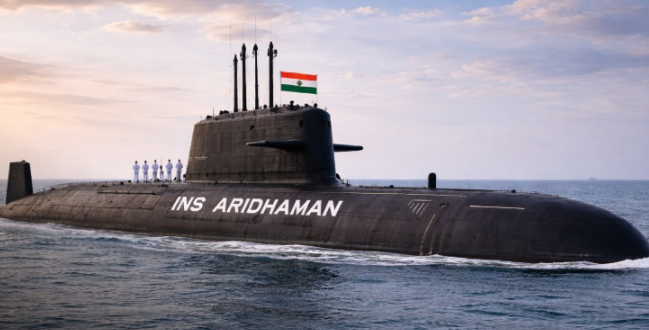
-
- Surface: ~6,000–7,000 tonnes
- Submerged: ~7,000 tonnes (larger than the ~6,000 tonnes of Arihant and Arighaat)
- Propulsion: One 83 MW Pressurised Water Reactor (CLWR-B1) developed by the Bhabha Atomic Research Centre (BARC). This enables virtually unlimited endurance (limited only by food and crew supplies) and high underwater speed.
- Armament: Equipped with eight vertical launch tubes (double that of INS Arihant/Arighaat). Can carry:
- Up to 24 K-15 Sagarika short-range SLBMs (range ~750 km)
- Or 8 K-4 intermediate-range SLBMs (range ~3,500 km)
- Future compatibility with longer-range K-5 SLBMs (5,000–6,000 km).
- Also has 6 × 533 mm torpedo tubes for conventional weapons.
Stealth & Survivability Features:
-
- Anechoic tiles for acoustic damping (reduces noise signature).
- Advanced sonar suites.
- Double-hull configuration for enhanced survivability.
- Quieter propulsion system compared to predecessors.
- Other Specs: Length ~130 m; designed for deeper and stealthier operations.
4. Significance of the Induction
- Strengthening Nuclear Triad: Completes a more robust sea-based leg, ensuring second-strike capability even if land and air assets are compromised.
- Deterrence in Indo-Pacific: Enhances India’s ability to deter adversaries (especially China and Pakistan) through credible underwater nuclear presence.
- Atmanirbhar Bharat in Defence: Major achievement in indigenous nuclear submarine technology, reactor design, and missile integration.
- Naval Modernisation: Boosts underwater warfare capabilities alongside projects like Project 75I and additional SSBNs.
- Strategic Message: Signals India’s growing technological self-reliance and resolve to maintain strategic stability in a volatile neighbourhood.
5. UPSC CSE State PCS Relevance
Prelims
- Key terms: SSBN, Arihant-class, Nuclear Triad, Second-strike capability, K-15 Sagarika, K-4 SLBM, ATV project, CLWR-B1 reactor.
- Facts: Commissioned on 3 April 2026; Third indigenous SSBN; 7,000-tonne displacement; 83 MW reactor; 8 vertical launch tubes; Can carry 24 K-15 or 8 K-4 missiles.
GS-3 (Defence & Security, Science & Technology)
- India’s nuclear doctrine and command structure; Indigenous defence production; Role of SSBNs in maritime strategy; Nuclear propulsion technology.
GS-2 (International Relations)
- India’s strategic posture vis-à-vis China and Pakistan; Balance of power in the Indian Ocean Region.
Essay / Interview
- “India’s Nuclear Triad: The Critical Role of Sea-Based Deterrence in National Security.”
- “Atmanirbhar Bharat in Strategic Technologies: Achievements and Challenges in Nuclear Submarine Programme.”
- “Evolving Maritime Doctrine: From Coastal Defence to Blue-Water Capabilities with SSBNs.”
MCQs
-
- Consider the following statements about INS Aridhaman:
- It is India’s third indigenously built nuclear-powered ballistic missile submarine.
- It belongs to the Arihant-class and was commissioned in April 2026.
- It is powered by a 83 MW pressurised water reactor developed by BARC.
Which of the statements given above is/are correct?
(a) 1 only
(b) 1 and 2 only
(c) 1 and 3 only
(d) 1, 2 and 3
Answer: (d)
- How many vertical launch tubes does INS Aridhaman have compared to INS Arihant?
- Same number
- Double
- Triple
- Six
Answer: (b)
- Which of the following missiles can INS Aridhaman carry?
- K-15 Sagarika (750 km)
- K-4 (3,500 km)
- BrahMos
Select the correct answer using the code given below:
(a) 1 and 2 only
(b) 2 and 3 only
(c) 1 and 3 only
(d) 1, 2 and 3
Answer: (a)
- INS Aridhaman was commissioned at:
(a) Mumbai
(b) Visakhapatnam
(c) Kochi
(d) Chennai
Answer: (b)
- The primary strategic role of INS Aridhaman is to strengthen India’s:
(a) Air defence
(b) Second-strike nuclear capability
(c) Anti-submarine warfare
(d) Amphibious operations
Answer: (b)
Mains Questions
- “The commissioning of INS Aridhaman marks a significant step in operationalising India’s nuclear triad.” Discuss the strategic importance of SSBNs in India’s nuclear doctrine and deterrence strategy. (15 marks / 250 words)
- Examine the progress made by India under the Advanced Technology Vessel (ATV) project and its contribution to Atmanirbhar Bharat in the defence sector. (10 marks / 150 words)
- “Sea-based nuclear deterrence provides the most credible and survivable leg of the nuclear triad.” Analyse this statement in the context of the recent induction of INS Aridhaman. (15 marks / 250 words)
- Essay (250 marks) “Nuclear Deterrence in the 21st Century: India’s Quest for a Credible and Survivable Triad amid Regional Security Challenges.”
Sukhna Wildlife Sanctuary: A Remarkable Success Story of Ecological Revival
1. Why in News?
- Sukhna Wildlife Sanctuary has recently emerged as a remarkable success story of ecological revival nestled in the fragile Shivalik Hills near Chandigarh. A Times of India report (April 2026) highlighted how the sanctuary, spanning approximately 2,600 hectares, has transformed from a degraded catchment area into a vibrant ecosystem supporting rich biodiversity.
- The recent confirmation of leopards thriving in the sanctuary marks a significant milestone, indicating that the ecosystem has matured into a near-natural, self-sustaining forest capable of supporting apex predators. This revival is attributed to decades of afforestation and soil conservation efforts aimed at protecting the iconic Sukhna Lake.
- Ongoing developments include proposals for Ramsar site designation for the Sukhna wetland and discussions on expanding the Eco-Sensitive Zone (ESZ) around the sanctuary (Punjab side), reflecting continued conservation focus amid urban pressures and legal battles over siltation and encroachment.
2. About Sukhna Wildlife Sanctuary
- Location A protected area located in Chandigarh, at the foothills of the Shivalik Hills, adjacent to the famous Sukhna Lake. It forms the critical catchment area for the lake.
- Origin & Establishment The sanctuary originated from large-scale afforestation undertaken for soil conservation and to prevent siltation of Sukhna Lake. Sukhna Lake was created in 1958 by architect Le Corbusier (planner of Chandigarh) by diverting the seasonal Sukhna Choe stream. The area was officially notified as Sukhna Wildlife Sanctuary on 6 March 1998 under the Wildlife Protection Act, 1972. It spans 2,600 hectares (26 sq km) of hilly terrain, including forests, grasslands, and wetlands.
- Geographical Features The Shivalik hills here are ecologically fragile and geographically unstable, highly prone to soil erosion due to surface runoff during rains. Soil is predominantly sandy with pockets of clay. Apart from Sukhna Lake, there are around 150 small and large water bodies that form the catchment area, helping recharge the lake annually.
- Vegetation Characterised by a mix of forests, grasslands, and wetlands. The ecosystem has significantly improved due to systematic afforestation with native species.
3. Flora & Fauna
- Flora Common species include: Khair (Acacia catechu), Phulai, Kikar (Prosopis juliflora), Shisham (Dalbergia sissoo), Moonj grass, Amaltas (Cassia fistula), Jhingan, Amla (Emblica officinalis), Rati, Vasaka, and many more native trees, shrubs, and grasses. The afforestation efforts have led to lush growth, particularly in the Nepli Forest area.
- Fauna Mammals: Squirrel, Common Mongoose, Indian Hare, Porcupine, Jungle Cat, Jackal, Wild Boar, Sambar Deer, Spotted Deer (Chital), and Leopards (recently confirmed as thriving, indicating apex predator presence and ecosystem health). Other notable species: Pangolin, various reptiles, butterflies, and a rich variety of resident and migratory birds. The sanctuary is known for one of the highest concentrations of Sambar Deer in the country in certain periods.
4. Significance of the Sanctuary
- Ecological Revival: From a siltation-prone zone to a self-sustaining forest ecosystem — a model of successful conservation through community and administrative efforts.
- Lake Protection: Plays a vital role in preventing soil erosion and maintaining water levels in Sukhna Lake, a major tourist and recreational spot.
- Biodiversity Conservation: Supports diverse flora and fauna in an urban-adjacent setting, acting as a green lung for Chandigarh.
- Conservation Challenges & Measures: Faces threats from urbanisation, encroachment, and builder activities. Proposals for Ramsar designation (international wetland status) and Eco-Sensitive Zone expansion aim to provide stronger legal protection. Recent Supreme Court observations have highlighted concerns over lake degradation due to alleged builder-mafia nexus.
- Broader Context: Aligns with Atmanirbhar Bharat and national goals of wetland and biodiversity conservation under the Ramsar Convention and Wildlife Protection Act.
5. UPSC CSE State PCS Relevance
Prelims
- Key terms: Sukhna Wildlife Sanctuary, Shivalik Hills, Sukhna Lake, Le Corbusier, Eco-Sensitive Zone (ESZ), Ramsar Site, Afforestation for soil conservation.
- Facts: Established 1998; Area 2,600 hectares; Located in Chandigarh; Apex predator — Leopard; ~150 water bodies; Flora — Khair, Shisham, etc.; High Sambar concentration.
GS-1 (Geography & Society)
- Physical geography of Shivalik Hills; Urban ecology and conservation in planned cities like Chandigarh.
GS-3 (Environment & Ecology)
- Biodiversity conservation, wetland protection, ecological restoration, human-wildlife interface, Ramsar Convention, ESZ notifications, challenges of soil erosion and siltation.
GS-2 (Polity & Governance)
- Role of Supreme Court in environmental protection; Centre-State coordination on ESZ and Ramsar proposals.
Essay / Interview
- “Ecological Restoration in Urban Fringes: Lessons from Sukhna Wildlife Sanctuary.”
- “Balancing Urban Development with Biodiversity Conservation in India.”
- “The Role of Protected Areas in Mitigating Climate Change and Soil Erosion in Fragile Ecosystems like the Shivaliks.”
MCQs
- Consider the following statements about Sukhna Wildlife Sanctuary:
- It is located in Chandigarh at the foothills of the Shivalik Hills.
- It was established in 1998 primarily to protect the catchment area of Sukhna Lake.
- The presence of leopards indicates a mature and self-sustaining ecosystem. Which of the statements given above is/are correct? (a) 1 only (b) 1 and 2 only (c) 1 and 3 only (d) 1, 2 and 3 Answer: (d)
- Sukhna Lake, associated with the sanctuary, was designed by:
(a) Edwin Lutyens
(b) Le Corbusier
(c) Charles Correa
(d) Louis Kahn
Answer: (b)
- Which of the following is NOT a common flora species found in Sukhna Wildlife Sanctuary?
(a) Khair
(b) Shisham
(c) Sundari
(d) Amla
Answer: (c)
- The recent ecological milestone in Sukhna Wildlife Sanctuary is the confirmed thriving of:
(a) Tigers
(b) Leopards
(c) Asiatic Lions
(d) Snow Leopards
Answer: (b)
- Sukhna Wildlife Sanctuary spans approximately:
(a) 1,000 hectares
(b) 2,600 hectares
(c) 5,000 hectares
(d) 10,000 hectares
Answer: (b)
Mains Questions
- “Sukhna Wildlife Sanctuary exemplifies successful ecological restoration in a fragile ecosystem.” Discuss the factors that contributed to its revival and its importance for biodiversity conservation in urban fringes. (15 marks / 250 words)
- Examine the challenges of soil erosion and siltation in the Shivalik region and evaluate the role of protected areas like Sukhna Wildlife Sanctuary in addressing them. (10 marks / 150 words)
- “Long-term afforestation and legal protections are essential for sustaining wetlands and wildlife in rapidly urbanising areas.” Analyse this statement with reference to Sukhna Lake and its sanctuary, including recent developments on Ramsar status and ESZ. (15 marks / 250 words)
- Essay (250 marks) “Nature’s Resilience and Human Stewardship: Ecological Revival Stories from India’s Protected Areas.”
IBC Amendments 2026: Strengthening India’s Insolvency Framework
1. Why in News?
- Parliament has passed the Insolvency and Bankruptcy Code (Amendment) Bill, 2026. The Lok Sabha cleared it on 30 March 2026, and the Rajya Sabha approved it on 1 April 2026 by voice vote.
- The Bill introduces 12 amendments (11 based on the Select Committee recommendations + 1 by the government) to address persistent delays, reduce tribunal backlog, improve resolution efficiency, and enhance creditor rights. Finance Minister Nirmala Sitharaman emphasised that the objective remains revival of viable businesses rather than liquidation.
- Key goals include faster admission of cases, introduction of an out-of-court mechanism, and frameworks for group insolvency and cross-border insolvency. These reforms aim to make the IBC more responsive, predictable, and aligned with global best practices.
2. About the Insolvency and Bankruptcy Code (IBC), 2016
- Enactment & Objective The IBC was enacted in 2016 to consolidate and amend laws relating to reorganisation and insolvency resolution of corporate persons, partnership firms, and individuals in a time-bound manner.
Core Philosophy 
-
- Creditor-driven process (shift from debtor-in-possession).
- Time-bound resolution (originally 180 days + 90 days extension for Corporate Insolvency Resolution Process – CIRP).
- Either revive the distressed entity through a resolution plan or liquidate it orderly if revival is not feasible.
Institutional Framework
-
- Adjudicating Authority: National Company Law Tribunal (NCLT) for corporates; Debt Recovery Tribunal (DRT) for individuals/partnerships.
- Regulator: Insolvency and Bankruptcy Board of India (IBBI).
- Insolvency Professionals (IPs) and Insolvency Professional Agencies (IPAs).
- Committee of Creditors (CoC) plays a central decision-making role.
- The IBC replaced a fragmented regime (SICA, SARFAESI, etc.) and has significantly improved credit discipline and reduced Non-Performing Assets (NPAs).
3. Major Issues in IBC Implementation
- Delays in admission of applications by NCLT.
- Prolonged resolution timelines (often exceeding 180/270 days due to litigation).
- High backlog at NCLT benches.
- Modest recovery rates in many cases (though improved over pre-IBC era).
- Challenges in handling group companies and cross-border cases.
- Conflicts of interest (e.g., resolution professional also acting as liquidator).
- Over-reliance on criminal penalties for procedural lapses.
4. Key Provisions of the IBC (Amendment) Bill, 2026
- Faster Admission of Cases: NCLT must admit an insolvency application within 14 days once default is established (based on information utility records or other evidence). Applications cannot be rejected on extraneous grounds.
- Creditor-Initiated Insolvency Resolution Process (CIIRP): A new out-of-court mechanism replacing the underutilised fast-track process. Specified financial creditors can initiate resolution with at least 51% approval by value. Management stays with the debtor under oversight of a resolution professional. Timeline: 150 days (extendable by 45 days). Can convert to standard CIRP if needed.
- Group Insolvency Framework: Enables coordinated resolution of interconnected companies in a corporate group (common bench, joint hearings, etc.). Central government empowered to frame detailed rules.
- Cross-Border Insolvency: Provides an enabling framework (Section 240C) aligned with UNCITRAL Model Law. Government can notify rules for recognition, coordination, and cooperation with foreign proceedings.
Other Reforms:
-
- Stricter timelines for appellate decisions.
- Prevention of conflict of interest: Resolution professionals barred from acting as liquidators in the same case.
- Replacement of certain criminal penalties with civil penalties for procedural violations.
- Enhanced oversight and transparency requirements for CoC decisions.
- Measures to reduce delays and improve overall efficiency.
5. Performance of IBC So Far
- 1,376 companies successfully resolved.
- Creditors recovered approximately ₹4.11 lakh crore.
- Financial creditors achieved recovery of over 34% of admitted claims (realisation ~94% of fair value and ~171% of liquidation value).
- IBC contributed significantly to NPA resolution (over 52% of total recoveries by banks in FY25 in some reports).
- Pre-IBC recovery rates were 15-20%; post-IBC improved to ~30-36% range, with better enterprise value preservation in resolved cases.
6. Significance & Implications
- Efficiency Gains: Faster admission and out-of-court options will reduce delays and tribunal burden.
- Creditor Empowerment: Stronger role for creditors and predictability in the process.
- Global Alignment: Group and cross-border frameworks will benefit complex corporate structures and foreign investors.
- Investor Confidence: Reduced litigation and clearer rules will improve Ease of Doing Business perception.
- Economic Impact: Supports credit culture, faster capital recycling, and preservation of jobs/enterprise value.
- Atmanirbhar Angle: Strengthens India’s insolvency ecosystem as part of broader financial sector reforms.
7. UPSC CSE State PCS Relevance
Prelims
- Key terms: IBC 2016, CIRP, CIIRP, NCLT, IBBI, Group Insolvency, Cross-Border Insolvency (UNCITRAL), CoC.
- Facts: Passed March-April 2026; 12 amendments; Mandatory admission within 14 days; 1,376 resolutions; ₹4.11 lakh crore recovered (as of Dec 2025).
GS-3 (Economy)
- Indian Economy: Insolvency resolution, NPA management, banking sector reforms, ease of doing business, credit discipline.
GS-2 (Governance & Polity)
- Institutional reforms, tribunal functioning, legislative process (Select Committee), Centre’s rule-making powers.
Essay / Interview
- “Insolvency Resolution as a Pillar of Economic Reforms: Evaluating the Journey of IBC since 2016.”
- “Balancing Speed and Fairness in Insolvency Frameworks: Lessons from IBC Amendments 2026.”
- “India’s Insolvency Ecosystem: From Fragmented Laws to a Creditor-Driven, Time-Bound Regime.”
MCQs
- Consider the following statements regarding the IBC (Amendment) Bill, 2026:
- It mandates admission of insolvency applications by NCLT within 14 days once default is established.
- It introduces the Creditor-Initiated Insolvency Resolution Process (CIIRP) as an out-of-court mechanism.
- It provides a full statutory framework for cross-border insolvency. Which of the statements given above is/are correct? (a) 1 and 2 only (b) 2 and 3 only (c) 1 and 3 only (d) 1, 2 and 3 Answer: (a) (Note: Cross-border is an enabling framework for rule-making, not a complete statutory code yet.)
- The Insolvency and Bankruptcy Code (IBC) was enacted in which year?
(a) 2014
(b) 2016
(c) 2018
(d) 2020
Answer: (b)
- As of December 2025, how many companies had been successfully resolved under the IBC?
(a) 876
(b) 1,376
(c) 2,500
(d) 3,200
Answer: (b)
- Which of the following is a major reform introduced by the 2026 IBC amendments?
(a) Abolition of the Committee of Creditors
(b) Introduction of Group Insolvency framework
(c) Removal of time limits for resolution
(d) Making liquidation mandatory in all cases
Answer: (b)
- The IBC (Amendment) Bill, 2026 was passed by Rajya Sabha on:
(a) 30 March 2026
(b) 1 April 2026
(c) 15 March 2026
(d) 10 April 2026
Answer: (b)
Mains Questions
- “The IBC Amendments 2026 represent a significant evolution in India’s insolvency regime.” Discuss the key provisions of the amendments and evaluate how they address the implementation challenges faced by the IBC since 2016. (15 marks / 250 words)
- Examine the role of the Insolvency and Bankruptcy Code in improving credit discipline and NPA resolution in India. How do the 2026 amendments seek to further strengthen this framework? (10 marks / 150 words)
- “Faster resolution and out-of-court mechanisms are critical for preserving enterprise value in distressed assets.” Analyse this statement in the context of the Creditor-Initiated Insolvency Resolution Process (CIIRP) and other reforms in the IBC (Amendment) Bill, 2026. (15 marks / 250 words)
- Essay (250 marks) “From Debt Recovery to Value Preservation: The Transformative Journey of India’s Insolvency and Bankruptcy Framework.”
Click Here to download the PDF
